


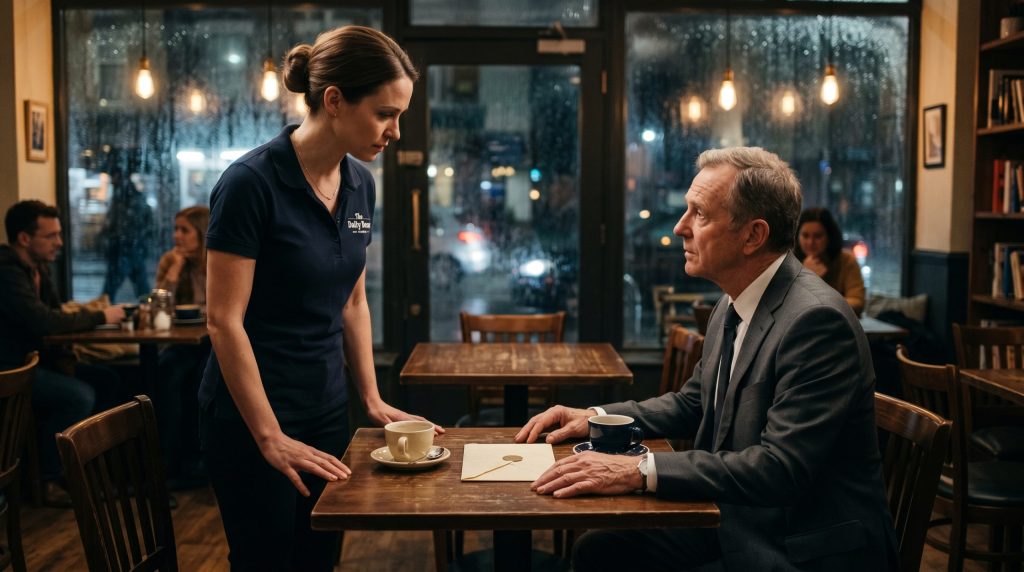
The Restaurant That Forgot to Notice
Soft jazz moved through the restaurant like it owned the place, and the guests beneath it acted like they did too.
The Ashworth Room at Cressida’s held forty covers on a Friday evening. White tablecloths. Candles burning low in crystal holders. Rain moving down the tall windows in slow, uneven lines. The kind of room where nobody raised their voice because nobody needed to.
Grace Whitmore had been on her feet since four o’clock.
She was thirty-one, though she looked closer to twenty-five when she slept — which she rarely did long enough to know. Her shift had started at the breakfast service. It was now eight-forty-seven. She wore the restaurant’s uniform polo, dark navy with the crest on the chest, her hair pulled back tight. Her shoes were the ones she’d bought two winters ago, the left sole beginning to separate at the ball of the foot. She’d taped it that morning. She did this every third day now.
Table eleven was her concern.
The woman at table eleven was perhaps eighty. She sat alone, very straight, with the careful dignity of someone who had once filled every room she entered and now simply occupied her portion of it. Her name — Grace would learn this later — was Margaret Caldwell. She’d ordered the soup, the brown bread, and a glass of water. She hadn’t opened the menu a second time. She’d been sitting for forty minutes and no one had refilled her water glass.
Grace noticed the empty glass before she noticed anything else.
She crossed the room quietly, lifted the crystal pitcher from the service station, and poured. The woman looked up. Her eyes were pale and clear and very steady, the kind that had watched a great deal of the world and had not been surprised by most of it.
“Thank you,” Margaret Caldwell said. Not the automatic kind. The kind that meant it.
Grace smiled and asked if she needed anything else. The woman said no. Grace moved on.
She did not think about it again. There were four other tables to manage, a dessert order backed up at the pass, and a couple at table seven who had been signalling for the bill for twelve minutes while talking too loudly about someone else’s money.
She did not notice that the woman at table eleven watched her go.
She did not notice that the woman at table eleven watched her for the rest of the evening.
She did not notice the man in the far corner booth, either — the one who had not touched his wine, whose hands rested completely still on the white cloth, whose eyes had moved from the woman at table eleven to Grace Whitmore and had not moved again.
She was too busy doing her job.
That was the whole of it, she thought. That was all this was.
What Margaret Ordered and What She Left
By nine-thirty, the room had thinned.
Three tables remained occupied. Table seven had finally settled their bill after a minor dispute about the service charge that Grace had absorbed with a smile she had long ago learned to keep in place regardless of what was happening behind it. The couple left without adding a tip. She cleared the table, reset it, and moved on.
Margaret Caldwell at table eleven had finished her soup. She had eaten it slowly, with precision, the way someone eats when they are genuinely hungry but too practiced to show it. She had broken the brown bread into careful pieces. She had drunk two full glasses of water.
Grace brought the bill without being asked. She had noticed the woman’s posture shifting slightly — not fatigue exactly, but the small rearrangement of someone preparing to leave. She set the small leather folder down beside the water glass and began to collect the soup bowl.
“Sit with me a moment,” Margaret Caldwell said.
Grace paused. This was not normal. The restaurant had rules about staff fraternising with seated guests, rules she generally agreed with because they kept things clean. But the room was nearly empty, her manager was dealing with a delivery discrepancy at the back, and something in the woman’s voice was not a request so much as a statement about what was going to happen.
She sat.
Margaret looked at her without preamble. “How long have you been working here?”
“Three years,” Grace said. “Four in the spring.”
“And before?”
“Hotels, mostly. One restaurant in Edinburgh. A catering company for about two years while I was finishing my night classes.”
“What were you studying?”
“Business administration. I finished last year.”
Margaret’s expression did not change. She had the stillness of someone who knew exactly what she was doing with every second she spent doing it. She looked at Grace’s hands, then at the left shoe — the taped sole was not visible, but the slight uneven compression of the ball of the foot was, if you knew what to look for.
“Who takes care of you?” Margaret asked.
It was such an unexpected question that Grace had no prepared answer. She said nothing for a moment.
“I manage,” she said finally.
“I’m sure you do.” Margaret opened her small handbag — dark leather, worn at the clasp — and removed an envelope. It was sealed. She set it beside the leather bill folder and placed two fingers on top of it, gently, as if it were something that had been waiting a long time to be put down.
“Don’t open this here,” she said.
Grace looked at the envelope. It was plain white, no writing on the outside. Something about its weight and the deliberateness with which it had been placed made the air in the room feel slightly different.
“What is it?” Grace asked.
“Something that belongs to someone who earned it,” Margaret said. She stood — slowly, with the measured effort of someone who had stopped pretending standing was easy — and picked up her coat from the back of the chair. “The bill is paid. I called ahead.”
Grace stood too. “Let me call you a car.”
“My driver is outside. He has been for an hour.” Margaret buttoned her coat with practiced hands. “You refilled my water without being asked. You didn’t make me feel invisible. At my age, in a room like this, that is not nothing.”
She walked toward the door.
Grace stood beside table eleven with the sealed envelope in her hand and watched her go.
In the far corner booth, the man who had not touched his wine placed a crisp note on the table, set his glass down, and rose without hurry.
She did not see him leave.
The Envelope
Grace did not open the envelope at work.
She almost did — three times, standing at the service station, thumb pressing the seal without breaking it. Each time she stopped herself. The woman had said not here, and there had been enough authority in those two words that Grace found herself obeying them even alone at eleven-fifteen, after the last table had cleared and she was stacking the folded napkins in the linen press.
She opened it in her car.
The car park behind Cressida’s was mostly empty by that hour. Rain still came down, streaking the windscreen in long diagonal lines. The overhead light in the car was the kind that flickered slightly when you first turned it on, as if deciding whether to cooperate.
She tore the seal carefully. Inside was a single folded card — thick, cream stock — and beneath it, a folded document.
The card read:
*You have been recommended to the Caldwell Foundation Graduate Placement Programme. This is not a competition. You have already been selected. If you choose to accept, present this card at the address below on Monday morning at nine o’clock. Bring nothing except yourself and whatever you have earned.*
*— M.C.*
Grace read it twice.
Then she unfolded the document beneath it.
It was a letter of employment offer. Formal headed paper, the kind printed on a press rather than a home printer. The Caldwell Foundation. Management trainee, first placement. The salary figure in the second paragraph made her breath leave her body in a single, quiet exhale.
She sat in the car for a long time.
The flickering overhead light made up its mind and held steady.
Her first thought was that it was a mistake. Her second was that someone was playing a trick, though she couldn’t imagine why or by whom. Her third was the practical one — the one she always arrived at eventually, the one that had gotten her through the night classes and the catering work and the four years of taped shoes: *find out if it’s real before you decide how to feel about it.*
She folded the document back along its crease and tucked it into the inner pocket of her bag.
She sat with the engine running for eleven minutes.
She had her hand on the gear shift when she thought about what Margaret Caldwell had said — *something that belongs to someone who earned it* — and the absolute certainty in the woman’s voice when she’d said it. Not warmth exactly. Conviction. The kind that didn’t need to be argued or defended.
Grace turned the engine off.
She went back inside and asked the overnight manager for Monday morning off.
He gave it to her without asking why, which was unusual enough that she noticed it, filed it somewhere, and did not ask questions.
The Foundation
The address on the card was a building on a quiet street in the older part of the city — Georgian stonework, brass fittings on the door, a discreet bronze plaque that said only *Caldwell* with no further explanation, the way old institutions name themselves when they have no need to explain what they are.
Grace arrived seven minutes early. She was wearing the best thing she owned — a dark blouse and pressed trousers, the shoes she kept for interviews. The left one had a different sole now. She’d bought new ones Saturday morning, the first thing she’d done, because if she was going to walk into a building like this she was going to walk in straight.
A young man met her at the reception desk and took her name. He did not look surprised to see her, which told her the meeting had been expected. He led her up a wide staircase to a room on the second floor — high ceilings, a long table, morning light coming through tall windows on the south wall.
Margaret Caldwell was already seated at the far end of the table.
Beside her was the man from the corner booth.
Grace slowed for one step, then continued forward.
“Sit down, Grace,” Margaret said. The same voice. The same certainty.
She sat.
The man across the table was perhaps sixty. He had the kind of face that had been considered handsome thirty years ago and had aged into something more useful — specific, watchful, with a stillness that did not signal passivity. He wore a dark suit, no tie, cufflinks that caught the morning light.
He introduced himself as Thomas Caldwell. Margaret’s son. He ran the Foundation’s operational side. He had been at Cressida’s on Friday evening because his mother had asked him to be there — she preferred, he said, a second opinion before she acted on her instincts. His mother’s instincts had been correct a sufficient number of times that he had long ago stopped questioning them.
He placed a folder on the table in front of Grace.
“We know about the night classes,” he said. “We know about Edinburgh. We know the catering work was not because you lacked ambition — it was because you were paying tuition without any help.” He paused. “We know because we looked. With your permission, going forward.”
Grace looked at the folder, then at Margaret, then back at Thomas.
“Why?” she asked. It was the only word she had.
Margaret answered. “Because I was sitting at a table for forty minutes and not one person in that room looked at me until you did. And when you looked, you didn’t look to see if I was about to complain. You looked to see if I needed something.” She folded her hands on the table. “That is rarer than you think. And considerably more valuable than a degree, though I’m glad you have that too.”
Grace opened the folder.
The placement was real. The salary was real. The start date was the following Monday.
At the bottom of the first page, in Margaret Caldwell’s handwriting — the same hand that had written the card — was a single line:
*She earned this before she knew she was being considered.*
Grace read it once. She did not read it again. She didn’t need to.
“Yes,” she said.
Neither Margaret nor Thomas looked surprised. Which meant, Grace understood, that they had not expected any other answer — not because they had assumed she would accept, but because they had understood exactly who she was before she had walked through the door.
That understanding, she thought, was the rarest thing in any room.
What the Room Remembered
Grace Whitmore started at the Caldwell Foundation on the second Monday of November.
Her first placement was in the operations division — logistics, supplier relations, the unglamorous infrastructure that kept the Foundation’s programme running. She was good at it immediately, the way people are good at things they have been practicing in a different form for years without being told that is what they were doing. The night classes had been theory. The catering work and the restaurant and the four years of managing twelve tables alone on a Friday evening had been everything else.
Thomas Caldwell said, at the end of her third week, that she had identified two process inefficiencies that his previous coordinator had missed for eighteen months. He said it without ceremony, as a fact, which was how Grace preferred to receive information.
Margaret came into the Foundation offices on Thursday mornings. She did not have a formal role — she was eighty, and the formal roles had been passed down and distributed years before — but she arrived at nine, drank tea at the long table in the second-floor room, read the week’s reports, and asked questions that nobody else had thought to ask. The staff, Grace noticed, arranged their Thursday mornings around her arrival without being asked to.
On Grace’s fourth Thursday, Margaret set down her cup and said: “How are the shoes?”
Grace looked up from her papers. “New ones. Both of them.”
Margaret nodded once. The conversation ended there. But something in the nod — the slight, deliberate weight of it — told Grace that the question had not been about the shoes.
The Cressida’s Restaurant chapter of Grace’s life did not end bitterly or dramatically. She handed in her notice the week after she accepted the Foundation position, thanked the overnight manager who had given her Monday morning without asking why, and worked her remaining shifts with the same care she had always brought to them. She refilled water glasses. She noticed when people needed something before they had to ask for it. She kept the taped-sole shoes in the bottom of her wardrobe — not as a reminder of hardship, but as a record of distance travelled.
The justice in this story was not loud. There was no confrontation, no exposure, no moment where someone who had underestimated Grace was made to stand in front of what they had missed. That was not how this particular reckoning worked.
The justice was quieter and, Grace thought, more permanent: she had been seen by the right person at the right moment, doing the only thing she knew how to do — her job, with her full attention, for a woman sitting alone at a table with an empty water glass.
She had not been performing goodness. She had not been aware of an audience. She had simply looked, seen what was needed, and moved toward it.
That was the whole of it.
Margaret Caldwell, for her part, never made a speech about it. She did not offer Grace a narrative about being a rough diamond discovered in an unlikely setting, or about potential going unrecognised, or about the world’s failure to reward good people adequately. She did not need to. She had placed the envelope on the table, pressed two fingers against it, and let the thing speak entirely for itself.
Years later — three, to be specific — Grace would be the one sitting at a table in a different restaurant, watching a young man in a staff uniform move through a nearly empty room with quiet, focused efficiency. She would watch him refill a glass without being asked. She would watch him notice things.
She would not approach him that evening. She would return the following week. She would bring an envelope.
She never told Margaret she had done it. She suspected Margaret already knew.