


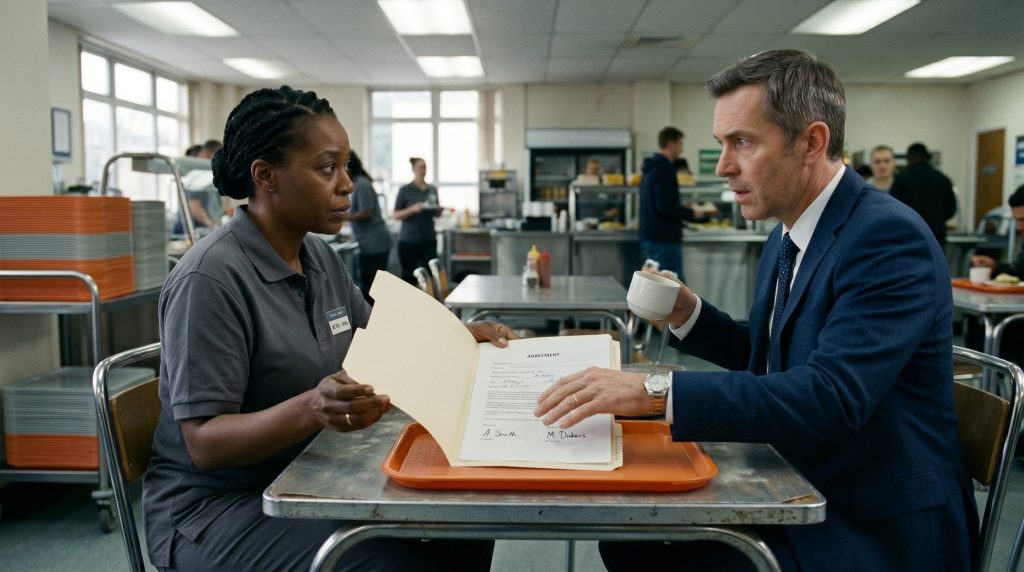
The Canteen at Half Past One
The canteen smelled like industrial gravy and the particular silence of people who had stopped pretending to like each other. Fluorescent tubes ran the length of the ceiling in pairs, one always flickering. The trays were orange plastic, cracked at the corners, stacked in a tower near the hatch. Grace Okafor set hers down at Table Four — the one by the far wall, the one that went quiet when someone sat there — and opened her flask without looking up.
She had worked in this building for eleven years. Not always in the canteen. For eight of those years she had been inside the house on Cavendish Lane, pressing the shirts of a man who now sat three floors above her in a corner office with a view of the car park.
Then—
The morning she was called in and handed an envelope. Not a leaving card. Not a handshake. An envelope with a typed letter and a number that was meant to feel generous, and a security escort to the door before she could say a word.
She had not gone quietly.
No one had seen that.
She ate her lunch. Behind her, at the executive table near the window, she could hear him. Marcus Holt. His voice carried the way expensive things did — without effort, without apology. He was telling a story she had heard before. The accident on the A38. His wife. His grief. The version he had rehearsed until it sounded true.
Grace’s jaw tightened.
She recognised the story. She had been in the house the morning it happened. She had seen him come home. She had noticed what he was wearing and what time it was and what he had asked her to do with the jacket before anyone else arrived.
She had written it down.
That specific memory — the grey jacket, the mud on the left sleeve, the way he had said *just put it with the dry-cleaning, Grace, don’t make a fuss* — had lived inside her for three years. Not because she had been waiting. Because she had been watching to see if he would ever slip.
He was slipping now.
She turned the flask in her hands. Beside it on the tray, slid flat under her sandwich wrapper, was a manila folder. She had carried it in her bag every day for six months. She had not opened it in this building before today.
Today was different.
Behind her, Marcus Holt laughed. The laugh of a man who believed the room agreed with him.
Grace Okafor reached for her sandwich.
Under her thumb, the folder’s corner pressed against the tray.
What She Kept
The folder had begun as a habit.
Grace had always kept a household log — dates, instructions, inventories, notes on what needed attention. It was professional practice, taught to her by the agency that had placed her. When you worked in someone’s home you wrote things down. It protected you.
The entry for the morning of the 14th of March was eleven lines long. She had written it the same afternoon, while the police were still in the driveway and Marcus was in the sitting room performing devastation for two officers who had come to ask routine questions.
She had not shown anyone.
Not because she was afraid — or not only. Because she had also found the second thing, three days later, tucked inside a dry-cleaning ticket she had pulled from the jacket pocket before she handed it in. A folded receipt. A petrol station on the A38, timed at 07:22 that morning. Marcus had told the police he had left home at nine.
She had photographed the receipt with her phone.
The phone had since been replaced. The photograph had not been lost.
The folder contained: the original log entry, printed; a copy of the photograph; a statement from the dry cleaner, who had asked about the mud on the sleeve and whom Grace had asked — carefully, on a different visit — to write down what she remembered; and a sealed second envelope, inside the folder, which she had not opened since the day she sealed it.
The second envelope contained one document that had arrived at the house six weeks after the accident, addressed to Marcus, which Grace had intercepted and copied before leaving it in his study.
She did not yet know if anyone else knew that document existed.
She did not yet know how far the conspiracy went.
What she knew: Marcus Holt had been on the A38 at 07:22. His wife had died on the A38 at 07:31. The official finding had been a deer on the road, a wet surface, an unavoidable tragedy.
The folder said otherwise.
Close-up on the folder’s edge. Slight shadow from the fluorescent tube above.
Grace slid her hand over it and felt the paper shift inside.
Across the canteen, she heard Marcus say the name again. Margaret. His wife. His poor Margaret. The same practiced grief, the same half-second pause before the name — as if it still cost him something to say it.
Grace had known Margaret.
Margaret had told her things, near the end, that she had not told her husband she was telling.
Grace pressed the folder flat against the tray and stood up.
The Outrage
She did not plan to walk to his table.
She had told herself, on the way in this morning, that today was reconnaissance. That she would sit, eat, watch him perform, confirm what she already suspected — that he had no idea she still worked in this building — and leave.
Then she heard what he said to the man beside him.
Not the grief story. Something else. Quieter. Said with the ease of a man who has said it before to people he is certain will agree.
— *I kept that woman in employment for eight years. The children called her auntie. She was part of the family. She signed a confidentiality clause when she left. That covers everything.*
The man beside him nodded.
Grace stood still in the centre of the canteen.
A confidentiality clause. She had signed one. For the house, for the children’s schedules, for household arrangements. She had signed it because she needed the severance and because she had been given forty-five seconds to decide and because she had been twenty-two days from her rent renewal.
He believed that piece of paper covered a murder.
She felt something very cold settle in her chest. Not anger. Not yet.
She sat back down.
She opened her flask and poured the tea and held the cup in both hands and breathed.
She had a decision to make.
The folder was here. The evidence was complete. She had, folded inside the second sealed envelope, the document that had arrived six weeks after the accident — an insurance assessment, pre-dated, with a notation in the margin in a handwriting she had compared carefully to Marcus Holt’s signature on the household accounts. The notation read: *confirmed before. proceed.*
Confirmed before the accident.
She set the cup down.
She picked up her keys from the tray. She held them for a long moment. She had a car in the car park. She had a flat thirty minutes away. She had, technically, the option to walk out, post the folder anonymously to a journalist, and never be in this room again.
She put the keys back down.
Because she had been in this building for three years since the dismissal, and she had watched him give that performance once a month at the executive table, and she had watched the room nod, and she had watched Margaret’s name used as furniture — something to rest his respectability on — and today he had said *that covers everything*, and it did not cover everything, and he was going to know that while there were witnesses.
She picked up the folder.
She stood.
She walked toward his table.
Table Four Goes Quiet
Marcus Holt saw her when she was four steps away.
She watched his face perform the calculation: recognition → reassignment to a category of person → dismissal. It took less than a second. Then the performance of warmth, the kind deployed for people who had worked for you and might make a scene.
— *Grace. How long have you been here?*
She did not answer that.
She set the folder on his table.
The sound of it — folder meeting table, clean and deliberate — was enough. The man beside Marcus stopped chewing. A woman three seats down looked up.
— *I kept this family alive for ten years*, Marcus said, and his voice had the familiar note of controlled patience, the tone he used when he was certain of the outcome. *That includes you. You signed the clause. Whatever you think you have—*
Grace said: *The receipt is dated before she died.*
Five words. She did not raise her voice.
Something happened to Marcus Holt’s face.
Not the expression he chose. The one underneath it. His hand — resting on the table beside his coffee cup — moved two centimetres toward the folder before he stopped it. He stopped it consciously, visibly, and that was worse than if he had grabbed it, because the stop meant recognition, and recognition meant guilt, and the man beside him had seen the hand move too.
Frozen.
Because Grace had not yet opened the folder.
He had already reached for it.
She opened the folder.
⚡ CLOSE-UP — the log entry, the photograph, the dry cleaner’s statement, and the sealed envelope, all visible, all dated.
She placed the dry cleaner’s statement on top.
— *A grey jacket*, she said. *Mud on the left sleeve. Seven forty-five in the morning. That is in this statement and in my log and in a sworn affidavit already lodged with a solicitor.*
Marcus Holt’s coffee cup tilted. He caught it. His hand was not steady.
Answering too quickly. She had expected that.
— *You have no idea what you’re—*
The sealed envelope. She placed it beside the statement. She did not open it yet.
— *Your handwriting*, she said. *In the margin. Confirmed before. Proceed.*
The room was absolutely still.
She had been waiting for the word *proceed* to land in a room full of witnesses.
It had landed.
Heartbeat pounding louder.
Marcus Holt stood up. He stood up too fast. His chair caught on the linoleum and scraped back with a sound that made the woman three seats down flinch.
He was looking at the sealed envelope.
She picked it up and held it closed.
He knew what was inside.
So did she.
The question neither of them had said aloud: who else had signed the document inside that envelope. Whose other name was on it. She had a theory. She had not yet confirmed it. She had copied the document, not the covering letter, and the covering letter had mentioned a firm she had not been able to find in any registry.
Marcus Holt was still standing.
The man beside him had taken out his phone.
The Verdict in the Canteen
She opened the envelope.
The document was a single page, printed on headed paper from a firm called Aldermoor Risk Associates — a name that appeared in no public registry before or after the date on the letterhead. The page bore two signatures at the bottom. Marcus Holt’s, in blue ink. And a second, in black, which Grace had spent three months trying to identify, and which she had finally matched — six weeks ago, in a Companies House filing for a dissolved consultancy — to the name of the man currently sitting beside Marcus Holt at the executive table.
Daniel Foss. Deputy Head of Operations, same building, same company. Three floors up. Ate his lunch here on Tuesdays.
Grace set the page face-up on the table between them.
Foss saw his own signature before Marcus said a word.
He did not reach for it. He pushed his chair back, very slowly, as if the table had become hot, and stood up with the careful deliberateness of someone deciding whether to run.
He decided not to run.
— *That document*, Marcus said, and his voice had lost the controlled patience entirely, thin now, too fast — *that was a routine risk assessment, there was nothing — it doesn’t—*
— *You signed it fourteen days before the accident*, Grace said. *It assesses the specific road. The specific conditions. The specific time of morning.*
Nobody at the table spoke.
She looked at Marcus directly.
— *Margaret told me she had found something in your study. Three weeks before she died. She told me she was going to show it to someone. She asked me to remember the date she told me.*
She had remembered.
She had written it in the log.
Marcus Holt’s face — the one he had worn in this canteen for three years, the one that performed grief on a monthly schedule — went very still, and then something underneath it moved, and what came through was not the grief he had rehearsed but something else entirely. Recognition. Of a person he had believed was neutralised, was categorised, was covered by a piece of paper he had handed her with forty-five seconds to sign.
She had signed it.
It had not covered this.
The folder, the log, the photograph, the dry cleaner’s statement, the document with two signatures — all of it had been with her solicitor since yesterday morning. The copies in her hand were a courtesy. The originals were already where they needed to be.
She had not told him that yet.
She said it now.
— *The originals were filed yesterday. This is for the room.*
The man with the phone three seats down was no longer hiding it.
Marcus Holt sat down. Not by choice. His legs made the decision before he did.
Daniel Foss did not sit. He walked — not quickly, not running, the deliberate walk of a man maintaining the fiction of control — toward the canteen exit. The door swung shut behind him.
Grace watched him go.
The sealed envelope was empty now.
She closed the folder.
She had not, in three years, told anyone why she had stayed in this building after the dismissal. Not the solicitor. Not her sister. She had told herself it was about evidence, about waiting for the right moment, about making sure the case was airtight.
All of that was true.
But she had also stayed because Margaret had asked her to remember the date. And remembering it in private, writing it in a log that nobody read, had not felt like honouring that. Saying it out loud, in a room full of witnesses, with the folder open on the table — that felt like it.
She picked up her tray.
She walked back to Table Four.
She finished her tea.
Aldermoor Risk Associates had no registered address, no public director listing, and no record of dissolution. Its letterhead existed on one document. That document now sat in a solicitor’s safe. Whoever had created the firm, whoever had known about the road and the morning and the specific conditions before Margaret Holt drove to work for the last time — that question had not been answered in the canteen.
It had only been opened.