


The Gala and the Ghost
The charity gala cost more to attend than most people made in a year, and everyone there had agreed not to think about that.
The ballroom of the Harrington Hotel smelled of white lilies and warm champagne. Crystal chandeliers threw honey-coloured light across six hundred people who had all paid to feel generous for an evening. The auction paddles were cream with gold edging. The centrepieces alone cost what Margaret had earned in her first three months as a personal assistant, twenty-two years ago, before she understood that proximity to wealth was not the same as having any.
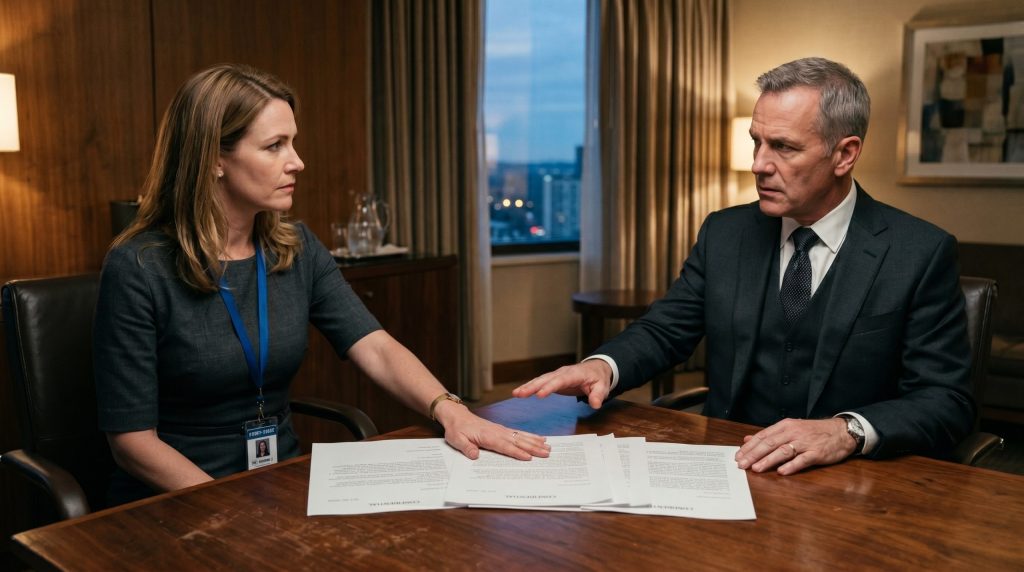
She stood near the far wall in a grey dress, a glass of sparkling water in one hand, a laminated staff lanyard around her neck. Event coordination. That was what the badge said. What it meant was: invisible.
Across the room, Harrison Vance worked the crowd with the ease of a man born doing it. He was fifty-three, silver-haired, straight-backed — the kind of man who made eye contact slowly, as if granting a favour. His wife, Eleanor, had died eighteen months ago in a car accident on the M4. He had wept publicly at the inquest. He had established a road-safety foundation in her name. He had raised two million pounds at last year’s gala alone.
Margaret had worked for Eleanor for eleven years.
She had kept every document Eleanor had ever asked her to file. Every email. Every instruction. Every copy of every letter that had passed through that household. She had kept them not because she planned to use them. She had kept them because Eleanor had asked her to, in a voice that was very quiet and very specific, in the last week of October, six weeks before the accident.
Then—
Harrison’s gaze found her from across the room. It moved past her in half a second. A ghost in grey. Exactly as intended.
Margaret set her glass down on a passing tray, touched the lanyard once, and walked toward the stage.
What Eleanor Asked Her to Keep
The backstage area behind the Harrington ballroom was all exposed cable runs and folding tables — the infrastructure of an illusion. Margaret had been here before. She knew where the secondary AV desk sat, who operated it, and which inputs fed the main ballroom screens. She had coordinated this event for four consecutive years under Eleanor’s direction. She knew the venue better than most of the staff wearing headsets.
She unzipped the inside pocket of her grey dress — a pocket she had had a tailor add specifically three days ago — and removed a USB drive no larger than a lipstick cap.
It was yellow. A small scratched sticker on the side read E.V. in blue ink. Eleanor Vance. Eleanor had handed it to her in the third week of October along with a manila folder and six words: — “Keep these somewhere he won’t look.”
Margaret had not asked what was on the drive. She had been Eleanor’s assistant for eleven years. She understood that some instructions were not requests for discussion.
She had listened to the drive’s contents exactly once, alone in her kitchen at two in the morning, fourteen months after Eleanor’s funeral. She had sat with her hands flat on the table for a long time afterward.
The backstage AV technician — a young Black man named Daniel who had worked three of these four galas — glanced up from his desk. He recognised her. She was a coordinator. She belonged here.
— “Quick change to the tribute reel,” she said. “Mr Vance approved it this afternoon.”
Daniel checked his clipboard. There was nothing on it about a change. But he had worked events like this long enough to know that late additions from the principal were normal and undocumented and not worth questioning. He held out his hand for the drive.
Margaret held it a half-second longer than she needed to.
The folder was already inside the bag she had left with the hotel concierge at six o’clock, addressed to a solicitor in the City. The folder contained everything else. The drive contained Eleanor’s voice.
She let go.
The Worst Thing a Kind Man Can Do
The tribute reel always came at nine o’clock, after the main auction and before the dessert service. Harrison had told the story of Eleanor’s foundation four times in eighteen months, and he told it the same way every time: the accident, the grief, the decision to build something lasting from the loss. He was very good at it. The room always went quiet in exactly the right places.
Margaret stood at the edge of the ballroom near the rear exit. She had her phone in her hand. Her bag was already with the concierge. There was nothing left to carry out of this room except whatever happened next.
On stage, Harrison accepted the microphone from the MC with a modest dip of the head. The lights warmed. Six hundred people turned toward him.
— “Eleanor would have been embarrassed by all of this,” he said. Light laughter. He let it settle. “She never wanted a fuss. She just wanted people to be safe.”
The screen behind him lit up with the foundation logo. Then it cut — not to the approved tribute reel, but to something else entirely.
Eleanor’s voice filled the ballroom.
Not Eleanor on stage, not Eleanor in a filmed tribute. Eleanor in a private room, recorded without knowing she was being heard. Her voice was low and very steady, the voice of a woman who had rehearsed this because she needed to get it exactly right.
“If you are hearing this, something has happened to me. I need you to understand that it was not an accident. I need you to understand that I told my solicitor three weeks ago that I intended to divorce Harrison and that I had instructed my assistant to hold certain documents until they were needed. I am recording this because I am frightened and because I want there to be a record in a voice that is mine.”
The room did not make a sound.
Harrison Vance stood on stage with a microphone in his hand and six hundred witnesses watching his face.
Margaret watched him from the back of the room. She had been watching him for eighteen months. She had been waiting for a room this large, with this many people, with cameras on every table and journalists from three outlets already present for the charitable coverage.
She had almost not done it. She had sat in her car in the hotel car park for twenty-two minutes before the event with the USB drive in her palm, engine running. She had thought about her flat, her savings, the slim client list she had spent four years building. She had thought about what Harrison Vance’s legal team would do to her in the morning.
Then she had thought about Eleanor asking her to keep things somewhere he would not look, in a voice that already knew it might be the last time she asked for anything.
She turned the engine off.
On stage, Harrison Vance lowered the microphone very slowly. His face had lost its colour. The room was completely still.
Heartbeat pounding louder.
Then, from the third row, a woman stood up. Then another. Then a man near the aisle. Not applause. Not yet. Just people getting to their feet because they did not know what else to do with the feeling in their chests.
The Documents That Waited
The folder reached the solicitor’s office at six forty-seven that evening, two hours and thirteen minutes before Eleanor’s voice played across the Harrington ballroom. By the time Harrison Vance lowered the microphone, a copy of that folder had already been transmitted to two other addresses: the detective inspector who had signed off on the original accident investigation, and the journalist from the broadsheet who had covered the foundation’s launch.
Margaret had not acted alone. She had been careful about that. One person holding a secret is a target. Three people holding it is a record.
The folder contained six items. A signed statement from Eleanor’s GP, noting a conversation in September in which Eleanor had described feeling unsafe at home. A copy of the divorce instruction Eleanor had given to her solicitor, date-stamped three weeks before the M4. A photograph of Harrison’s car — the same make and model as Eleanor’s — at a petrol station seventeen miles from the accident site at a time when Harrison had claimed to be in Edinburgh. An insurance document showing Eleanor’s policy had been increased significantly eight months before her death, with Harrison as sole beneficiary. A chain of emails between Harrison and a number. The number had never been identified. And a handwritten note in Eleanor’s handwriting: a single line, no salutation, no date — “He knows about the drive.”
Margaret had read each of these documents many times. She knew their weight. She had held them for eighteen months, waiting for the moment when the room would be too full and too public for them to be quietly buried.
In the ballroom, two of Harrison’s associates moved toward the stage. A third moved toward the AV desk. Margaret had anticipated this. Daniel had already removed the drive and was standing near the secondary exit with it in his inside jacket pocket — she had given him a second envelope before she handed over the USB, with instructions he had not opened until the reel began playing. He had read it. He had stayed.
Harrison found Margaret’s face across the room. The distance between them was perhaps forty feet. He looked at her with an expression she had seen before — not anger, not fear, not guilt. Calculation. The same face he had made at Eleanor’s inquest when the coroner had asked about the timeline.
Margaret held his gaze without moving.
She recognised the case number on the original accident report. She had filed the complaint herself, four years earlier, under a different matter — a harassment concern Eleanor had raised about a business associate. The detective inspector had been assigned to that complaint too. He had never followed up. When she had sent the folder tonight, she had attached a note with that case number at the top.
She wanted him to know that she remembered.
From the third row, the woman who had stood up first was now speaking into her phone. One journalist had already left their seat. Harrison’s solicitor, visible near the entrance, had his own phone pressed flat to his ear.
Harrison Vance took one step toward the edge of the stage. Then he stopped.
Because the screen behind him had not gone dark. It was playing again, from the beginning. Eleanor’s voice, steady and exact, filling every corner of the room a second time.
What the Room Remembered
The investigation was reopened nine days after the gala.
The detective inspector who had signed off on the original accident findings issued a public statement acknowledging that new evidence had been submitted and that the case had been elevated to a dedicated review team. He did not name Margaret. He did not need to. Three outlets had already run the story, and two of them had described the source as a former personal assistant who had held the materials for eighteen months, waiting for a moment when they could not be suppressed.
Harrison Vance was asked to surrender his passport on day eleven.
The Eleanor Vance Road Safety Foundation froze its accounts pending a full audit of its two-year operating period. The foundation’s board, which had met only twice and contained two of Harrison’s business associates, resigned collectively in a single letter that nobody leaked to the press but that reached the charity commission within the week.
Margaret gave her account to the review team on a Tuesday morning in a beige conference room in a building near the Strand. She had brought copies of everything — not because the originals were at risk, but because she had been keeping copies of everything for eighteen months and the habit had not yet left her. A detective constable asked her why she had waited. She told him that she had needed a room that was large enough and public enough that nothing could be done quietly afterward. He wrote this down without comment.
The unidentified number in Harrison’s email chain was traced six weeks later. It belonged to a logistics coordinator based in Bristol who had no connection to the Vance family that anyone could find in their first pass through his records. The review team was still working through the second pass when the newspaper ran their long-form piece.
The long-form piece quoted Eleanor’s recorded statement in full. It ran to four columns. The photograph of Harrison’s car at the petrol station — the one Margaret had kept flat in a manila folder for eighteen months — ran alongside it, below the fold, captioned only with the date and the location.
Margaret did not read the piece on the day it published. She spent that Tuesday at her kitchen table with a cup of tea that went cold, looking at the photograph she kept on the windowsill: Eleanor at a garden party, squinting into the sun, laughing at something off-camera. It had been taken in the summer before the October conversation. Before the voice note. Before the drive with the scratched yellow sticker and the blue ink initials that Margaret had carried in a tailor-made inside pocket for one night in a ballroom full of people who had paid to feel generous.
The verdict the room had delivered was not a verdict anyone had spoken aloud. It was the shape of six hundred people going completely still, and then slowly rising to their feet, and then a screen replaying a dead woman’s voice in a room her husband had built in her name.
She kept every letter.
At the inquest review, five months later, the coroner recorded an open conclusion, pending further findings. Sitting in the public gallery, Margaret heard Eleanor’s name spoken fourteen times in three hours. Each time, it landed with the weight of something that had been waiting a long time to be said correctly.
She did not stay for the press outside. She walked out through a side door into a grey afternoon and caught the tube home.
Daniel, the AV technician, sent her a message two weeks after the gala: a single line, no explanation. She had expected this. She replied with two words and did not hear from him again.
Harrison Vance was charged fourteen months after the gala. The charge related to the insurance documentation and the emails, not the accident itself — that investigation was ongoing, the review team said, and they were not in a position to comment further. Margaret read the charge notice on her phone on a Thursday morning, standing at the kitchen counter with her coat still on.
She never told anyone about the twenty-two minutes in the car park. That part belonged only to her.