


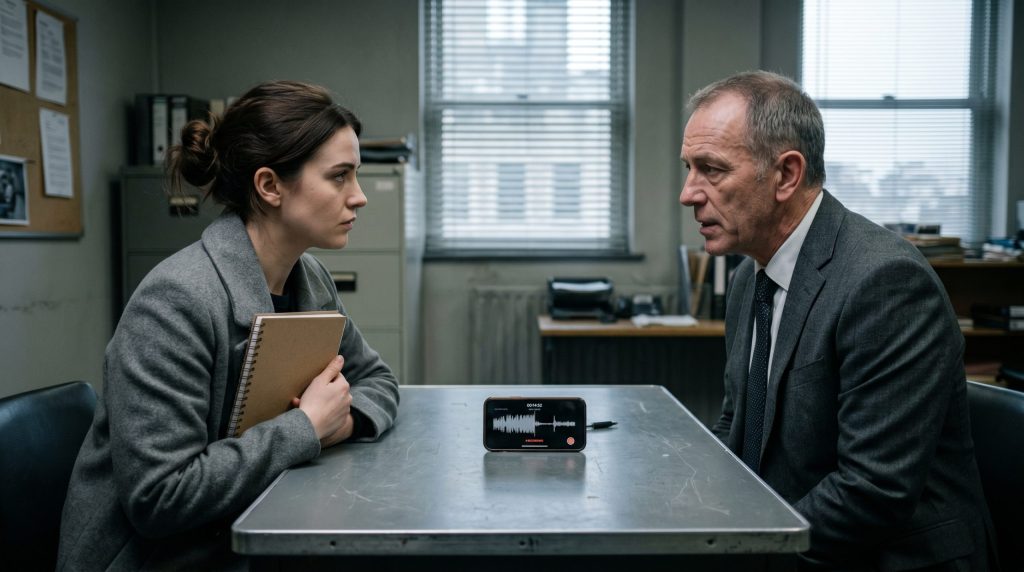
The Room That Forgot She Was There
The prison visiting room smelled like industrial soap and stale breath and the particular silence of adults deciding something a child couldn’t change.
Elena Marsh had been in rooms like this before. Not this one — not with the thick reinforced glass and the telephone handsets worn smooth by ten thousand desperate hands — but rooms where the adults forgot she existed, where the conversation moved around her like water around a stone, where she could read every word off their lips and they never knew she could.
She had been deaf since birth. She had never told anyone how much she understood.
Across the glass, her mother sat in a pale blue prison shift. Margaret Marsh. Fifty-one years old. Three months into a six-year sentence for a crime the entire courtroom had agreed she committed — except Elena, who had been in that courtroom, lip-reading everything that happened in the lawyers’ row, and who had written it down.
The notebook was in her bag. Spiral-bound. Three hundred and forty-seven pages. Dated entries going back four years, beginning the week her mother was first arrested, ending forty-eight hours ago when a man with a biker gang tattoo covering his left forearm sat across from a woman in a grey suit at a coffee shop in Manchester and discussed, quietly and completely without shame, how a witness was going to be made to disappear.
Elena had been two tables away. Drinking tea. Lip-reading.
Her mother picked up the telephone handset. Elena picked up hers.
‘They sent someone,’ Margaret said. Her voice through the handset was thin, compressed. ‘For you. Not for me. For you.’
Elena didn’t flinch. She had known since Tuesday.
‘I know,’ she said. ‘I have everything I need.’
Margaret’s hand tightened on the handset until her knuckles went white.
‘Elena. These are not people who stop.’
Elena looked at her mother through the glass — at the fear in her face, real and reasonable — and felt something settle in her chest like a stone finding the bottom of a river.
She had spent four years writing down what rooms assumed was private. She had the names, the dates, the exact words spoken when powerful people believed no one was listening.
She was always listening.
She reached into her bag and touched the notebook’s cover without taking it out.
Then the door behind Margaret opened, and a prison officer stepped in and said something Elena couldn’t see clearly — his back was partially turned — and Margaret’s face went very still.
Elena pressed her hand flat against the glass.
The Notebook Nobody Was Supposed to See
The family that had hired the biker gang was called Renwick.
Elena had learned this in stages — a word here, a name there, the way you assemble a sentence when you can only see the consonants. Victor Renwick. Sixty-three. Chairman of a logistics company that had, for eleven years, employed Margaret Marsh as a personal assistant. Margaret had seen things. Margaret had kept records of her own. When the company’s internal audit produced a fraud report that somehow ended with Margaret charged rather than Victor, Elena had started her notebook.
She was twenty-four at the time. She was twenty-eight now.
The notebook had begun as something between grief and precision. A deaf woman’s particular adaptation: if you cannot catch sound, you catch everything else — the shape of a word at fifty feet, the way a man’s jaw sets when he says ‘arrangement’ versus ‘agreement,’ the exact moment a face goes from performing calm to manufacturing it.
The first entry was dated April 3rd, four years ago.
*Victor Renwick, conference call, glass-walled office — 14:22. ‘The Marsh woman is handled.’ Person on the other end: not visible. Duration of call: three minutes forty seconds. He laughed once, at the end.*
The entries had grown from there. Courtroom observations. Car park conversations. A lunch between two men she didn’t know yet whose names she later found on the dissolved subsidiary Victor had used to move money. A meeting between Victor’s solicitor and someone from an organisation called Carver Group — a name that appeared three times in her notebook and produced zero results when she searched it.
Two months ago, something had shifted.
The Renwick family had stopped pretending the conviction had ended things. The conversations Elena observed had moved from legal strategy to something older and quieter. A man had approached her outside her flat — not violently, not yet — and stood too close and said nothing, just looked at her, the way people look at a problem they are deciding how to solve.
She had written that down too. Date. Time. Description of his left forearm tattoo: a black eagle, wingspread, covering the skin from wrist to elbow.
The same tattoo she saw at the coffee shop in Manchester forty-eight hours ago.
Elena sat in her car outside the prison car park and opened the notebook to the last entry. She read it once. She had a copy — USB drive, locked in a safety deposit box at a branch in Leeds under a name that was not hers. She had a solicitor who had a sealed letter with instructions.
She also had an appointment. Tomorrow morning. Nine a.m. A detective sergeant named Claire Okafor, who had reached out three weeks ago through a channel Elena didn’t fully understand yet — which meant someone else knew something. Someone who hadn’t introduced themselves.
The car park was empty. The afternoon light sat flat on the concrete.
Elena looked at the notebook.
She turned to the last page.
She had written a name there, in red ink, that she had not written anywhere else in three hundred and forty-seven pages — a name she had lip-read once, in a room she was not supposed to be in, spoken by Victor Renwick to a man whose face she never saw clearly.
She touched the name with one finger.
Then her phone buzzed on the passenger seat. A message from an unknown number: *Don’t go to the meeting tomorrow.*
The Worst Thing They Did Was Say It Out Loud
She didn’t sleep.
Not because of the message — she had expected interference. Because of what she had seen that morning, replaying on the back of her eyelids every time she closed them: Victor Renwick’s solicitor, Daniel Howe, sitting across from a man in a coffee shop in Leeds — a different one, same chain — at seven forty-five a.m., before Elena had told anyone about the Manchester conversation, which meant they already knew she had been there.
They had been watching her watch them.
She sat on the edge of her bed at two in the morning and held the notebook in both hands.
Here was the worst thing she had ever written in it.
Entry dated six weeks ago. Victor Renwick’s home office — she had been outside the window, replacing a battery in the garden security light, a favour for her mother’s neighbour whose house backed onto the Renwick property. Victor had not drawn the blinds. He stood at his desk, phone to his ear, facing the garden, facing her, speaking clearly.
*’She’s deaf. She can’t testify to anything she heard. Whatever she wrote down is hearsay from a woman who cannot verify the source. Get someone credible to challenge the notebook’s authenticity and it goes nowhere. And if she brings it to Okafor — we discussed this — the Carver Group makes that conversation disappear too.’*
Elena had written every word in the dark, by feel, her pen moving from muscle memory, her eyes fixed on his mouth.
He had said it like a fact. Calm. Unhurried. The way you state something the room already agrees with.
She was the problem to be managed.
She put the notebook in her bag.
She picked up her keys.
She sat there for eleven minutes with the keys in her hand and the bag on her lap and the door four feet away.
Her solicitor had told her: once she walked into that meeting, the protections changed. She would be a named witness. A target with paperwork attached. The safety deposit box in Leeds, the sealed letter — those were contingencies, not shields.
She could drive to Leeds right now. She could add a new entry to the notebook and seal it and walk away and let someone else find the name on the last page in their own time.
She thought about her mother’s hand pressed flat against the glass.
She thought about what Victor Renwick had looked like when he said *she can’t testify to anything she heard* — the slight upward pull of his mouth on the word *heard*, like a private joke he was the only one in on.
She put the keys in her pocket. She picked up her phone. She typed a message to Claire Okafor: *I’m coming. I have everything. Don’t move the time.*
She sent it before she could delete it.
Then she opened the notebook to the last page and looked at the name in red ink for a long time.
Tomorrow, she would say it out loud for the first time.
And the room would go completely still.
What the Room Heard When She Opened It
Detective Sergeant Claire Okafor’s office was on the fourth floor of a building that smelled like carpet adhesive and recycled air. Nine a.m. The morning came in grey through institutional blinds.
Elena sat across from Okafor with the notebook on the table between them, closed.
Okafor was reading the transcribed summary — twelve pages, typed, that Elena had prepared over three sleepless nights — and her face was very still. The kind of still that meant she was working to keep it that way.
Then the door opened without a knock.
Two men. One Elena recognised immediately — the left forearm tattoo, the black eagle, same man from the Manchester coffee shop. The other was taller, older, wearing a suit that did not belong to a police building.
The suited man — late fifties, iron-grey hair, voice that filled a room without effort — set a business card on Okafor’s desk without looking at her. He was looking at Elena.
‘You’ve been writing about my client for four years,’ he said. ‘Did you really think that made it evidence?’
Elena looked at him. She felt the room’s attention shift, felt Okafor go very still beside her.
She reached into her bag.
She did not take out the notebook.
She took out a phone. She placed it on the table, face-up, and pressed play.
Victor Renwick’s voice filled the room. Clear, unhurried, the exact cadence she had transcribed six weeks ago.
*’She’s deaf. Whatever she wrote down is hearsay from a woman who cannot verify the source — and if she brings it to Okafor, the Carver Group makes that conversation disappear too.’*
The suited man froze.
Because he had been in that room. His voice was not on the recording. But his name was — Victor had said it once, briefly, at the end of a sentence Elena had not included in the played excerpt, because she was not ready to play that part yet.
Elena watched his left hand. The fingers opened. One by one. The way a grip releases when the body understands something the mind has not admitted yet.
Okafor stood up.
The man with the eagle tattoo took one step backward toward the door.
‘There are two more recordings,’ Elena said. She said it quietly, the way she said everything — controlled, projected, every word distinct. ‘The second one has your name in it. The third one has a name I don’t recognise. Yet.’
She looked at the suited man.
‘The notebook,’ she said, ‘has three hundred and forty-seven pages. I’d like to start from the beginning, if that’s all right.’
The suited man’s mouth opened.
Nothing came out.
Elena picked up the phone and pressed pause.
The eagle tattoo on the forearm of the man near the door caught the grey morning light for just a moment — and Okafor’s hand was already moving toward her radio.
What Four Years of Silence Sounds Like
Victor Renwick was arrested at his home at eleven forty-three that morning. His solicitor, Daniel Howe, was brought in for questioning within the hour. The man with the eagle tattoo — whose name, Elena learned, was Gary Peel, with three prior convictions and a documented affiliation with a Manchester-based gang hired for contract intimidation — was already in custody by the time Okafor’s sergeant reached the stairwell.
Elena sat in a small room with a plastic cup of tea and waited.
She did not feel triumph. She felt something quieter than that — the particular exhaustion of having held something very carefully for a very long time and finally being allowed to set it down.
Claire Okafor came back at two in the afternoon.
‘The recording is admissible,’ Okafor said. ‘The notebook — all three hundred and forty-seven pages — is being processed as documentary evidence. Your mother’s case is being referred for appeal review. That’s not a guarantee, but it is a formal process now.’
Elena nodded.
‘The name on the last page of your notebook,’ Okafor said. ‘The one in red. I need you to tell me how you got it.’
Elena had been waiting for this question.
‘Victor said it once,’ she said. ‘In a phone call. I was outside the window. I only caught the last name — Carver.’ She paused. ‘The same name as the organisation he mentioned on the recording. I don’t know if they’re the same person or a different one. But the notebook entry is dated eight months before he says the name on the recording.’
Okafor was quiet for a moment.
‘That means he’d been in contact with Carver for at least eight months before your mother’s case went to trial,’ Okafor said slowly. ‘Before the charges were even finalised.’
Elena watched Okafor’s face work through that arithmetic.
‘Yes,’ Elena said.
The silence that followed was the most significant silence in four years.
Margaret Marsh was released on conditional bail pending appeal review six weeks later. She walked out of the prison gates on a Tuesday morning into flat grey light, and Elena was standing ten feet away with the notebook in her bag — all three hundred and forty-seven pages, plus a new entry, the first one in months, written that morning in the car park.
Margaret stopped when she saw her daughter.
She had not cried once in the visiting room. Not in three months. She cried now, standing on the pavement in a borrowed coat, without making any sound at all.
Elena crossed the ten feet between them.
The investigation into the Carver Group was ongoing. Okafor had told her that much and nothing more — that the name connected to documents predating the Renwick fraud case by several years, that there were other names attached, that it was larger than one man and one conviction.
Elena didn’t know yet how large.
But she knew how to wait. She knew how to watch. She knew how to sit in a room where the powerful said things they thought no one could hear, and write every word down, and remember the date.
She had been doing it her whole life.
She never told her mother that she’d always been able to lip-read. That was the one thing she kept.