


The Diner at the End of the Road
The private hospital was too quiet for a building full of people trying not to die.
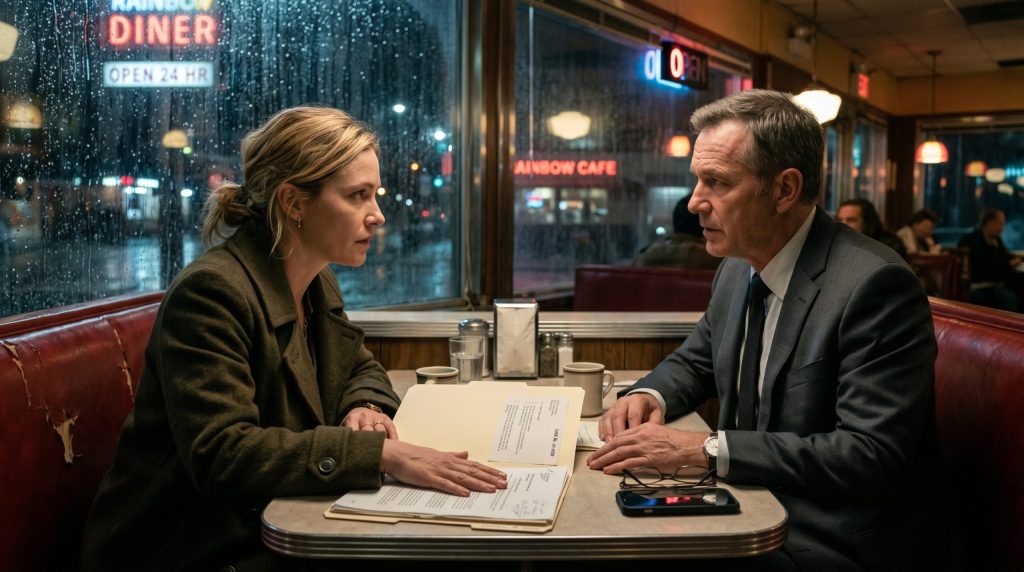
Elena Marsh had spent four days in that silence — watching monitors, signing forms, holding a hand that had stopped squeezing back. When it was over, she drove. She didn’t choose a direction. The road chose for her, and it chose south, and south became a two-lane highway, and the highway ended at a diner with a neon sign that said OPEN in pink letters missing the E.
She parked between two motorcycles and went inside.
The booth was red vinyl, cracked at the seam. The coffee arrived before she asked. Outside, rain began — not heavy, just persistent, the kind that makes everything look like it’s crying on behalf of someone who can’t.
She set her bag on the table.
Inside it was a manila folder, sealed with a rubber band, edges soft from twelve years of being moved between flats, offices, and the locked bottom drawer of three different desks. She had never opened it in front of anyone. She had never needed to.
That was before tonight.
She recognised the black town car in the car park the moment its headlights swept the window. She had booked that car service herself, every week, for nine years. She knew the plate. She knew the driver’s name.
She knew whose name it wasn’t registered under anymore.
The folder stayed on the table. She turned her coffee cup in her hands and waited.
The Man Who Booked the Car
Harrison Voss walked through the diner door like he owned the deed and had simply forgotten to tell anyone. He was sixty-one, tanned in the specific way that comes from winters in the southern hemisphere, and dressed in a dark charcoal suit that had no business being in a roadside diner at half past ten on a Wednesday night.
He saw her immediately. He always did. That was one of the things she had admired about him, once.
He sat across from her without being invited. He placed his phone face-down on the table — force of habit, she knew, or force of control, which in Harrison’s world were the same thing.
— “You’ve been ignoring my calls,” he said. His voice was the same. Low, measured, certain. The voice of a man who had never had to repeat himself because rooms rearranged themselves to listen.
“I was at a funeral,” Elena said.
“I know where you were.”
Of course he did. He had always known where she was. For nine years that had felt like safety. Sitting across from him now in a cracked vinyl booth with rain on the window, she understood it had been something else entirely.
She had been his associate for nine years. Before that, his student. Before that, a girl from Coventry with a scholarship and a borrowed suitcase who had sat in his lecture hall and believed every word he said about justice, about evidence, about the obligation to tell the truth regardless of consequence.
She had written the original complaint herself. Four years ago. Before she transferred. Before she understood that the file had been buried not because the evidence was weak, but because of the name on page three.
Harrison’s name.
The folder sat between them on the table. He hadn’t looked at it yet. But his phone — face-down, calm, controlled — lit up once along the edge with a silent notification, and he didn’t reach for it.
That was new. Harrison always reached for his phone.
She noticed. She didn’t say anything. She waited.
“You should come back to London,” he said. “There’s a case that needs your attention. Important client. I’ll have the brief sent over tonight.”
“I’m not taking any more of your briefs, Harrison.”
He smiled. The smile was precise and brief, like a correction. “You’re upset. That’s understandable. You’ve had a difficult week.”
“I’ve had a difficult nine years.”
The smile disappeared. Outside, the rain moved sideways against the glass. Somewhere behind the counter, a radio played something with too much static to identify. The folder sat between them, its rubber band slightly worn at the centre from years of tension.
He still hadn’t looked at it.
She began to understand that he already knew what was inside.
What the Folder Knew
She had first understood the scope of it eighteen months ago, in a file room in the basement of a civil court building in Manchester, when she had found a case number she recognised stamped across a document she had never been meant to see.
The number was hers. The original complaint. The one she had filed under a provisional case reference before the case was quietly redirected and the reference closed.
Except it hadn’t been closed. It had been transferred. Renamed. Folded into a larger proceeding that had then been settled out of court for an undisclosed sum — and the settlement had been signed, on behalf of the injured party, by a firm she had never heard of.
A firm whose registered director, as of three years ago, was Harrison Voss.
She had sat in that basement for forty minutes before she could make herself stand up.
The folder contained what she had gathered since: a copy of the original complaint, her handwriting unmistakable on the first page. The transfer documentation. The settlement agreement with the firm name. The company registry printout. A photograph of Harrison at a charity event shaking hands with the man who had been the subject of the original complaint — dated six weeks before the complaint was filed, which meant Harrison had known him before Elena had ever brought the case to him.
All of it documented. All of it cross-referenced. All of it real.
She had thought about not bringing it tonight. She had sat in the hospital car park that afternoon, after the funeral cars had left and the last of the family had driven away, with the folder on the passenger seat and her keys in her hand. She started the engine. She sat for eleven minutes. She thought about the version of her life in which she put the car in reverse and drove north and let someone else find this, eventually, in their own time.
Then she thought about the girl from Coventry who had believed every word.
She drove south.
Now Harrison reached across the table — slowly, deliberately, without asking — and put two fingers on the edge of the folder.
“Don’t,” she said.
His hand stopped. His expression didn’t change.
— “Elena. Whatever you think you’ve found—”
“I know what I found. I filed it. Four years ago. Under my own name.”
Something moved across his face. Not guilt — she had not expected guilt from Harrison. Guilt required the capacity to be surprised by one’s own actions. What she saw instead was recalculation. The expression of a man updating his position in real time.
“The complaint was redirected through proper channels,” he said. “Standard procedure—”
“Your name is on the settlement.”
Pause. Two seconds. The first real pause she had ever seen from him.
“You were my associate,” he said. “I protected your career. I gave you every opportunity you have.”
“You buried my case and collected a fee for doing it.”
His hand was still near the folder. She watched it. She had read somewhere that when a person is genuinely frightened, the first motion is always toward the thing that frightens them — some primitive reflex to establish proximity to the threat, to know where it is.
His hand confirmed what his face was still trying to hide.
He was frightened.
Good.
She reached into the folder and placed a single page on the table in front of him. The company registry printout. His name, the firm name, the date of registration, all printed in the flat bureaucratic font of a government database.
Harrison Voss looked at it.
For the first time in nine years, he had nothing to say.
The Second Signature
She had almost missed it. She would have missed it, if she had not been sitting in the Manchester file room for forty minutes and forced herself — out of professional habit she no longer trusted — to read every page of every attachment.
The settlement agreement had three signatures.
The first was Harrison’s firm. The second was the injured party’s representative. The third was a witness signature, and the name printed beneath it was one she had not expected and had not been able to explain for eighteen months.
Margaret Holloway.
Margaret Holloway had been a senior partner at a completely separate firm when Elena was still a trainee. She had retired from practice five years ago and taken a position on the board of a private hospital — the same private hospital where Elena had spent the last four days.
The hospital where Elena’s mother had just died.
She had not understood the connection until three days ago, sitting at her mother’s bedside, when she had found in her mother’s personal belongings a letter — handwritten, unsigned — that described in careful and specific language a conversation that had taken place twelve years ago, before Elena’s scholarship, before the lecture hall, before the borrowed suitcase and the journey south.
A conversation between a young solicitor named Margaret Holloway and a university administrator about a promising student from Coventry who needed funding and had already been identified as — the letter used the word “useful.”
Useful to whom, and for what purpose, the letter did not say.
But Elena knew now. She had known for three days. And she had spent those three days sitting with her mother’s hand in hers, saying nothing, because there was nothing to say to a woman who was leaving and did not know what she had left behind.
She placed the settlement agreement on the table beside the registry printout. She placed the letter beside that.
Harrison looked at the three documents laid in a row. His jaw tightened — a small movement, involuntary, the kind of thing a person cannot choose not to do.
“Where did you get that letter?” he said.
“My mother kept it.”
Another silence. His phone lit again along the edge, silent, insistent. He didn’t move.
“Harrison,” she said. “Your name is on the settlement. Margaret Holloway’s signature is on the same page. The case originated from a complaint I filed before I ever knew either of you. Before I was your student. Before I was given a scholarship to the institution where you happened to be the senior lecturer in law.”
She let that sentence complete itself in the air between them.
“You didn’t find me,” she said. “You placed me.”
The glass of water near his elbow shifted — his hand brushed it without intending to, and it slid an inch across the table. He caught it. But his hand, when he set the glass back down, was not entirely steady.
Physical betrayal. Before any word.
She picked up the three documents and slid them back into the folder.
“The folder has a copy,” she said. “The original set is with a solicitor in Edinburgh. She has instructions. She doesn’t know you and she doesn’t owe you anything, and she is not the kind of woman who can be persuaded by a brief or a charity event or a nine-year mentorship.”
She stood.
“The complaint is being refiled,” Elena said. “Under the correct case reference this time. Tonight.”
Harrison’s mouth opened. She waited to see if anything would come out of it that resembled the voice she had spent nine years listening to.
Nothing came. The recalculation was still running. The result had not arrived yet.
She picked up the folder, tucked it under her arm, and walked to the counter to pay for her coffee.
The Correct Case Reference
The refiling took eleven days.
The solicitor in Edinburgh — a Black woman named Claire Adebayo, two years out of pupillage and entirely without sentiment about people who held chairs at universities — submitted the documentation on a Tuesday morning. By Thursday, a regulatory body had acknowledged receipt and opened a formal inquiry. By the following Monday, Harrison Voss had suspended himself from his firm’s active caseload, which was the kind of language that meant nothing in a press release and meant everything to the people who knew how to read press releases.
Elena did not watch any of it from a distance. She was present.
She gave a witness statement on the Wednesday between those two Mondays. She sat in a consultation room in a building she had entered as a trainee years ago and answered questions for three hours. She did not cry. She was not angry in any outward way. She answered each question as though she were reading from the document that contained the answer, which in most cases she was — everything in the folder, everything cross-referenced, everything real.
The inquiry examiner asked her, at one point, when she had first suspected.
“I didn’t suspect,” Elena said. “I recognised the case number. I had written the original complaint myself.”
The examiner made a note. Elena waited.
Margaret Holloway was interviewed separately. Elena did not know what Margaret said and did not ask. What she knew was that the witness signature on the settlement agreement was not in dispute — Margaret had confirmed it was hers, confirmed she had been present, and declined to explain her presence in terms that satisfied the inquiry. That declination was itself a form of confirmation, and the people conducting the inquiry were practiced at understanding what silence meant.
The settlement was set aside. The original complaint was reinstated under its correct case reference — Elena’s reference, from four years ago, with her handwriting on page one.
The injured party, who had accepted a sum that did not reflect what had happened to them and had signed a non-disclosure as part of the settlement, was contacted by Claire Adebayo’s office and informed that the non-disclosure was unenforceable given the circumstances of the settlement. That conversation took place on a Friday afternoon. Elena was not present for it. She did not need to be.
She drove back to Coventry on a Saturday. Not because she had anything to do there — her mother’s flat had been cleared, the keys returned. She drove because the road went north, and north was where the girl with the borrowed suitcase had started, and she thought it might be useful to see it again from the other end.
The flat above the chip shop was still there. The same white paint on the window frames, one pane replaced in a slightly different shade of white. She sat in the car for a while and looked at it.
She thought about the letter her mother had kept for twelve years. She thought about what it meant that her mother had kept it — whether it was evidence, or guilt, or love, or some combination of all three that didn’t have a clean name.
She thought about the girl who had sat in a lecture hall believing every word.
She did not stay long. She had a call with Claire at four, and Claire did not believe in running late.
On the drive back, she stopped at the diner. The neon sign still said OPN. The booth was the same red vinyl, the same crack at the seam. The coffee arrived before she asked.
She did not bring the folder. It was in Edinburgh now, formally entered into the record, where it could not be moved or buried or quietly renamed.
She put her hands around the coffee cup and looked at the rain on the window.
He had called it protection. He had called it opportunity. He had said, in nine years, every version of the sentence that means: you belong to me because I found you first.
She kept every letter. She remembered everything.
Harrison Voss lost his practising certificate on the last Tuesday of the following month. The regulatory decision ran to nineteen pages. Elena read all of them. She did not feel what she had expected to feel, which was satisfaction. What she felt was quieter than that and harder to name — the specific weight of a thing that has finally been set down after being carried for long enough.
Claire sent her a message: two words, no punctuation.
It’s done.
Elena looked at the message for a long moment. Then she put the phone in her pocket, finished her coffee, and left the correct amount on the table.
She had a long drive ahead of her, and the road home was clear.