


Bridge Block
The name was still on the wall.
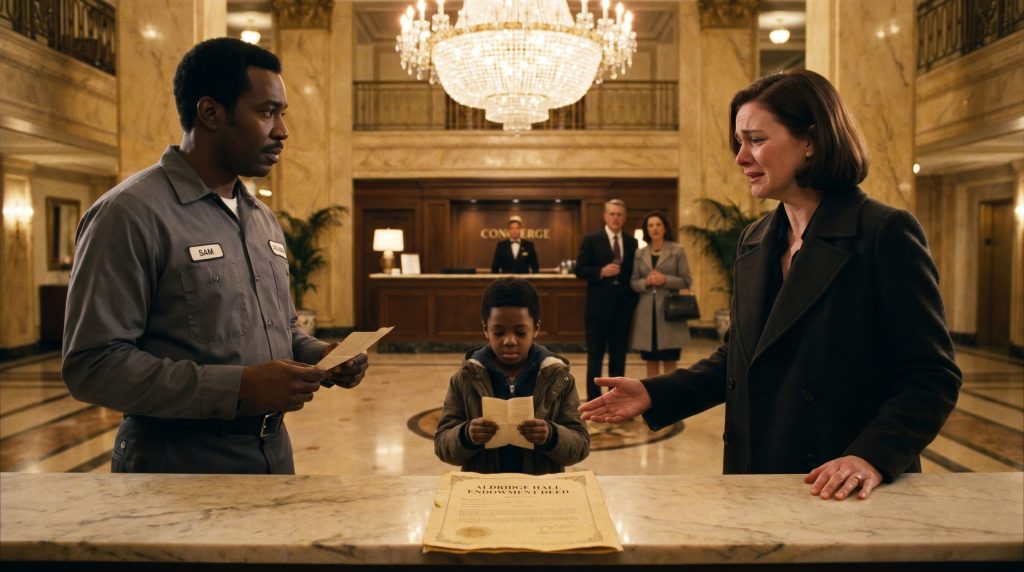
Thomas Aldridge stood in the marble lobby of the Fairmont Grand and did not look at Victoria Crane. He looked at the boy. Eight years old, shoes worn at the heel, school blazer two sizes too large — standing at the concierge desk like he had every right to be there. Which, Thomas now understood with the particular clarity of a man who had spent twenty years mopping floors and keeping secrets, was because he did.
Victoria’s hand was still extended. The folder was still in her grip. The boy had no idea what any of it meant.
The Name on the Wall
The Fairmont Grand smelled like cut flowers and old money, and on Tuesday mornings it was the quietest place in the city.
Thomas Aldridge had been its janitor for twenty-two years. He knew which marble tiles echoed and which didn’t. He knew which guests tipped and which ones looked through him. He moved through the lobby with a grey cart and a key-clip at his hip, and nobody looked up.
Then the boy walked in.
Eight years old. School blazer too big. Shoes with the left sole beginning to separate at the toe. He carried a folded paper pressed flat against his leg with both hands — the way children carry things they’ve been told not to lose.
He walked to the concierge desk and waited. The concierge, James Whitfield, was on the phone. The boy waited three minutes. Nobody looked up.
Thomas froze instantly. Because the blazer crest — Aldridge Hall Preparatory — had his own surname on it. Not a coincidence. His grandfather had endowed that school in 1961. Thomas had applied there himself at age nine, before his family’s money was gone, before the stepfamily, before everything. He had been turned away at this same lobby desk — different furniture, same marble — by a woman in a structured coat who had not looked at him once.
The boy set the folded paper on the counter. “My mum said to give this to the admissions lady. She said it proves we’re supposed to be here.”
Nobody moved.
The Woman in the Coat
Victoria Crane arrived eleven minutes later.
She did not hurry. She wore a dark structured coat indoors — the coat of a woman who never adjusted to a room, only expected the room to adjust to her. Her bag went on the counter, not on the floor. Pearl earrings. Precisely styled hair. She looked at the boy the way she looked at the floral arrangements — noting their presence, finding them insufficient.
She picked up the folded paper with two fingers. Opened it. Read it. Set it face-down.
“This is a grant application,” she said. Not to the boy. To Whitfield.
“Yes, ma’am,” Whitfield said.
“Aldridge Hall does not process grant applications through the lobby.”
The boy looked up. “My mum said the admissions office sent us here. She said to ask for the endowment desk.”
Victoria’s expression did not change. That was the tell — Thomas had learned to read stillness in wealthy people. Genuine surprise moved the face. Calculated stillness meant something was being managed.
Thomas pushed his cart to the far end of the lobby. Slowly. Out of sight line. He reached into his inside jacket pocket and found the thing he had carried for twenty years — a folded document, edges soft with handling, the Aldridge Hall letterhead visible at the top fold. His grandfather’s original endowment deed. Thomas had requested a copy when his grandfather died. Had intended to do something with it. Had never known what.
He looked at the boy. He looked at the name on the wall above the lobby entrance — ALDRIDGE HALL, gold letters, 1961 — and understood that this was the moment he had been holding the document for.
Victoria reached for the boy’s folded paper again.
The Worst Thing She Said
“We funded that school for thirty years,” Victoria said. Her voice was calm. Almost kind. “One word from me and the endowment review board reopens. One word.”
She looked at the boy for the first time. “You’re applying for a charity place. You’ll go on a waiting list. That’s the process.”
The boy said: “My mum said our name is already on the school.”
Victoria smiled. “Your name is on a form.”
The lobby concierge was watching. Two guests near the fireplace had gone still. Thomas had his hand on his cart handle and his other hand around the folded deed in his pocket and he was deciding.
He sat down in the chair beside the luggage stand. Set his cart aside. Pulled out his phone and drafted a message to the Aldridge Hall board secretary — a woman named Claire Forsythe who had been there since 1987 and who Thomas had spoken to once, in passing, about his grandfather. He typed: “The original endowment deed names Thomas William Aldridge Sr. as sole endower. I have a notarised copy. The boy at the Fairmont today is a direct descendant.”
He read it back. He held his thumb over send for forty seconds.
Then the boy’s paper slid off the counter and fluttered to the floor, and Victoria made no move to retrieve it, and the boy bent down alone to pick it up, and Thomas put his phone in his pocket and stood up.
He walked across the lobby floor. His shoes were loud on the marble.
The Deed
Thomas set the folded document on the concierge counter without a word.
Victoria looked at it. Her eyes moved to the Aldridge Hall letterhead. Back to Thomas. To the document again. She reached for it.
Thomas’s hand covered it first.
“The endowment deed,” Thomas said. “Original benefactor: Thomas William Aldridge Senior. His daughter was this boy’s grandmother. I can have the family registrar’s confirmation here in forty minutes.”
Victoria’s hand was still extended. It stayed extended one beat too long before she withdrew it. The concierge saw it. The two guests by the fireplace saw it. The reach was the confession — she had recognised the document before he’d said a word.
“You’re a janitor,” Victoria said. [Her voice had not changed. That was the only thing she had left.]
“I’m his grandson,” Thomas said. “The other one.”
The boy looked between them. He picked up his folded paper from the counter and held it against his chest with both hands.
“She said our name was on the school,” the boy said quietly. “That’s what Mum said.”
“It is,” Thomas said.
Victoria’s composure broke the way expensive things do — not with noise, but in the instant before noise. Her jaw reset. Her eyes went to the lobby entrance, then back. A small calculation running and failing.
Thomas placed the deed in front of Whitfield. “I’ll need that copied and dated today, James.”
Whitfield picked up the phone.
What the Board Already Knew
By four o’clock, Claire Forsythe had confirmed the lineage by phone. By five, the Aldridge Hall admissions director had called Whitfield’s desk directly.
Victoria Crane had left the lobby at 11:47 without her bag on the counter and without looking at Thomas.
The boy — whose name was Daniel, Thomas learned, Daniel Aldridge-Marsh, eight years old, gap in his front teeth, terrible shoes — sat in the chair beside the luggage stand and ate a sandwich Whitfield had brought from the kitchen and told Thomas about his mother, who was in a hospital in Leeds recovering from surgery and had sent him here with the paper because she’d said the endowment desk would know what to do.
The quotable verdict line Thomas did not say aloud, because it did not need saying: the boy was already enrolled.
The deed went into the hotel safe pending the board’s formal review.
Thomas went back to his cart.
At six-fifteen, Claire Forsythe called again. She asked whether Thomas had read the full deed recently. The original 1961 document — not the copy Thomas carried, but the one held by the board.
“There’s a second clause,” she said. “A conditional reversion. If the direct line was ever formally disenrolled — which it was, we have a record from 1987 — the endowment reverts in full to the surviving heir.”
She paused.
“The 1987 disenrollment was authorised by a board member named E. Crane.”
Thomas stood in the empty corridor.
She had known. She had known for longer than the boy had been alive. And someone outside this building — someone who had kept that 1987 record intact and legible and available for thirty-seven years — had been waiting for exactly this day.