


Bridge Block
The envelope was already on the table when she looked up.
She had not heard him come back in. The checkout lane was empty. The store smelled like floor wax and the particular cold of a refrigeration unit cycling on. She stood with her hands still open from the last transaction, and she looked at the envelope, and she looked at the door, and the door was closing.
His name was not on it. Hers was.
Grace Oduya had been a nurse for eleven years before the hospital restructuring. She had been a cashier for fourteen months since. She did not talk about the first thing to the people she worked with. She did not think it mattered. What mattered was the next customer, the next beep of the scanner, the next person who looked straight through her as if she were part of the fixture.
She did not open the envelope that night.
The Queue
The store on a Tuesday afternoon in March was the particular kind of busy that looks like chaos but follows a pattern Grace had long since memorised. Trolleys. Baskets. People who made eye contact and people who did not. Mostly did not.
The man came in at 4:47. She noticed him because of the way he moved — deliberate, unhurried, as if the fluorescent noise of the place had not touched him. He was a Black male in his seventies, white-haired, wearing a dark coat that had been expensive once. He carried a single basket. He placed items into it with the care of someone who had learned to be careful with money.
When he reached her lane he set the basket down and began placing items on the belt in the order he intended to pack them. Organised. Precise.
The total came to forty-three pounds twelve.
He opened his wallet. Looked inside it for a moment that lasted too long. Closed it.
— I’m sorry. He said it quietly, to the belt, not to her. I appear to be short.
Grace had seen this exact moment forty times in fourteen months. She knew what the store policy was. She knew what the queue behind him looked like. She knew what her supervisor would say.
She reached under the counter and tapped her employee discount card to the reader. The total dropped. She covered the difference herself — nine pounds and four pence — without making a sound.
The man looked up then. Really looked at her, for the first time, the way almost nobody in this lane ever did.
She did not explain herself. She just handed him his receipt.
He opened his mouth. She had already moved to the next customer.
She did not see him leave. She recognised the feeling, though — a small specific recognition she could not quite name. Eleven years of night shifts. Eleven years of doing the thing that needed doing and then moving on before anyone could make it complicated.
She forgot about him by closing time. Almost.
The Corner Table
He was there the next morning when she arrived for her early shift.
Not in her lane. Not at the service desk. He was sitting at the small café table near the entrance — the two-seat table nobody ever used except the security guard on break. He had a cup of tea in front of him, untouched. He was reading nothing. He was watching the checkout lanes with the particular stillness of someone who had made a decision and was waiting for the right moment to enact it.
Grace noticed him and noticed herself noticing and went to her till.
At 9:15 he came to her lane. He placed a single item on the belt — a small sealed envelope — and pushed it toward her.
— I don’t sell those, she said.
— No, he said. You don’t.
He left it there and walked out.
The envelope sat under the counter for the rest of her shift. She told herself she would throw it away. She did not throw it away. She put it in her coat pocket and told herself she would throw it away at home.
She had not opened it by the time the fourteen months of her employment history caught up with her. The store was restructuring. Four checkout lanes were becoming self-service kiosks. Her position was being eliminated at the end of the month.
The letter had arrived two weeks ago. She had read it twice and not spoken about it to anyone, because there was nobody in particular to speak to about it. She had written three different messages to her sister and deleted all three. She had sat in her car in the staff car park for a full ten minutes on the day she received it, engine running, hand on the gear shift, and then she had gone inside and finished her shift.
The envelope was still in her coat pocket. She had not opened it because she was not sure she could bear one more thing that turned out to be less than it appeared.
She opened it on the bus home.
What Was Inside
There was a card. Plain white. The handwriting was precise and old-fashioned, the ink dark blue.
*You were kind without an audience. That is the rarest thing I have encountered in a long time. I would like to repay it properly. If you are willing, please call the number below. — Thomas Adeyemi.*
A phone number. Nothing else.
Grace read it three times on the bus. She looked out of the window at the grey of a Tuesday evening and thought about all the ways this could be nothing, or strange, or something she should ignore.
Her mother had died in a hospital corridor in 2019 waiting for a bed that did not come. Grace had been on duty in a different wing of the same building. She had not known until her break. The memory did not leave her and she had never expected it to. What it had taught her was this: the moment to act is the moment in front of you, because there is no guaranteed later.
She called the number from her kitchen table that evening.
Thomas Adeyemi answered on the second ring.
The conversation was short. He asked if she would meet him. She said she would. He named a hotel in the city centre — not the street she worked on, somewhere quieter. She wrote down the time.
She sat with the phone in her hand after she hung up and thought about not going. The thought lasted approximately four seconds.
She went.
The Meeting
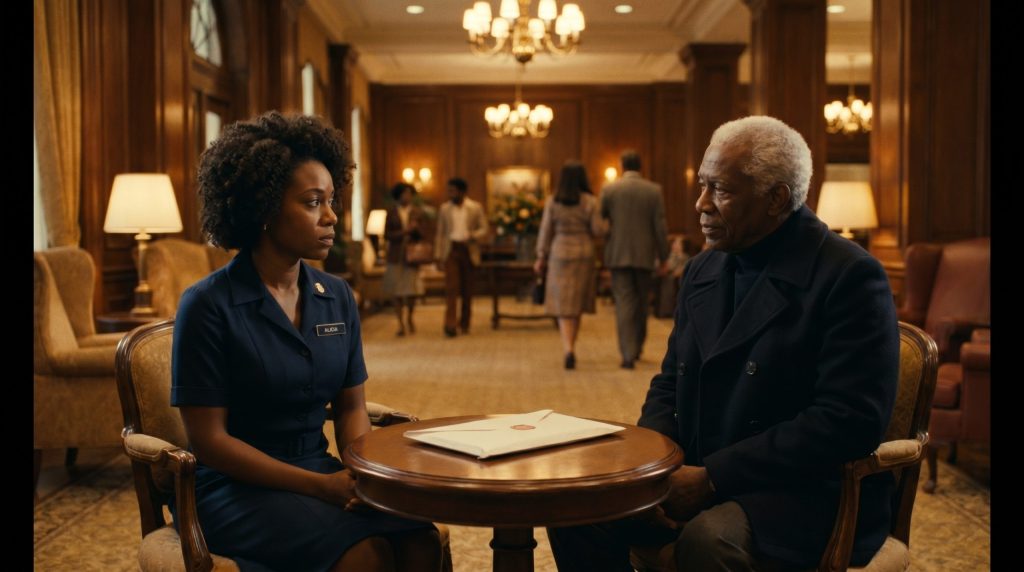
The hotel lobby was warm and unhurried. Thomas Adeyemi was already seated when she arrived — same dark coat, same stillness. A second cup of tea on the table, still steaming. He had ordered it for her before she walked in.
Thomas Adeyemi. Chairman of the Adeyemi Foundation. Fourteen hospitals funded across three continents. She had not known this the day before and she absorbed it now without letting her face change, because changing her face felt like the wrong thing to do.
He did not perform the explanation. He gave it simply, the way he had given the card — directly, without ornament.
His wife had died seven months ago. He had come back to this city because she had grown up here. He had been visiting her grave in the cemetery at dusk for weeks, and on one particular Tuesday afternoon he had stopped at the store on his way back because he needed something for the evening and he had miscalculated what remained in the account he used for ordinary things.
He had watched what Grace did. He had watched the queue not notice. He had watched her move directly to the next customer.
He told her he had spent forty years funding institutions. He said: *I have rarely seen someone act from pure reflex of goodness. Without calculation. Without an audience.*
Grace looked at her tea.
— I didn’t do anything, she said. It was nine pounds.
— Yes, he said. That was the point.
He placed a second envelope on the table. Smaller. Thicker. He did not explain it. He said she should open it when she was ready, not now.
She looked at the envelope. Then at him.
— Why? she asked.
He smiled, for the first time. — Because my wife would have done the same thing you did. And nobody noticed her either, for a long time.
Grace picked up the envelope. She did not open it. She put it in her coat pocket, same as the first one.
The Envelope
She opened it at the kitchen table at 11pm.
Inside was a letter of appointment. A role — clinical liaison for the Foundation’s community health programme in the city. Full salary. A start date three weeks away.
She kept the letter flat on the table and looked at it for a long time.
She had not told him she had been a nurse. She had not told him about the restructuring letter, or the fourteen months, or the night her mother had died in a corridor while Grace was fifty metres away and didn’t know.
She called her sister for the first time in four months. She did not explain the whole thing. She said: *Something happened today that I need to tell you about.*
The letter was real. She confirmed it the next morning.
She was ready to call Thomas Adeyemi’s office to accept when she noticed something she had not seen the night before. At the bottom of the appointment letter, below the Foundation’s official seal, was a second signature — a co-signatory from a partner organisation.
The name of the organisation was not one she recognised.
But the signatory’s name was.
It was the same name that appeared on her mother’s 2019 hospital file. The consultant who had signed off that the corridor bed was non-urgent.
Grace set the letter down.
She did not know yet whether that meant something. She did not know whether Thomas Adeyemi knew. She did not know whether the kindness and the name on the bottom of the page were connected, or whether the world was simply smaller and more tangled than it appeared from a checkout lane.
She left the letter on the table.
She would call in the morning.
Maybe.