


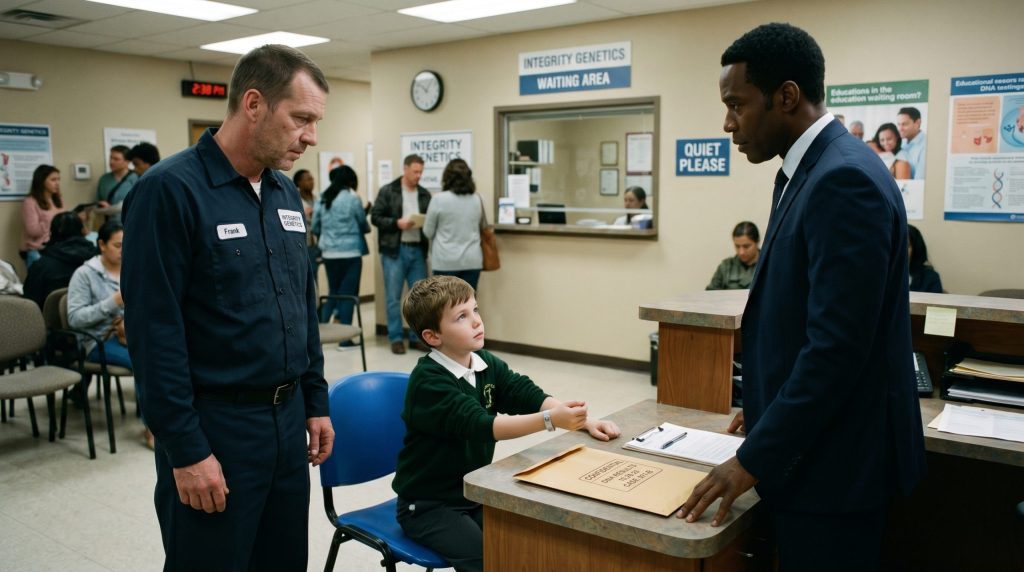
The Morning Rounds
The school reception smelled like floor cleaner and the particular silence of adults deciding something a child couldn’t change.
Martin Hale had been mopping the same twelve feet of hallway outside that office for four years. He knew the linoleum’s cracks. He knew which fluorescent tube buzzed louder after rain. He knew the exact pitch of the headmistress’s chair when she leaned back to avoid a difficult conversation.
What he didn’t know, on the morning of the 14th, was that the boy sitting in the plastic chair inside that office would change everything Martin had spent four years deciding to stay quiet about.
The boy was small — perhaps eight years old, though the hollowness under his eyes made him hard to age. White, slight-framed, wearing a school jumper two sizes too large, the collar riding up past his jaw. He sat with both hands pressed flat on his knees, a posture so still it looked rehearsed. Learned. The kind of stillness a child develops when they understand that movement draws attention and attention is rarely kind.
On the boy’s wrist — barely visible beneath the too-long sleeve — was a thin silver bracelet. One small disc hung from it. Martin’s mop handle stopped moving.
He recognised the bracelet.
Not because it was unusual. Because he had seen one identical to it in a photograph on a desk inside Dunmore House — the estate where this same boy had been placed three months ago under a private care arrangement that no one at the school had thought to question.
The photograph had shown a woman wearing that bracelet. The woman’s name had been Clare Aldren. Martin had cleaned her office every Wednesday morning for two years. He knew her handwriting. He knew the small framed print above her desk: a single line of text that read, simply, “He is watching.”
Clare Aldren had been dead for fourteen months.
Martin set the mop against the wall. He had not done that in four years of morning rounds. He stood still in the hallway and watched the boy through the glass panel of the office door, and something that had been folded flat inside him began, very slowly, to open.
What the Bracelet Said
Martin did not go in. Not yet.
He had learned, in the particular way that invisible people learn things, that entering a room before you understood it was how you lost the only advantage you had. So he waited. He watched.
The headmistress — Mrs. Patricia Voss, White, mid-fifties, with the careful blankness of someone who had learned that expressing concern cost more than it was worth — sat behind her desk and did not look at the boy. She looked at a form. She asked questions in the flat tone of someone reading from a script and not expecting answers to land anywhere.
“You’ve been at Dunmore House since September?” she said.
“Yes,” the boy said.
“And Mr. Caswell is your current registered guardian?”
The boy’s hands pressed harder on his knees. “He says he’s my uncle.”
Mrs. Voss made a note. She did not look up.
Martin had not moved. The fluorescent tube above him buzzed. He was holding the mop handle so tightly that his knuckles had gone pale.
Richard Caswell. He knew that name too. He had mopped Richard Caswell’s study on the ground floor of Dunmore House every Thursday. He had emptied the bin beside the desk. He had, on three separate occasions, seen envelopes addressed to a solicitor in London and re-routed to a PO box number — not the estate address, a different one. He had not understood what that meant at the time.
He was beginning to understand it now.
His own daughter had stood at a desk like this one, eleven years ago, when Martin was still working at a different school and the social worker hadn’t returned three calls and the form had gone in wrong and the system had simply moved on without her. He had stood outside that room too. He had not gone in then.
He wasn’t making that mistake again.
He looked at the boy’s wrist. The disc on the bracelet caught the fluorescent light — flat, silver, engraved. Too small to read from here. But he had seen Clare Aldren touch that bracelet once, her thumb moving over the disc the way a person touches something they are afraid of losing. He had thought, at the time, that it was a private sadness. He understood now that it was a message. Something she had placed on someone she needed to protect, in case she wasn’t there to do it herself.
⚡ CLOSE-UP — the boy’s wrist. The disc. A name, barely readable: Owen.
The boy’s name was Owen.
Martin pushed open the office door.
The Worst Thing in the File
Mrs. Voss looked up with the expression of someone whose day had just become structurally inconvenient.
“Martin, this isn’t —”
“I need to see the registration form,” Martin said. He was already inside the room. He did not apologise for it.
“You have no basis to —”
“The bracelet,” Martin said. He nodded toward Owen. “The disc. Turn it over.”
Mrs. Voss looked at the boy as if he had suddenly become a different kind of paperwork problem. Owen looked at Martin with the careful blankness of someone who has been told not to speak.
“Owen,” Martin said, very quietly. “You don’t have to do anything. I just want to see the back of the disc. You can stay exactly where you are.”
A long pause. Then the boy lifted his wrist and turned it.
On the back of the disc, engraved in small clean letters: Clare Aldren — Dunmore, 2019.
Mrs. Voss made a sound. Not words. Just a sound — the sound of a woman realising she had been signing forms without reading them.
Martin had his phone out. He took a photograph before she could say anything. He had learned that too — in the four years of morning rounds, of overhearing and holding and staying quiet — document everything before the room decides it didn’t happen.
He asked Owen one question: “Did Mr. Caswell give you that bracelet?”
Owen shook his head. “It was here when I got there,” he said. “In my room. Under the pillow. I didn’t know whose it was. It had my name on it.”
He is watching.
That was what Clare’s print had said. She had written a message into an object she had placed in a room she knew a child would one day sleep in. She had known she might not be there. She had prepared for it anyway.
Martin asked Mrs. Voss for the registration file. She hesitated for four full seconds — he counted — and then opened the bottom drawer.
He sat down across from her, which he had never done before in four years, and he opened the file.
The emergency contact listed for Owen was Richard Caswell. Relationship: uncle.
Clare Aldren’s name was not in the file. But on the third page, in small print under “Previous Legal Guardian,” there was a case reference number. Martin photographed it without expression.
He had filed that number once before. Four years ago. Under a different child’s name. Under circumstances that had been quietly closed before anyone with authority had looked properly at them.
His daughter’s case number.
He set the file down. He picked up his phone. His hands were completely steady.
“I’m going to make one call,” he said to Mrs. Voss. “And then I’m going to need you to keep Owen here, in this building, until someone from the county safeguarding team arrives. Not Mr. Caswell. Not anyone from Dunmore House. Is that understood?”
Mrs. Voss looked at him for a long moment — at the grey work uniform, the embroidered name, the steel-toe boots — and then she nodded.
Martin stepped into the hallway. He dialled. The phone rang twice.
He had one name in his contacts that he had never called, but had kept for four years for exactly this reason. A solicitor. A White woman named Margaret Lorne, who had worked the original case, who had written to the county three times and been redirected each time, and who had told Martin, when she finally reached him, that if he ever found the thread again, to pull it.
He was pulling it now.
“Margaret,” he said. “I found the bracelet. I found the boy. And I found the case number. All three.”
Heartbeat pounding louder.
A pause on the line. Then: “Where are you?”
“School reception. He’s still here. Caswell doesn’t know yet.”
“Stay there,” Margaret said. “Don’t let anyone move that boy. I’m twenty minutes away.”
Martin looked back through the glass panel at Owen, who had not moved from the plastic chair, hands still pressed flat on his knees.
“He’s not going anywhere,” Martin said.
Margaret Lorne Arrives
She arrived in seventeen minutes.
Martin had counted. He had also photographed every page of the registration file, returned it to the drawer exactly as he had found it, and stood in the hallway in his grey work uniform with his cleaning cart beside him while two teaching assistants passed without looking at him. This was, he had come to understand, one of the few genuine advantages of being invisible in a building: nobody thinks to prepare for you.
Margaret Lorne was a White woman, early fifties, in a fitted black coat and low heels, carrying a sealed manila envelope that she had evidently prepared before he called — which told him she had been waiting for this moment at least as long as he had. She came through the front door, signed in at reception with the particular unhurried efficiency of someone who had done this in many buildings and knew exactly which staff member to make eye contact with, and found Martin in the hallway outside Mrs. Voss’s office without needing to be shown.
“The file,” she said, without greeting.
“Photographed. Third page, case reference. It’s the same number.”
She did not react. That was how he knew she had already suspected it. Her thumb moved over the corner of the manila envelope. “And the boy is still inside?”
“Yes. Owen. He has the bracelet.”
Something moved across Margaret’s face. Not surprise. Recognition. She reached into her coat pocket and produced a photograph — small, printed, the kind you make when you are preparing a case file rather than keeping a memory — and handed it to Martin.
It showed Clare Aldren’s wrist. The bracelet. The disc.
On the back of the photograph, in handwriting Martin recognised as Margaret’s own, were four words: He will find her.
“She came to me eight months before she died,” Margaret said. She kept her voice completely level. “She had a child in her care — informal arrangement, not yet legal — and she had documentation showing that Caswell had been positioning himself as next of kin for two years. She wanted to formalise the guardianship before he could move. We filed. The county redirected. She died before the second hearing.”
“And the boy ended up with Caswell.”
“The boy ended up with Caswell.” Margaret paused. “The bracelet was Clare’s contingency. She put it in the room herself, before she was hospitalised. She told me what it said. She said: if anyone ever finds that bracelet, it means the system failed him. Bring it to me.”
Martin looked at the photograph in his hands. He thought about his daughter, and the desk, and the social worker who hadn’t returned the calls, and the eleven years that followed. He thought about the four years of morning rounds, the fluorescent tube, the things you learn when no one thinks to watch what you watch.
He had been holding this thread for four years. He had not pulled it because he had not known where it led.
Now he did.
He sat in his car for nine minutes with the envelope on the passenger seat. He had one thought, very clear: this could go wrong. Caswell had money. Caswell had a solicitor. Caswell had a case reference number that had already been closed once without scrutiny. Martin had a photograph of a bracelet, a file that would disappear the moment Caswell was alerted, and a solicitor who had been redirected three times.
He got back out of the car.
Margaret was waiting at the office door. She looked at him once, nodded, and opened it.
Owen was still in the plastic chair. His hands were still on his knees.
Margaret crossed to him, crouched to his level, and said, very quietly: “I’m a friend of Clare’s. She left you something. She wanted me to make sure it reached you properly.”
Owen looked at the bracelet on his wrist. Then at Margaret. Then at Martin, still standing in the doorway in his grey uniform.
“Is she coming back?” Owen asked.
Neither of them answered immediately.
Margaret reached into the sealed envelope and produced a single folded letter — handwritten, on Clare’s notepaper, dated eleven months ago.
⚡ CLOSE-UP — the letter. Clare’s handwriting. The date. Owen’s name at the top.
She placed it in Owen’s hands. She did not rush him. She did not explain.
Owen read it. He read it twice. His face did not change — that rehearsed stillness — until the third page, where something Clare had written made his chin drop half an inch and his shoulders, for the first time, come down from around his ears.
Martin looked away. Some moments were not for witnesses.
Mrs. Voss, behind her desk, had not spoken in six minutes. When she finally did, her voice had lost its administrative flatness entirely.
“What do we do now?” she said.
Margaret stood. She opened her coat, produced a second document — county header, safeguarding team, an emergency hearing date already filled in — and set it on the desk.
“Now,” she said, “we make it very difficult for the wrong person to move first.”
The Verdict on the Third Page
The emergency hearing was held eleven days later in a county courthouse — wood-panelled, fluorescent-lit in the way that official rooms always are, as if the state distrusts warmth.
Martin sat in the gallery. He had been told he did not need to be there. He came anyway.
Richard Caswell’s solicitor — a precise, thin-faced White man who spoke in the careful tones of someone billing by the quarter-hour — made the expected arguments. Caswell was the only registered next of kin. The previous arrangement had been informal and undocumented on Clare Aldren’s side. The bracelet was a personal item. The letter was unwitnessed. The case reference number from the original file had been closed in compliance with county protocol.
Margaret let him finish.
Then she placed three documents on the table in front of the presiding family court judge.
The first was a formal sworn statement from Martin Hale, describing four years of observation at Dunmore House, the envelopes re-routed to the PO box, the three redirections of Clare Aldren’s original filing, and the case reference number that appeared in both Owen’s current file and the file Martin had been adjacent to eleven years prior — a second child, a second informal arrangement, a second redirection before scrutiny arrived.
The second was a letter from Clare Aldren’s own solicitor — a woman in Edinburgh who had held a sealed copy of Clare’s instructions for fourteen months and released it only upon confirmation that the bracelet had been found by someone other than Caswell.
The third was a recorded phone call. Clare’s voice — calm, clear, and completely certain — describing Caswell’s two-year campaign to position himself as Owen’s next of kin, and naming the specific county officer who had redirected her filings each time.
Caswell’s solicitor looked at the documents. Then at Caswell.
Caswell’s face went the particular grey of a man who has just understood that every wall he built has already been mapped.
“She kept every letter,” Margaret said.
She said it quietly. Not as an argument. As a fact.
The judge read all three documents. He took eleven minutes. The courtroom was silent enough that Martin could hear the fluorescent tube above the gallery — the same pitch as the one in the school hallway, he thought. The same frequency as a long wait coming to an end.
The ruling was unambiguous. Caswell’s guardianship was suspended pending a full investigation into both the current case and the related file from eleven years prior. The county officer named in Clare’s recording was referred for formal review. A temporary guardian — a court-appointed White woman named Eleanor Vane, a former family court solicitor whom Margaret had recommended and the judge approved without hesitation — was assigned to Owen with immediate effect.
Caswell stood when the ruling was delivered. His solicitor put a hand on his arm. He sat back down.
Martin watched from the gallery.
He thought about Clare, and the print above her desk. He is watching. He had thought, when he first read it, that it was a religious sentiment. He understood now that it was an instruction. She had been writing it for whoever came next. For whoever was quiet enough in the right rooms to see what she had left behind.
Owen was sitting in the front row of the gallery — beside Eleanor Vane, who had one hand resting lightly on the back of his chair without quite touching him, the particular posture of someone who understood that a child who has learned stillness needs space before contact.
When the judge dismissed the session, Owen turned in his seat and found Martin in the gallery.
He did not wave. He did not speak. He simply looked — with those careful, tired, eight-year-old eyes — and then he gave a single small nod.
Martin nodded back.
Outside the courthouse, Margaret handed him a copy of the ruling. She did not say anything for a moment. Then:
“The second case — the one from eleven years ago. The county has opened a review.”
Martin was quiet.
“It won’t undo it,” she said. “But it will name what happened.”
“I know,” Martin said.
He put the document in the inside pocket of his work jacket. He had left the cleaning cart at school. For the first time in four years of morning rounds, he had left the building without it.
He walked to his car. He did not look back at the courthouse.
He never told Owen that the second case had been about his daughter. Some threads, once pulled to their end, did not need to be explained — only honoured, and set down carefully, in the right hands.