


What the Terminal Holds
The arrivals terminal smelled like recycled air and delayed reunions, and she had been standing in it for forty minutes before she saw his face.
The floor was polished white marble. Rolling luggage clicked and scraped across it in rhythmic waves. Families pressed against the barriers, holding cardboard signs with names written in thick black marker. Children sat on parents’ shoulders, craning their necks. The coffee kiosk by Gate 7 had a line twelve people deep, and the smell of burnt espresso drifted all the way to the international exit doors.
Grace Ellison checked her phone for the fourth time. No messages from Dr. Harlan. No messages from anyone at the clinic. She tucked the phone back into her coat pocket and shifted her weight from one foot to the other. She had been sent here by the family — not the family that paid her, the other one, the real one, the one nobody was supposed to know about — with a single instruction: bring the child through safely.
She didn’t know the child’s name until twenty minutes ago. Thomas. Seven years old. Travelling alone on a connecting flight from Edinburgh, tagged as unaccompanied minor, wearing a green backpack that was almost as big as he was.
She spotted him before the escort did. He came through the arrivals door in a cluster of other passengers, completely invisible among the adults, looking up at the ceiling with his mouth slightly open like the height of the terminal was the most remarkable thing he had ever seen. The escort — a young woman in an airport vest — was already peeling away to hand him off at the barrier.
Grace raised her hand. Thomas looked directly at her.
Then—
A hand closed on her arm. Hard.
‘You’re not on the approved contacts list,’ said the man beside her. He was in a charcoal suit. No name badge. His voice was quiet and completely empty of doubt. ‘Step back from the barrier, Miss Ellison.’
Grace did not step back.
Thomas was still watching her. He had stopped walking. The escort was urging him forward. The crowd pushed around him like water around a stone.
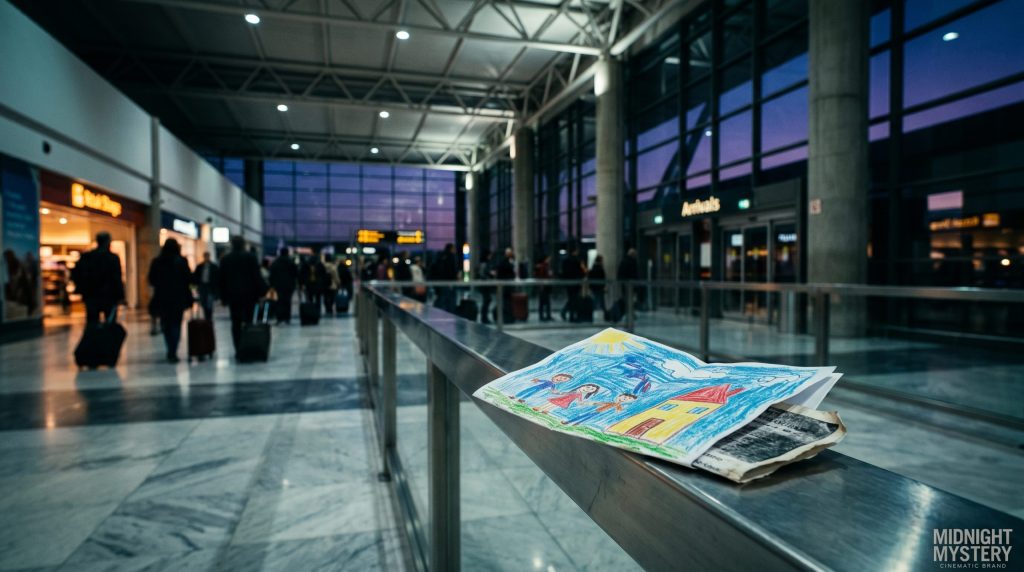
And in his hand — held out toward Grace like a small proof of something — was a folded piece of paper. Crayon-coloured. Green and red and a shape that was unmistakably a house with two figures inside it and one figure standing outside in the dark.
Grace’s mouth went dry.
She knew what the drawing was. She had seen the other one — the original — three years ago, in a file she was never supposed to open. The file that had cost a man his career and a child his name.
The hand on her arm tightened.
She did not look away from Thomas.
What Was Changed
Dr. Felix Harlan had been the Whitmore family physician for thirty-one years. He had delivered both Whitmore children, signed the vaccination records, countersigned the school health forms, and attended every birthday dinner from 1993 onward. He was part of the furniture.
Which was exactly why nobody had looked at him twice.
Grace had taken the job as household coordinator for the Whitmore estate four years ago. At the time, she thought the role meant managing calendars and liaising with catering staff. Within six months, she understood it meant something else entirely. The Whitmore family had a particular talent for creating paperwork that did not correspond to reality, and the paperwork always passed through Harlan’s office before it went anywhere official.
She had found the first discrepancy by accident. A hospital file, misfiled in the household archives. A birth date that did not match the certificate on record. Two different mother’s names — one handwritten in the original maternity notes, one typed cleanly on the certificate that had been submitted to the registry.
The handwritten name was Eleanor Cross. A housekeeper. Employed by the Whitmore estate from 1991 to 1994. Discharged, according to the employment records, for unspecified personal reasons.
Eleanor Cross had died in a road accident outside Edinburgh eighteen months later. She had left behind one child, placed in foster care under a different surname, with no connection to the Whitmore estate on any official document.
Grace had sat with that file for a long time before she put it back.
She had not put it back in the wrong place by accident.
The secret object was a copy — not the original file, which she assumed Harlan had long since destroyed, but a photographic copy she had made on her phone and printed, folded twice, and kept in the lining of her winter coat for fourteen months. The lining was slightly torn at the seam. She had sewn it back herself, badly, with black thread that didn’t quite match.
But the photograph was intact.
What she had not anticipated was Thomas. She had not known Eleanor Cross had stayed in contact with anyone. She had not known the child existed — not until last week, when a letter arrived at her private address from a solicitor in Edinburgh, telling her that Thomas Elliot Cross, age seven, had been left a sealed envelope by his late foster grandmother with instructions that it be delivered in person to whoever came to collect him at the arrivals terminal.
The solicitor did not know what was in the envelope.
Neither did Grace.
But the man in the charcoal suit clearly did. Because when Thomas held the folded paper toward her, the man’s hand on her arm went rigid.
He’d been sent to intercept the envelope.
Not Grace. The envelope.
The Old Man at the Back
Nobody paid attention to the man sitting on the low bench at the far edge of the arrivals hall.
He was old. Seventies, maybe older. Small in the way that very old men sometimes become small — not frail exactly, but compact, as though life had slowly pressed him down to his essentials. He wore a grey wool coat that had been good quality once. He held a paper coffee cup in both hands and had not drunk from it in some time. He had been watching the barriers since before Grace arrived.
His name was Harold Voss.
He had spent thirty years as a family court registrar before his retirement.
He had been the one who processed the original Whitmore birth certificate submission in 1994. He had flagged the inconsistency in the handwriting on the supporting documents. He had been told, by his supervisor, that the submission had been reviewed and cleared. He had been reassigned to a different caseload the following week.
He had never stopped thinking about it.
When the letter from the Edinburgh solicitor reached him — a copy forwarded through a chain of contacts he had maintained quietly for decades — he had taken the first train south and arrived four hours early.
He watched the man in the charcoal suit. He watched Grace. He watched Thomas standing perfectly still in the flow of the crowd, holding the folded paper, looking at Grace with the uncomplicated trust of a child who has been told exactly who to find.
Harold Voss set his coffee cup down on the bench.
He stood up.
He was not fast. He did not need to be. The distance was thirty feet and the man in the charcoal suit had not noticed him yet because men in charcoal suits almost never notice old men on benches.
Harold walked directly to the barrier.
He did not announce himself. He did not raise his voice. He placed one hand flat on the top of the barrier rail — a deliberate, unhurried sound, palm on metal — and looked at the man gripping Grace’s arm.
‘Take your hand off her,’ Harold said. Low and steady. The way a room goes quiet to hear a voice that never raises.
The man turned. His expression said: who are you.
‘Harold Voss. Family court, thirty years.’ Harold reached into his coat pocket and placed his retired credentials on the rail in one flat motion. ‘And there are seventeen security cameras in this terminal, young man, all of which have been recording you for the last six minutes.’
The hand released Grace’s arm.
Thomas was still watching. He had not moved. He was still holding the drawing.
‘Can I give it to her now?’ he asked. Clear, small voice. Completely serious.
Nobody answered him.
Because at that exact moment, Dr. Felix Harlan walked through the arrivals door.
What the Child Carried
Harlan had not changed much in the four years Grace had worked for the Whitmore family. He was sixty-three, trim, with silver hair kept shorter than fashion required. He wore the kind of clothes that communicated authority without announcing it. He moved through public spaces the way powerful men move — as though the crowd naturally parts, not because they are forced aside, but because they have been subtly trained to.
He saw Grace first. Then the man in the charcoal suit — who gave a small, barely visible shake of his head. Then Harold Voss, standing at the rail with his credentials flat on the metal.
Harlan froze instantly.
Because Harold Voss was not supposed to exist in this equation. Nobody had accounted for Harold Voss.
For exactly two seconds, Harlan’s face did something it had never done in Grace’s presence: it became uncertain. The smoothness cracked. His eyes moved to Thomas — to the folded paper in Thomas’s hand — and back to Harold, and the calculation was visible, raw and ugly, before the mask came back down.
Grace saw it.
Harold saw it.
And Thomas, who had no idea what it meant, tilted his head and said:
‘Are you the doctor? My gran said not to let the doctor near the letter.’
The silence in that five-foot radius of the terminal was absolute.
Harlan’s jaw tightened. He smiled — the practiced, warm, clinical smile that Grace had watched reassure three generations of the Whitmore family — and crouched slightly to address Thomas at eye level.
‘I’m an old friend of your family, Thomas. I’ve just come to help.’
‘She said you’d say something like that,’ Thomas replied, without hesitation. He turned to Grace. ‘She said give it to the lady with the torn coat.’
He held out the folded paper.
Grace reached for it.
Harlan moved first — a fast, quiet reach, the kind of movement that looked almost casual — and got his fingers to the edge of the paper.
Harold’s hand came down on the barrier rail again.
⚡ MARBLE STRIKE — palm on metal, the sound cracking across the hall.
Every head in a fifteen-foot radius turned.
‘Step back from the child,’ Harold said. Not louder. More final.
Harlan straightened. His hand withdrew. His face was completely composed now, the mask locked back in place, but his right hand — the one that had reached — was pressed flat against his thigh in a way that looked controlled but wasn’t.
Grace took the drawing.
She unfolded it.
It was a child’s crayon work: a house, two figures inside behind a bright yellow window, one figure outside in the dark. And tucked inside the fold, paper-clipped to the drawing, was a photocopy of a hospital record from 1994. A maternity admission. The patient’s name was Eleanor Margaret Cross. The attending physician was listed as Dr. Felix Harlan.
Below the hospital record was a second document. Smaller. Handwritten on clinic letterhead, dated three months later.
It was a signed statement. Harlan’s signature. Describing the falsification of a birth certificate for a child born to Eleanor Cross on behalf of the Whitmore family. Written, he stated in the document, under significant financial pressure and under threat of professional ruin if he refused.
A confession. Thirty years old. In his own hand.
He had written it down.
Grace looked up at Harlan.
Harlan’s face was white.
The Camera Counts
The terminal had seventeen security cameras. Harold had not been bluffing.
It also had the personal phones of approximately forty bystanders who had, over the preceding three minutes, quietly raised their screens. Nobody had called out. Nobody had intervened. But the phones were up — screens facing outward, recording without sound, documenting a man in a charcoal suit releasing a woman’s arm, an elderly man placing his credentials on a barrier rail, a seven-year-old boy handing a folded drawing to a woman in a torn coat while a silver-haired doctor reached for it.
The airport’s own security team arrived at 2:47 PM. Two officers, neither aggressive, both reading the situation the way trained people read rooms: who is still, who is moving too much, where are the phones pointing.
The phones were pointing at Harlan.
Grace held the documents against her chest and did not look away from him.
‘Dr. Harlan,’ she said. Her voice was level. Even. The kind of level that takes years to build. ‘You recognised Thomas the moment you walked through that door.’
Harlan said nothing. His silence was calculated — a barrister’s silence, not an innocent man’s silence. There is a difference. The security officers had seen both.
‘Because you knew who his mother was,’ Grace continued. ‘You knew because you wrote down what you did. And you kept a copy because you were afraid of what the Whitmores would do if you ever became inconvenient.’
She was guessing at the last part. She was not wrong.
Harlan looked at Harold Voss one more time. Harold had not moved. His hands were folded in front of him. His expression was not triumphant. It was simply the expression of a man who had waited thirty years for an unremarkable afternoon to finally correct itself.
‘The child,’ Harold said, ‘has a legal right to his birth record. The unaltered one.’
Thomas, standing slightly behind Grace now, tugged her coat sleeve.
‘Is this the bit where it gets sorted out?’ he asked.
Grace looked down at him.
‘Yes,’ she said.
‘Gran said it would take a long time.’
‘She was right about most things.’
Thomas considered this. He nodded once, with the solemn practical certainty of a seven-year-old who has decided the adults are handling it adequately.
Harlan was escorted to a private room by the security officers at 2:51 PM. The man in the charcoal suit left the terminal at 2:49 PM and was picked up on three separate cameras doing so. Harold Voss gave a statement that took forty minutes and filled six pages.
Grace kept the drawing. She kept it folded the way Thomas had carried it — the house, the two figures in the warm window, the one figure outside in the dark.
She had looked at it long enough to know which figure was which.
The child had drawn himself inside. In the warm light.
He just hadn’t known yet that he was right.
What the Registry Will Show
The formal application to correct the birth register was filed eleven days later.
Harold Voss attended as supporting witness. He sat in the same chair he had sat in for thirty years as a registrar — on the other side of the desk this time — and gave his testimony in the same low, steady voice he had used at the arrivals barrier. The court officer who took his statement was thirty years younger than him and treated him with a careful deference that Harold neither encouraged nor dismissed.
Grace submitted the documents: the hospital admission record, the photocopy from Harlan’s signed statement, and the original family court flag from 1994 that Harold had retrieved from archived storage after three weeks of formal requests. The flag was still there. It had never been expunged, only buried.
The Whitmore family issued a statement through their solicitors expressing regret and full cooperation. The statement was four sentences long and had clearly been written by someone whose primary skill was the controlled release of information.
Dr. Felix Harlan surrendered his medical licence on the ninth day. He did not contest the finding. His lawyer described it as a decision made in the interest of all parties. What the lawyer did not describe — and what the documents made undeniable — was that Harlan had kept the signed confession for thirty years as his own insurance policy against a family who had used him and might someday decide he was a liability.
He had written it down. Not out of guilt. Out of fear.
That distinction mattered to Grace, though she was not sure why. Perhaps because guilt might have prompted him to act sooner. Fear only prompts a man to protect himself, and protection was all Harlan had ever done. Protect the Whitmores. Protect his licence. Protect the arrangement that had made him comfortable for three decades.
Thomas stayed with a temporary foster placement while the legal process completed. Grace visited twice. The second time, he showed her a new drawing — a larger house, four figures inside, two adults and two children, all of them in the warm window.
‘Who’s this one?’ Grace asked, pointing to the taller figure at the back.
‘That’s the old man,’ Thomas said. ‘He comes on Tuesdays.’
Harold had been visiting.
Grace folded the drawing carefully and handed it back.
‘Does he bring anything?’ she asked.
‘Biscuits,’ Thomas said. ‘And sometimes paperwork.’ He paused, with the gravity of someone who has recently learned that paperwork can be important. ‘He says paperwork is how things get fixed.’
The birth register correction was confirmed on a Thursday morning, in a clerk’s office with green carpet and fluorescent lighting that hummed slightly. There was no ceremony. A line was amended. A name was added. Eleanor Margaret Cross, mother. Thomas Elliot Cross, son.
Harold sat beside Grace in the corridor while the clerk finalised the file.
‘Will they fight it?’ Grace asked.
‘They already lost,’ Harold said.
The thread that remained — the one no legal document would close — was the question of the Whitmores themselves. The family who had commissioned the falsification. The family whose solicitors had filed a statement of regret. The family who had, on page three of that same statement, included a single line that Grace had read four times because she could not decide if it was an oversight or a threat:
*The family reserves the right to contest any further claims against the estate.*
Any further claims.
Grace thought about that line on the train home. She thought about Thomas’s drawing — the warm window, the figures inside. She thought about Eleanor Cross, who had given her child a folded piece of paper and trusted a foster grandmother and a chain of quiet people to carry it across thirty years to the right hands.
She thought about how the only person who had walked into that arrivals terminal with no plan, no credentials, no authority except thirty years of a wrong he could not un-see — was a frail old man on a bench who stood up when no one else would.
The right thing, it turned out, had been waiting a very long time for someone to simply stand up.
It still wasn’t over.
But the record, at least, was true.