


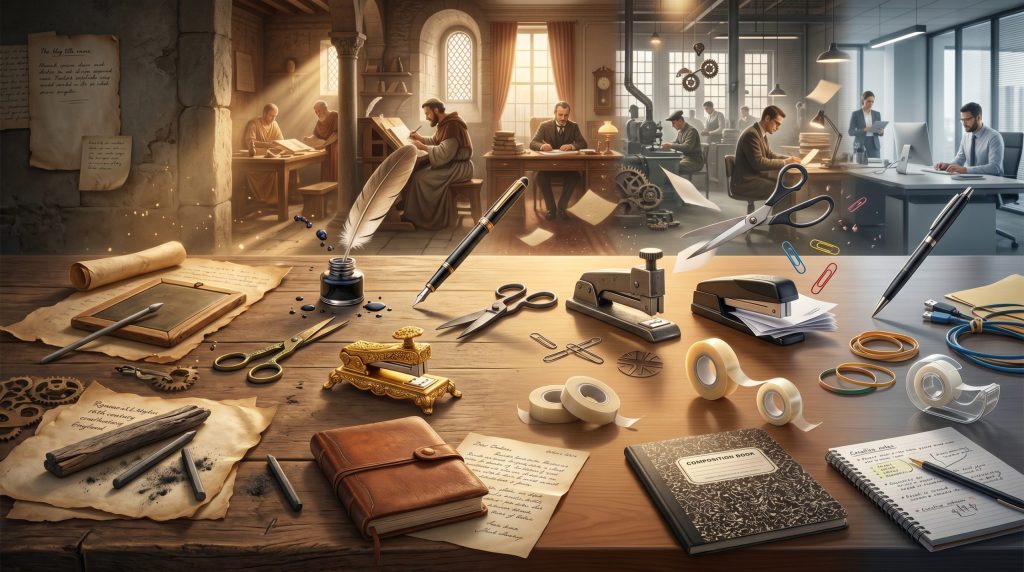
Have you ever paused mid-staple or while scribbling a note and wondered where these everyday tools came from? I mean, office supplies are so ubiquitous that we barely give them a second thought. They’re the unsung heroes of our desks, helping us organize chaos, jot down ideas, and keep things together—literally. But dive a little deeper, and you’ll find a treasure trove of forgotten history behind these common items. From ancient origins to quirky inventions born out of necessity, the story of office supplies is a fascinating blend of innovation, mishaps, and cultural shifts. In this article, we’ll peel back the layers on some of the most ordinary desk dwellers, like pencils, pens, paper clips, and more. You’ll discover surprising facts that might just make you appreciate that humble stapler a bit more next time you use it. Let’s embark on this journey through time, exploring how these tools evolved from rudimentary beginnings to the staples (pun intended) of modern work life.
The Humble Pencil: From Ancient Marks to Modern Graphite Wonders
Let’s start with the pencil, that trusty companion for doodles, lists, and everything in between. You might think pencils have always been around, but their history is richer than you imagine. Way back in ancient times—think Roman era—people used stylus-like tools made from lead to mark wax tablets. But the pencil as we know it didn’t emerge until the 16th century. It all began in 1564 when a massive graphite deposit was discovered in Borrowdale, England. Locals started using the soft, dark mineral to mark sheep, and soon, they wrapped it in string or sheepskin for easier handling. Can you picture shepherds jotting notes with raw graphite? It’s a far cry from the sharpened No. 2 pencils we sharpen today.
Fast forward to the 1790s, and the French Revolution threw a wrench in things. With graphite supplies cut off from England, Nicolas-Jacques Conté stepped up. As an inventor and officer in Napoleon’s army, Conté mixed powdered graphite with clay and baked it into rods—voilà, the modern pencil lead was born. This process allowed for varying hardness levels, from soft 6B for artists to hard 4H for precise drafting. It’s one of those forgotten innovations that revolutionized writing. Without Conté’s ingenuity, who knows how we’d be sketching ideas in meetings?
But here’s a quirky forgotten fact: The yellow pencil? That’s thanks to American manufacturers in the 19th century. They painted them yellow to evoke the high-quality graphite from China, where the color symbolized royalty. Brands like Dixon Ticonderoga capitalized on this, turning a simple tool into a status symbol. And that eraser on top? It wasn’t standard until 1858 when Hymen Lipman patented the idea of attaching one to the pencil end. Before that, people used bread crumbs to erase mistakes—talk about crumbly solutions!
Pencils have even played roles in history you might not expect. During World War II, British spies used hollow pencils to smuggle maps and messages. And in space? NASA spent millions developing a pen that writes in zero gravity, while the Soviets just used pencils. (Okay, that’s a myth—both used pencils initially, but it’s a fun tale that highlights their simplicity.) Today, with digital notes taking over, pencils remind us of tactile creativity. If you’re rediscovering analog tools, try a quality graphite pencil; it’s a small way to connect with centuries of innovation.
The Evolution of the Pen: From Feathers to Ballpoints and Beyond
Ah, the pen—mightier than the sword, or so they say. Its history is a saga of drips, blots, and breakthroughs. Long before ballpoints, quill pens ruled the roost. Made from bird feathers (goose were favorites for their durability), quills date back to the 6th century. Scribes sharpened the tips with knives, dipped them in ink, and wrote until the feather wore out. Imagine the frustration of constant trimming! Shakespeare himself penned his plays with quills, and the U.S. Constitution was signed with them. But quills were messy and short-lived, leading to the quest for something better.
Enter the steel nib pen in the early 19th century. Invented around 1822 by John Mitchell in Birmingham, England, these metal points attached to holders and dipped in inkwells. They were cheaper and more consistent, fueling the Industrial Revolution’s paperwork boom. But still, the dipping hassle persisted. The real game-changer came with the fountain pen. Lewis Waterman, an insurance salesman tired of leaky pens ruining contracts, patented a reliable version in 1884. His design used capillary action to feed ink steadily—no more blots on important docs!
Now, for the ballpoint pen, a true forgotten hero of office supplies. Hungarian journalist László Bíró fled Nazi-occupied Europe and, noticing newspaper ink dried fast, teamed up with his brother György to create a pen using similar viscous ink rolled by a tiny ball. Patented in 1938, it hit the market post-WWII. The British RAF loved them for writing at high altitudes without leaks. But early models were pricey—$12.50 in 1945, about $200 today! Marcel Bich (yes, of Bic fame) bought the patent, refined it, and made affordable disposables. By the 1960s, ballpoints were everywhere, outpacing fountains.
Forgotten tidbit: The space pen myth? Fisher Space Pen developed one that writes in zero-G, upside down, or underwater, but astronauts initially used pencils. NASA’s order of 400 pens at $2.39 each sparked outrage, but it’s a testament to pen evolution. Today, with gel and rollerballs, pens blend tradition and tech. I’ve switched to ergonomic ones for long writing sessions—they feel like an extension of my hand. If you’re a pen enthusiast, hunt for vintage fountains; they’re a nod to the craft’s artistry.
The Paper Clip: A Simple Twist with a Controversial Past
Who would’ve thought a bent wire could have such a storied history? The paper clip seems so basic, yet its origins are wrapped in myths and patents. Contrary to popular belief, Norwegian Johan Vaaler didn’t invent the modern paper clip. In 1899, he patented a rectangular version without the inner loop, but it never caught on. The real star is the Gem clip, that familiar oval-with-loops design, which appeared in Britain around 1890. William Middlebrook patented a machine to make them in 1899, but the clip itself wasn’t patented—it was already in use.
Paper clips exploded in popularity during the late 19th century’s office boom, as paperwork multiplied with typewriters and carbon copies. They were cheap, reusable, and better than pins, which damaged paper. But here’s the forgotten wartime lore: During WWII, Norwegians wore paper clips as a symbol of resistance against Nazi occupation, pinning them to lapels to show unity. It stemmed from the Vaaler myth, amplified for national pride. Post-war, paper clips became office essentials, with billions produced yearly.
Evolution-wise, we’ve seen jumbo sizes, colored plastics, and even shaped ones (hearts, animals). But the core design endures. I once used a giant paper clip as a bookmark—versatile little things! Forgotten fact: In 1998, Kyle MacDonald famously traded a red paper clip up to a house through a series of barters, proving their unexpected value. If your desk is cluttered, a box of these can tame the mess without fanfare.
Staplers: Binding the World One Click at a Time
Staplers might seem mundane, but their history is full of royal intrigue and industrial grit. The first known stapler was crafted in the 18th century for King Louis XV of France. Made of gold and encrusted with jewels, it fastened papers with custom staples embossed with the royal insignia. Talk about luxury office supplies! But it wasn’t practical for the masses.
The modern stapler emerged in the 1860s. George McGill patented the first staple press in 1866, which inserted brass fasteners. By 1879, he had a machine that bent wire into staples on the fly. Then came the Hotchkiss No. 1 in 1895, a Japanese import that popularized stapling. But the desktop model we know? Credit E.H. Hotchkiss Company, though the name “stapler” stuck from a brand.
Forgotten innovation: The stapleless stapler, using paper cuts to bind, harks back to eco-friendly roots. During WWII, metal shortages made staplers scarce, pushing alternatives. Today, electric and heavy-duty versions handle thick stacks, but the manual click is satisfying. I’ve stapled my way through reports, and nothing beats that “ka-chunk” sound. Pro tip: Load staples spine-first to avoid jams—a lesson from history’s trial and error.
Rubber Bands and Elastic Wonders
Rubber bands, those stretchy loops, have a bouncy history tied to natural resources. Charles Goodyear vulcanized rubber in 1839, making it durable, but rubber bands waited until 1845. Englishman Stephen Perry patented them for holding papers and envelopes. Made from sliced rubber tubes, they replaced string in offices.
Forgotten fact: In the 1920s, William Spencer invented a machine to mass-produce them from scrap rubber, turning waste into utility. During wars, rubber shortages led to synthetics. Today, they’re in crafts, slingshots, and even therapy tools. I keep a jar on my desk—they’re great for bundling cables or impromptu stress relief.
Scissors: Cutting Through Centuries
Scissors date to 1500 BCE in Egypt, as spring-loaded bronze tools. Pivoted versions appeared in Rome around 100 AD. The modern design, with finger holes, evolved in the 18th century. Office scissors, smaller and precise, aided in cutting paper trails.
Forgotten story: Left-handed scissors weren’t common until the 1960s, addressing a long-ignored need. From tailoring to offices, they’ve cut across industries.
Tape: Sticking It All Together
Adhesive tape started with surgical tape in 1845 by Horace Day. Scotch Tape, invented by Richard Drew at 3M in 1930, was for painters but became office gold. Dispensers followed in 1932.
Forgotten gem: During the Great Depression, it sealed bread wrappers, saving food. Now, from masking to duct, tape fixes everything.
Notebooks: Pages of Progress
Notebooks trace to ancient codices, but spiral-bound ones came in 1924 from Edward Podosek. Legal pads, yellow for visibility, debuted in 1888.
Forgotten: Thomas Holley’s idea from paper scraps birthed the legal pad.
The Digital Shift and Lasting Legacy
As offices go paperless, these supplies hold nostalgic value. Yet, hybrids like stylus pens bridge old and new.
In wrapping up, the forgotten history of common office supplies reveals human ingenuity at its best. From quills to clicks, they’ve shaped how we work. Next time you grab a pencil, think of those shepherds in Borrowdale. What’s your favorite office relic? Share in the comments—I’d love to hear!