


White Flowers
The church was full of white flowers and the kind of happiness that photographs well.
Peonies along every pew. Ribbon on the ends, ivory, tied by the florist at six that morning. The light through the stained glass landed warm and gold across the stone floor, and the organ had just finished, and four hundred guests were breathing that particular held breath — the one just before a bride appears.
Grace Ellison sat in the third row from the back. She had dressed carefully: her good navy coat, her mother’s pearl clip at the collar. She had sat in the third row because she could see everything from there and nobody would look at her. Housekeepers learn this. You find the angle where the room forgets you.
She had worked for the Whitmore family for twenty-two years. She had raised James Whitmore’s children when James Whitmore was too occupied to. She had packed school lunches and attended school plays and once, on a Tuesday in February, sat on a hospital floor with Thomas, the youngest, for six hours while they waited for results that turned out fine. She was not family. She had never been invited to pretend she was.
But she was here. She had been given a seat at the back and a printed order of service, and she was grateful, which was the posture she had kept for twenty-two years.
The bride appeared at the doors.
Elena. Twenty-eight years old, dark-haired, composed in the particular way of someone who learned composure early because it was required. Grace had known Elena since she was four. Had known, specifically, the sound Elena made when she cried — the small, held-back sound of a child who had been told not to bother anyone.
Grace looked at Elena now and felt the old familiar warmth. And beneath it, the thing she had been feeling for eleven months.
Dread.
Dr. Gerald Marsh was seated in the second pew on the left, white carnation in his lapel, expression serene. The Whitmore family physician for thirty-one years. Trusted completely. Spoken of at dinner parties with warm adjectives. He caught Grace’s eye for one moment across the aisle and gave her the small, polite nod he always gave her.
The node of a man who had never once considered her a threat.
Grace looked down at her handbag. Felt the folded document inside it.
Then the music began, and Elena walked forward, and the priest raised his hands, and everything was still and luminous and about to break.
What the Boiler Room Kept
Eleven months earlier, Grace had found the certificate by accident.
She had been cleaning the study in the Whitmore house — the third floor study, the one nobody used, the one that smelled of old paper and James Whitmore’s father’s tobacco. She cleaned it every six weeks. It was a formality; nobody worked there anymore.
The cabinet beside the window had a drawer that never opened cleanly. Grace had learned to lift and pull simultaneously. On a Tuesday in October she had lifted and pulled and the drawer had come out entirely, spilling its contents across the rug.
She had gathered the papers without reading them. That was the discipline of twenty-two years — you touched the family’s things only enough to do your job.
But one paper caught the light differently. Heavier stock. An official seal in the corner. And a name she recognised printed in the BIRTH PARENT field.
Not Elena’s mother.
A different name entirely.
Grace froze instantly. Because the name in that field was the name of the woman who had died in the Whitmore house fourteen years ago. The woman James Whitmore had told his children was a former colleague. The woman Grace had watched die slowly and without enough morphine while Gerald Marsh visited twice a week and signed forms and spoke to James in the corridor in a low, careful voice.
Grace had always understood, in the wordless way of someone who sees a family’s private hours, that something had been wrong about that death. She had never had a name for it.
Now she did.
She photographed the certificate on her phone with her hands shaking. She replaced the paper exactly as it had been. She replaced the drawer. She finished cleaning the study.
Then she sat in her car in the Whitmore driveway for twenty-three minutes with the engine off.
She had her own reason for not letting this go. Fourteen years ago she had tried, once, to tell James Whitmore that something felt wrong about the way the woman upstairs was being managed. She had used the words ‘I think you should ask someone else.’ James had looked at her with a kind of patient, exhausted contempt and said: ‘Gerald has been our doctor for seventeen years, Grace.’
She had gone back to her work. The woman had died six weeks later.
Grace had never forgiven herself for going back to her work.
She would not go back this time.
She had the image on her phone. But she needed the original — a photograph proved only that a document existed; the original carried the registrar’s seal, the ink, the physical chain of custody. She needed it before Elena’s wedding. Before Elena, who did not know her mother was not her mother, bound herself permanently to a family whose foundation was a thirty-year lie managed by a man who still received Christmas cards from everyone in that house.
She had eight months to get the original out of that drawer.
She took it on a Wednesday in June, wearing her ordinary navy cardigan, while Gerald Marsh was at his practice forty minutes away. She replaced it with a precise photocopy she had made at a library in a different borough.
The original went into the waterproof sleeve behind the boiler.
Elena’s wedding date was September the fourteenth.
The Worst Act
Three days before the wedding, Gerald Marsh came to the Whitmore house on a Thursday.
This was not unusual. He came most Thursdays. Ostensibly to check on James Whitmore’s blood pressure, which had been elevated since the spring. In practice, Grace had observed for years, to manage the information inside the family — to be present, to be visible, to be the trusted voice in the room when anything needed framing.
Grace was cleaning the hallway when he arrived. He did not look at her. He never looked at her for longer than courtesy required.
He went into James’s study. She heard the door close.
She kept cleaning.
Twenty minutes later, the door opened. Gerald came into the hallway with his bag and his carnation-wearing air of competent goodwill, and then he stopped. Because on the console table, where Grace had left it while she cleaned around it, was her handbag. And the flap was open. And the top of the waterproof sleeve was visible at the edge.
Grace had not left it there by accident. She had needed to know if he would recognise it.
He did.
She watched his hand move toward the bag. Watched him stop himself. Watched his face go through four expressions in under two seconds — reaching, stopping, composing, deciding — and then he looked up and found her watching him from the end of the hallway.
He smiled.
“You’ve been here a long time, Grace,” he said. His voice was warm. “James speaks very highly of you.” A pause. “You’re the help. This conversation isn’t for you.”
He said it the way he said everything — pleasantly, with the full assurance of a man who had never once been answered back by someone in her position.
Grace did not move. She held his gaze for exactly three seconds. Then she said, very quietly: “I know what you filed.”
The warmth left his face like a light going off.
He left without speaking again. She heard his car on the gravel.
She stood in the hallway alone and understood two things simultaneously: that he now knew she had it, and that he would be at that wedding on Saturday with every intention of getting it back.
She went to her car. She sat in the driver’s seat. She started the engine.
She could drive away. File the document with a solicitor by post, anonymous, let the legal process do what legal processes do — slowly, privately, without her standing in a church aisle in her good navy coat making herself into the story. She could let Elena’s wedding happen and deal with it afterward. There were arguments for this. Good ones.
She sat with the engine running for nine minutes.
Then she thought of the woman in the upstairs room fourteen years ago. The held-back morphine. The careful voice in the corridor.
She turned the engine off.
She went back inside.
The Certificate
Saturday arrived the way September arrives — clear and golden and indifferent to what people are carrying inside it.
Grace was in the church before anyone else except the florists. She watched it fill. She watched Gerald Marsh take his second-pew seat with the white carnation and the composed expression of a man who believed he had assessed the situation and found it manageable. He had looked for her when he sat down. Found her. Noted her position. Looked away.
She had watched him do exactly this calculation and felt something steady settle in her chest.
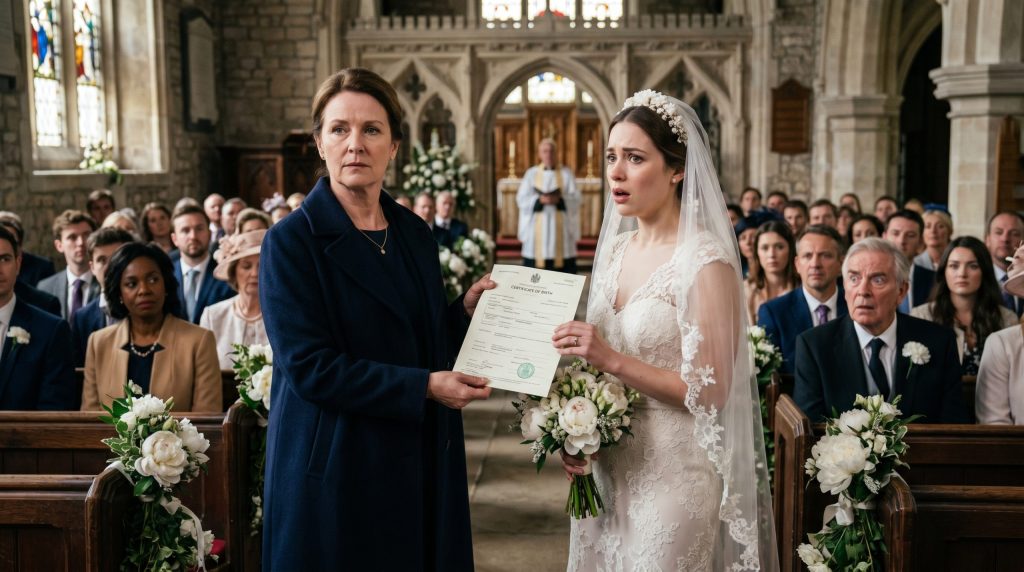
The ceremony began. The priest’s voice filled the stone interior, warm and unhurried. Elena stood at the altar in white with her hands clasped and her composure intact, the way it had been intact since she was four years old and learned it was safer that way.
The priest reached the vows.
And Grace stood up.
Not loudly. Not dramatically. She simply rose from the third-to-last pew and walked down the aisle toward the altar — the wrong direction, against the whole direction of the room — and the sound of her footsteps on stone cut through the ceremony with a soft, unstoppable clarity.
Four hundred heads turned.
Elena turned.
Gerald Marsh turned. And his hand, Grace noted with the calm of someone who had been watching this man’s hands for twenty-two years, moved involuntarily toward his breast pocket. A reaching gesture, barely begun. He stopped it. But not before the woman beside him saw it and leaned slightly away.
Grace reached the front of the church.
She took the document from the waterproof sleeve. Held it up — not to the crowd, to Elena. Face-forward. The registrar’s seal catching the gold light from the stained glass above.
Elena’s expression did not break. It changed the way a photograph changes when the light source shifts — same elements, entirely different meaning.
“This is your birth certificate,” Grace said. Quietly. Fully audible in the stone silence. “Your real one. It has your mother’s name on it. Her actual name.”
She looked at Gerald Marsh.
“He filed a replacement thirty years ago. I found the original in this family’s house.”
Gerald rose from the pew. His colour had gone in the manner of a man who has managed rooms for decades and has just discovered this is not that kind of room.
“You’re the help,” he said. “This conversation—”
“She kept every letter,” Grace said. Calm. Certain.
The room held completely still.
Because Grace had not said whose letters. She had not said what they proved. She had said it the way you say something that has already happened, and Gerald Marsh had gone pale before she finished the sentence — which told everyone present exactly what they needed to know about whose name was in those letters.
Elena reached for the certificate with both hands.
And the document had two signatures at the bottom. Elena studied them. Grace watched her face change again.
She had only shown Gerald the first name. She had not yet explained the second one. The second signature belonged to a practice administrator at a medical firm that had dissolved in 2019 — a firm Grace had not been able to trace, whose dissolution records listed a co-director whose name she did not recognise.
Someone else had known. Someone outside this family, outside this church, outside the careful warm world Gerald Marsh had built around his thirty-year secret.
That question would have to wait.
The Verdict
The priest did not resume the ceremony.
He stepped back from the altar and clasped his hands and said nothing — which was, Grace thought, exactly the right thing to do.
Elena read the certificate twice. She read it the way she did everything that mattered: carefully, without rush, the way she had learned to process difficult information in the silence of rooms where nobody had thought to prepare her.
Then she looked up at Gerald Marsh and said: “How long did my father know?”
Gerald said nothing. The silence went on long enough that it became its own answer.
James Whitmore, seated in the front pew, had not moved since Grace had stood up. He was looking at the floor. His hands were flat on his thighs. He did not look like a man who had been ambushed. He looked like a man who had been waiting, in some very tired part of himself, for a long time.
“He knew,” Grace said. She had not planned to say it. But Elena deserved that much.
Gerald Marsh attempted one more room. He turned to face the four hundred witnesses, the composed expression reassembled, and began — “This document is not—”
Grace said: “I have photographs of the original drawer. Dated. The cabinet it was kept in. And I have her letters — your patient’s letters, Dr. Marsh. The ones she wrote to Elena before she died, that were never given to her. All eleven of them.”
Elena’s breath caught once. One small audible catch, quickly contained.
Gerald Marsh sat down.
Not by choice — his knees made the decision before he did. He sat in the second pew in his white carnation and his managed expression and he looked like a man who had finally arrived at the end of a very long performance and found no audience left to perform for.
The Medical Council received a formal submission the following Monday, filed by a solicitor Elena retained that same afternoon. Gerald Marsh’s licence was suspended pending investigation within the week. James Whitmore gave a written statement that took him four hours and two solicitors to complete.
Elena did not speak to her father for six months. When she did, it was on her own terms, in a room of her choosing, without Gerald Marsh present or needed or considered.
Grace drove home on the Saturday evening in her good navy coat. She made tea. She sat at her kitchen table for a long time.
Elena called her at nine that night. She did not say very much. Neither did Grace. They had never needed much.
What Grace did not tell Elena — what she kept because it was not yet hers to give — was that the second signature on the birth certificate had sent her, quietly, to Companies House records three months later. The dissolved firm’s co-director had registered two other medical practices under different names. Both still trading. Both in different cities.
Gerald Marsh had not worked alone. He had never worked alone.
She wrote it down. Carefully. Filed it where she filed everything that mattered.
Behind the boiler. In the waterproof sleeve. Waiting.