


Floor Cleaner and Silence
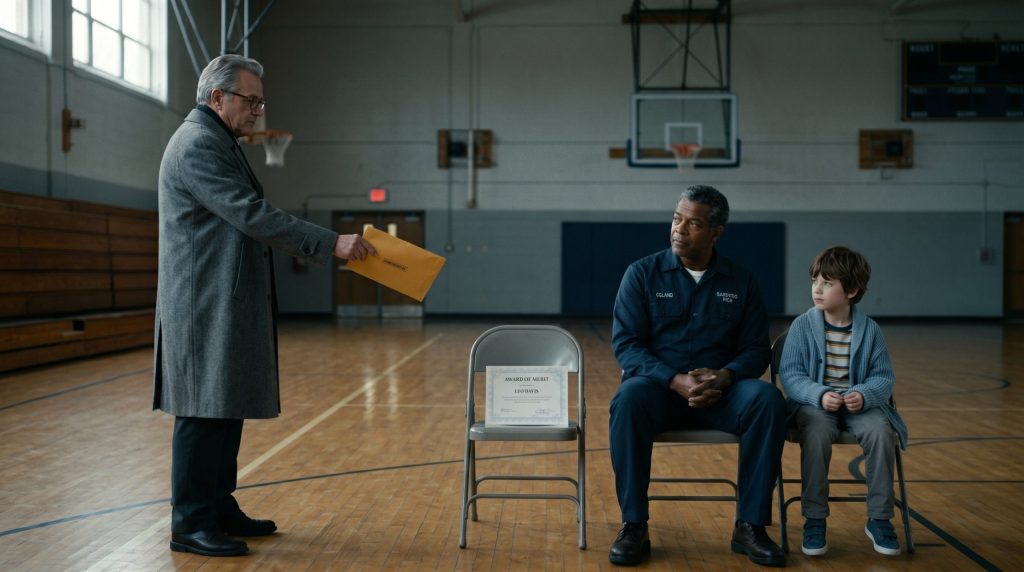
The school gymnasium smelled like floor cleaner and the particular silence of adults deciding something a child couldn’t change.
Parent after parent filed past the rows of plastic chairs, collecting their children’s trophies, exchanging the small pleasantries of people who would not remember each other’s names by morning. The overhead lights were too bright. They always were at Westfield Academy — the kind of institution that confused brightness with importance.
Martin had been mopping this floor for eleven years. He knew its every imperfection: the patch near the east wall that buckled in winter, the seam between the boards where the wax pooled wrong. He moved his cart along the edge of the room the way he always did at these events — visible enough to avoid, invisible enough to be ignored.
The awards ceremony had run long. Families were leaving in clusters, and near the far corridor door, a boy sat alone on the last chair in the last row. Seven years old, perhaps. Round face, wide dark-lashed eyes that held that specific kind of patience only children who have learned not to expect things carry with them. Pale blue cardigan slightly too large for his shoulders, fraying at the left cuff. He held a folded piece of paper flat against one knee with both hands, the way a person holds something they were specifically told to keep safe.
His name had been called twenty minutes ago. Martin had heard it. Nobody had come forward.
The boy had not moved. He was still waiting.
Martin recognized that waiting. Not the surface kind — not the waiting of a child who expected someone to arrive at any moment. The deep kind. The kind a child settles into when they have already understood, on some wordless level, that waiting might be all there is.
He steered his cart toward the wall. He told himself he was checking the wax line near the east panel. He was not checking the wax line near the east panel.
Then—
The gymnasium door at the far end opened. A woman in a cream coat stepped through. She scanned the room once, twice, the practiced scan of someone deciding whether a space was worth entering. Her eyes passed over the boy without slowing.
The Paper He Was Holding
The woman’s name, Martin would learn later, was Mrs. Harlow. She served on the school’s parent fundraising committee and had attended this ceremony for reasons unrelated to any child in the room. She was looking for the headmistress. She had a concern about the catering contract for the spring gala.
She found the headmistress near the trophy table. They spoke in the low, efficient register of people for whom time is a resource to be managed.
The boy watched them from his chair. His expression did not change.
Martin moved his cart another few feet along the wall. One of the overhead lights was flickering at the far end — he noted it, the way he noted everything in this building that needed attention. In eleven years, he had filed forty-three maintenance reports. Thirty-one had been actioned. The other twelve were still pending, which was the school’s way of saying they would not be actioned.
He was close enough now to see the folded paper more clearly.
It was a certificate. He could make out the gold border, the Westfield Academy crest at the top. The boy’s name was printed across the centre in the school’s formal typeface: Oliver Crane. Below the name, in smaller print: Outstanding Achievement in Mathematics — Year Two.
Oliver Crane was holding his own award. Had been holding it for the full duration of the ceremony, which meant someone had given it to him beforehand — a teacher, perhaps, hedging against the absence they had already anticipated.
Martin set the mop handle against his cart.
He had a specific memory he did not examine often. His own son, fourteen years ago, standing outside a school hall in a pressed shirt, holding a rolled certificate in both hands, waiting for Martin to arrive. Martin had been running late — a shift that ran over, a bus that didn’t come. He had arrived eleven minutes after the ceremony ended. His son had been sitting on the front steps. Still in the pressed shirt. Still holding the certificate. Not crying. Just waiting.
That was the memory. He did not examine it often because it did not require examination. It was simply there, the way certain things are simply there — facts about yourself that you carry without comment.
He walked toward the boy.
Not quickly. Not in a way that would alarm him. He walked the way he walked through every part of this building — as if he belonged to the floor, not to any particular destination on it.
“That seat taken?” Martin asked.
Oliver looked up. “No, sir.”
Martin sat. He left one chair between them, the way you do with children you don’t know, so the space doesn’t feel like a wall but doesn’t feel like a claim either.
“Good ceremony,” Martin said.
Oliver considered this. “It was quite long,” he said.
“It was,” Martin agreed.
They sat in silence for a moment. Not uncomfortable silence. The functional kind, between two people who have both been in this room long enough to have earned it.
“Is someone coming for you?” Martin asked.
Oliver looked at the door. “My mum said she’d try.”
Tried and failed — Martin heard it in the word. Tried was what people said when they already knew the answer but didn’t want the child to know it yet.
“She works evenings?” Martin asked.
“Thursdays and Fridays,” Oliver said. “And sometimes Tuesdays now.”
Martin nodded. He did not say anything else about it. There was nothing useful to say about it.
“That your certificate?” he asked instead.
Oliver looked down at the paper in his hands. “Miss Paterson gave it to me before. She said to keep it safe.”
“Mathematics,” Martin said. “Year Two. Outstanding Achievement.”
Oliver looked at him. “You can read it from there?”
“I’ve got good eyes,” Martin said. Which was true. Which was also not the point. “That’s a serious thing to earn. You know that?”
Oliver turned the certificate over once in his hands. “Dad said maths is what everything else is made of.”
Martin was quiet for a moment. “Your dad’s right.”
“He died last year,” Oliver said. Not dramatically. Just factually, in the way children report things that have become facts of their landscape — present-tense truths that no longer require softening.
The gymnasium was almost empty now. Two families remained near the trophy table. The headmistress and Mrs. Harlow had moved their conversation toward the exit corridor. The flickering light at the far end had stabilised briefly, then started again.
Martin did not move.
What Mrs. Harlow Saw
Mrs. Harlow noticed them on her way out.
She noticed them the way you notice something that is slightly wrong with a room — not wrong enough to stop for, but wrong enough to register. A school janitor, seated beside a child, in a gymnasium that was now almost cleared. She paused at the corridor entrance.
She had been at Westfield Academy long enough to know Martin’s face in the way that people know the faces of fixtures — the way you know the front desk, the photocopier, the particular squeak of the third stair. She did not know his name. She had never needed to.
She took one step back into the gymnasium.
“Excuse me,” she said. Her voice carried the particular precision of a woman who expected rooms to rearrange themselves in response to it. “Is this child waiting for collection?”
Martin looked up. “He is.”
“Has the school been notified?”
“I expect they’re aware,” Martin said. Which was not quite an answer.
“I’ll speak to reception,” she said, more to the room than to him. She looked at Oliver. “Someone will sort this out, sweetheart.”
Oliver nodded politely. He had the manner of a child who had been told many times that someone would sort things out.
Mrs. Harlow turned to leave. Then she stopped.
She stopped because Oliver, without looking up, said: “He’s been sitting with me for ages. He didn’t have to.”
The sentence was not directed at her. It was not directed at anyone. It was the kind of observation a child makes aloud when they are simply processing something true — the way you might note that a window is open, or that it has started to rain.
Pain. Recognition.
Mrs. Harlow stood in the doorway for three full seconds. Martin watched her. He watched the thing that happened to her face — not a dramatic thing, just a quiet one. The way a person looks when a small true sentence lands on a place they had not known was exposed.
She came back into the gymnasium.
She sat down. Not beside Martin. Not beside Oliver. One row forward, turned sideways, so she was facing them both. She placed her handbag on her knee.
“What’s your name?” she asked Oliver.
“Oliver Crane.”
“What have you got there, Oliver?”
He held up the certificate. She read it. She was quiet for a moment.
“Outstanding Achievement in Mathematics,” she said. “That’s impressive.”
“My dad said maths is what everything else is made of,” Oliver said again.
Mrs. Harlow looked at Martin.
Martin said nothing. He had learned, in eleven years of being invisible in rooms where important things happened, that the most useful thing a person can do is sometimes simply stay present and let the moment finish forming on its own.
“Is there a parent coming?” Mrs. Harlow asked him, quietly now.
“His mother works Thursdays,” Martin said. “She said she’d try.”
The gymnasium was silent now. The last family had gone. The trophy table stood empty. The flickering light had settled into its irregular rhythm — on, off, on, off — the way things do when they have been neglected long enough that they no longer bother performing reliability.
Mrs. Harlow reached into her handbag. She was looking for her phone, Martin assumed — to call someone, to escalate this, to activate the machinery of responsible adults that existed for exactly these situations.
But she set her phone on her knee and did not dial.
She was looking at Oliver’s certificate.
“My son won this same award,” she said. “Fourteen years ago. In this same gymnasium.”
Oliver looked at her with polite interest.
“I almost missed it,” she said. “I was late. A work thing.” She paused. “I’ve thought about that a lot.”
Martin watched her say it. He thought about his own son on the front steps. The pressed shirt. The rolled certificate. Eleven minutes.
Heartbeat pounding louder.
Some moments, he had come to understand, are not individual moments. They are the same moment, recurring, until somebody stays.
The Mop and the Medal
The school’s head receptionist, a brisk woman named Sandra whose lanyard read STAFF in block capitals, appeared in the gymnasium doorway at six forty-three.
She had been informed by a passing teacher that a child was still uncollected. She had her clipboard. She had the look of someone who managed situations like this with efficient compassion — the kind that is genuine but has also been systematised for speed.
“Oliver Crane?” she said.
“Yes,” Oliver said.
“We’ve reached your mum. She’s on her way — about twenty minutes.” Sandra looked at Martin with a professional nod that meant: you can leave now, we have it from here. Then she looked at Mrs. Harlow, whose presence required a different kind of accounting. “Mrs. Harlow — I didn’t realise you were still—”
“I’m fine here,” Mrs. Harlow said. Simply. Without elaboration.
Sandra processed this, nodded again, and withdrew. She left the door open, which was protocol for uncollected children — so the child was never alone with one adult in a closed room. Martin noted this and approved of it. Rules existed because history had demonstrated their necessity.
The three of them settled back into the particular quiet of people who have stopped needing to explain themselves to each other.
Oliver looked at Martin. “Do you like your job?” he asked.
This was the kind of question that a seven-year-old asks without any awareness that it has a difficult answer. Martin considered it as seriously as it deserved.
“I like this building,” he said. “I’ve known it a long time.”
“I like it too,” Oliver said. “Except the lunch hall smells.”
“That’s the drain under the serving counter,” Martin said. “I’ve reported it four times.”
“Does anyone fix it?”
“Not yet,” Martin said. “But I keep reporting it.”
Oliver considered this. “That’s good,” he said. “That you keep trying.”
Martin was quiet.
He had not thought about it in those terms before. He had thought about it in terms of the report forms, the maintenance queue, the particular institutional indifference that treated his observations as suggestions rather than facts. He had not thought about it as trying. He thought about it that way now.
Mrs. Harlow was watching them both with the expression of someone witnessing something they had not expected to need to witness.
“I want to do something,” she said. Abruptly. Not impulsively — it had the weight of a decision made, not an impulse spoken.
Martin looked at her.
“For Oliver,” she said. “Not — I don’t mean charity.” She stopped. Started again. “My husband runs the Harlow Foundation. We have a mathematics scholarship. For secondary school. It’s early — Oliver is years away from secondary — but there’s an associated primary programme. Tutoring. Academic support.”
She looked at Oliver. “It’s not a rescue,” she said, with a precision that suggested she understood the difference and wanted him to understand it too. “It’s a head start. Because you earned one.”
Oliver looked at his certificate. Then at Martin.
Martin gave him the small nod that means: it’s your call, I’m not going anywhere.
“Would my mum have to say yes?” Oliver asked.
“Yes,” Mrs. Harlow said. “It’s entirely up to her.”
“She’ll say yes,” Oliver said, with the quiet certainty of a child who knows his mother’s values even when her schedule makes them difficult to demonstrate. “She cares a lot about maths. She says it’s what everything—”
“Is made of,” Martin and Mrs. Harlow said, at the same time.
Oliver looked between them.
“Dad said it a lot,” he said.
Neither of them spoke. The flickering light at the far end of the gymnasium had stopped flickering. It held, steady and full, for the first time all evening. Martin noticed it. He did not mention it. Some things you let be what they are.
Still Waiting
Oliver’s mother arrived at seven o’clock exactly.
Her name was Clare Crane. She was a Black woman in her mid-thirties — still in her work uniform, a dark blue care assistant’s tunic with the name of the residential home embroidered on the chest pocket. She had run from the bus stop. Martin could tell by the slight breathlessness she was managing down as she came through the gymnasium door, and by the way she scanned the room with the specific terror of a parent who has made their child wait.
She saw Oliver and stopped.
He was still sitting in his chair. He was holding his certificate. He had, at some point in the last twenty minutes, allowed Martin to take the chair directly beside him rather than leaving the gap of one between them. He was telling Martin about a calculation he had done at lunch — how many tiles were in the gymnasium ceiling — and whether his estimate of four hundred and twelve was right or whether he needed to recount from the third row.
Clare Crane crossed the gymnasium floor in ten steps.
“I’m so sorry,” she said. “The shift ran — the bus—” She stopped. She looked at Martin. She looked at Mrs. Harlow. She looked at the fact of two adults sitting with her son as if time were not a concern.
“He wasn’t alone,” Martin said.
The words were simple. They were also the only thing she needed to hear. He watched them land.
“Thank you,” she said. Not the reflexive thank-you of someone moving through a moment. The full kind — the kind that means: you gave me something I cannot give back, and I know it.
She held Oliver for a moment. He let her, with the slightly performative patience of a seven-year-old who has decided he is too old for this but understands the circumstances require it.
“Mum,” he said, when she released him. “I won Outstanding Achievement in Mathematics.”
“I know, love. I know you did.”
“And Mrs. Harlow knows about a programme. For maths. She said you have to say yes.”
Clare looked at Mrs. Harlow.
Mrs. Harlow stood. She extended her hand. “Catherine Harlow. My husband chairs the Harlow Foundation. I’d like to speak to you about Oliver, if you have a few minutes.”
Clare Crane looked at her son. Oliver nodded, with the gravity of a child who has already conducted the due diligence and found it satisfactory.
“Yes,” Clare said. “I have a few minutes.”
Martin gathered his cart.
He had a drain report to file — the fourth one, technically the fifth if you counted the informal verbal mention he had made to the facilities coordinator in October, which nobody had written down and which therefore did not exist in any official sense. He would write it down tonight. He would keep reporting it until it was fixed, because that was what you did with things that needed fixing: you noted them, you documented them, you did not stop.
He was at the gymnasium door when Oliver called after him.
“Mr. Martin.”
He turned.
Oliver held up the certificate. “Four hundred and twelve,” he said. “Do you think I’m right?”
Martin looked up at the ceiling. He made a show of counting from the first row, moving his lips slightly. He looked back at Oliver.
“Four hundred and eleven,” he said. “There’s a replaced tile above the east wall. Different size. Throws the count.”
Oliver stared at him. “You actually know?”
“I know this building,” Martin said.
He left them there — Clare Crane and Mrs. Harlow exchanging numbers near the trophy table, Oliver tilting his head back to recount from the first row, certificate still held flat in both hands.
The corridor was quiet. The flickering light above the east panel had held steady all evening. Martin made a note to check the fitting in the morning — sometimes things settled on their own; sometimes they needed one last small adjustment to hold.
He had never told his son about the eleven minutes. His son was thirty-one now, an engineer in Edinburgh, and they spoke every other Sunday. Martin had not mentioned it because it did not seem like a story that needed telling. It seemed like a debt that could only be paid forward, not back.
He pushed his cart toward the service exit.
He would file the drain report when he got home. He would keep filing it until someone fixed it. That was what you did with things that mattered: you showed up, you stayed, you kept the record — not because anyone was watching, but because the work was real whether or not anyone saw it.
The gymnasium door swung shut behind him.
Oliver’s voice carried faintly through it, still counting tiles, starting again from row one.