


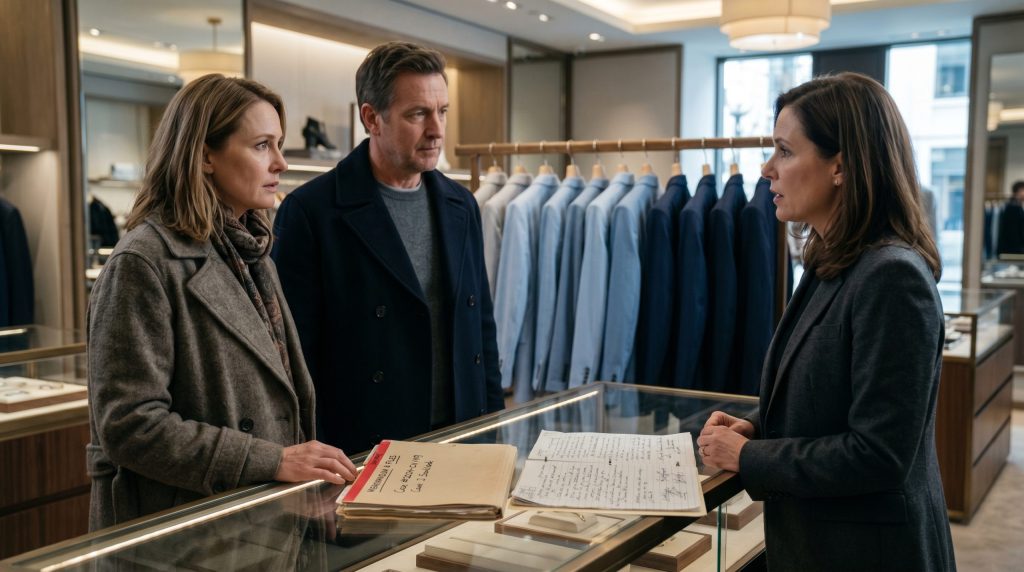
The Store That Decided Before You Spoke
The store was the kind of place that played soft music and charged for the quiet, and the staff had been trained to notice who didn’t belong.
Victoria Marsh had worked the floor for six years. She knew the architecture of the place — the way the light fell warmest near the cashmere wall, the way the mirrors were angled so that no customer ever caught a bad reflection of themselves. The store sold confidence as much as clothing, and the staff were its instruments.
She was folding a display of silk scarves when the woman came in.
The woman was perhaps sixty, wearing a wool coat that had seen better winters. Her shoes were sensible and scuffed. She carried a canvas bag over one shoulder and moved through the entrance the way people move when they already expect to be asked to leave — shoulders angled slightly inward, eyes tracking the staff before the merchandise.
A second woman followed immediately behind her. Different. Fitted charcoal blazer. Structured bag. The kind of unhurried walk that assumed the room would wait.
Victoria moved toward the second woman without making a decision about it.
Then—
The woman in the wool coat stopped in front of the central display and reached toward a jacket on the rail. Just to touch it. Just to see.
“I’m sorry.” Victoria was there before she’d registered walking. Her voice was bright, helpful, the wrong kind. “Are you looking for something in particular? Or — ” a pause shaped like a door closing ” — are you perhaps waiting for someone?”
The woman in the wool coat looked at her. Her eyes were very calm.
“I’m shopping,” she said.
Victoria smiled the smile that wasn’t one. “Of course. It’s just that some of our pieces start at — ”
“Eleanor.” The second woman’s voice came from across the floor, low and certain. “Come and look at this one.”
Victoria turned. The second woman — the one in the charcoal blazer — had not moved toward them. She was standing at the far rail, her back deliberately to the interaction, giving Eleanor Marsh time to be seen without an audience.
Victoria’s smile held. Her neck was warm.
In the far corner of the store, half-hidden behind a rack of winter coats, an old man sat on the single public bench. He had been there when the store opened. The staff had assumed he was waiting for a wife. He was not looking at the merchandise. He had not been looking at the merchandise for forty minutes.
He was watching Eleanor Marsh.
And something in his face, hidden at that distance, had just gone very still.
Eleanor reached into her canvas bag. Her hand closed around something inside it — something she did not take out. Not yet.
She stepped toward the jacket on the rail again.
The camera on the ceiling caught the whole thing. Nobody was watching the camera.
The Folder That Was Never Supposed to Surface
The second woman’s name was Claire Adeyemi. She was a housing advocate, and she had driven Eleanor Marsh to this particular store on this particular Tuesday because Eleanor had asked her to, and Eleanor never asked for things.
Claire had known Eleanor for three years — since the support group that met in the church hall on Wednesdays, since the evening Eleanor had sat down beside her with a cup of tea and said, very quietly: “I need to understand what happened to my daughter. I need someone to help me understand that.”
Claire had started as a listener. She had graduated into a researcher. Over fourteen months, they had assembled a folder together — tab by red tab — that told a story so methodical in its cruelty that Claire had stopped being surprised by anything inside it.
Eleanor kept the folder in her canvas bag. She carried it everywhere now. Not because she expected to need it — because the carrying of it was the only thing that felt like forward motion.
The jacket on the rail was pale blue. A good pale blue, the kind that looks like early morning. Eleanor did not want to buy it. She wanted to hold it for a moment and pretend she was a woman who could.
She felt the social worker before she saw her.
Diane Rowland had not changed much in twenty years. Heavier at the jaw. Shorter hair. But the walk was the same — the particular confidence of someone who had spent decades making decisions about other people’s children and had never once been asked to explain one.
She was crossing the floor from the staff corridor, not in uniform, clearly not working here — just cutting through. A shortcut she’d used before. A store she was comfortable in.
Eleanor’s hand tightened around the folder inside her bag.
She had not planned for this. She had planned for a court date, three weeks away. She had planned for a solicitor’s office, a conference room, a process.
This was a Tuesday afternoon in a clothing store.
Diane Rowland stopped walking.
Because Eleanor Marsh was standing five feet away from her, and Eleanor Marsh was looking directly at her, and Eleanor Marsh was not the kind of woman Diane had ever expected to see again.
“Mrs. Marsh,” Diane said. The voice was controlled. The eyes were not.
Her hand moved, involuntary, to the strap of her own bag — the grip of someone steadying themselves before they knew they needed to.
Eleanor said nothing.
In the far corner, the old man on the bench rose, slowly, to his feet.
What Diane Rowland Had Done and Called Due Process
The folder had twelve pages. Eleanor knew them by heart.
Page one: the placement order dated March 1999. Her daughter Grace, aged four, removed from Eleanor’s care following a report filed by Diane Rowland citing evidence of domestic instability. The report named a hazard that had been remediated six weeks prior. Eleanor had the inspection certificate. It had not been included in the file.
Page four: the receiving family. A couple in a different county, vetted by the same office Diane Rowland supervised. Their license had lapsed the following year. The vetting oversight that had allowed the placement had never been formally reviewed.
Page seven: Eleanor’s three appeals. Each returned with a form response. The third bore a handwritten note in the margin — not Diane’s handwriting, someone else’s, never identified: *This one won’t persist.*
Page eleven: a letter sent by Grace herself, aged sixteen, to the authority that had placed her. It had been received. It had been logged. It had been filed under a category that ensured it would never reach Eleanor.
Page twelve: a second signature on the original placement order. Not Diane Rowland’s. A name Eleanor had only found eight months ago, belonging to a consultancy firm that had held a contract with the county authority from 1997 to 2003 — a firm whose dissolution papers listed Diane Rowland as a secondary director.
Eleanor had taken the folder to the court listing office three weeks ago. The hearing date was set. The file was lodged.
What she had not planned was this — Diane Rowland, here, now, in a store that smelled of cedar and expensive light, watching Eleanor with the eyes of someone calculating distance.
“You shouldn’t be here,” Diane said. Not loud. The voice of someone used to rooms obeying them. “Whatever you think you have — ”
Eleanor opened her bag.
Diane took one step forward, arm half-extending — the instinct to intercept, the muscle memory of twenty years of taking things from mothers.
She stopped herself. Because Claire Adeyemi had moved without hurry into the space between them. And because the old man from the bench had walked to within ten feet and was simply standing there, still, in the way that very old or very certain people sometimes stand.
Eleanor set the folder on the display counter.
Diane Rowland answered too quickly: “That’s not — those are not complete records.”
She had not been told what was in the folder. She had named its incompleteness before she had been shown a single page.
The room noticed.
Victoria, behind the counter, had stopped pretending to fold scarves.
Eleanor looked at Diane Rowland and said, very quietly: “Page twelve.”
That night, Eleanor sat in Claire’s car in the car park for twenty-two minutes with the engine running. She had the hearing date. She had the solicitor. She had everything she needed. She reached for the gear shift three separate times.
Each time, she thought of the letter on page eleven. Grace’s handwriting, sixteen years old, asking a filing office if anyone had told her mother she had written.
She turned the engine off.
The Man at the Back of the Room
His name was Thomas Calloway.
Forty-one years on the bench. Retired eighteen months. He had walked into this store today because his daughter had asked him to meet her here — a different daughter, his youngest, who wanted his opinion on a coat for her mother’s birthday. He had arrived early, as he always arrived early, and he had sat on the bench in the corner, and he had been waiting.
And then Eleanor Marsh had walked through the door.
He had not seen Eleanor Marsh in twenty-three years. The last time he had seen her, she had been thirty-seven, sitting across from him in a family court anteroom, waiting for a hearing that would never happen because the case had been administratively rerouted — a rerouting he had been asked to approve, as a senior family judge, by the authority handling the placement.
He had approved it. He had not read the full file. He had been given a summary. He had trusted the summary.
He had thought about Eleanor Marsh perhaps forty times in twenty-three years. He had never found a mechanism for that thought that wasn’t self-exculpation.
He understood, watching her now from the corner, that there was no mechanism. There had never been one.
Eleanor had opened the folder. Diane Rowland had answered too quickly, and the room had rearranged itself around that answer. Claire Adeyemi stood with the quiet competence of someone who had been waiting a long time for exactly this Tuesday.
Thomas Calloway stood.
His knees were not what they had been. He made the ten feet in the deliberate way of a man who has decided something and is no longer in any hurry about it.
Diane Rowland saw him. Her colour drained — not slowly, the way it happens in fiction — instantly, the way it happens when a body recognises before the mind does.
“Your Honour — ” she started.
“You were never on that case legitimately,” Thomas said. His voice was the voice he had used for four decades when verdicts were final. “You were always the mechanism. I was told you were the caseworker. I was not told you had a financial interest in the placement contract.”
He reached into the inside pocket of his coat and set a single document on the counter beside Eleanor’s folder.
An internal court memorandum, dated June 1999. Routed to him. His own signature at the bottom, authorising the administrative reroute — and beside it, in the margin, in handwriting he recognised now as Diane Rowland’s: *Confirmed. CR will hold.*
*CR.* Two initials. Not Diane Rowland’s. Not Thomas Calloway’s. Someone else, who had been involved in whatever this was, whose name had never appeared in Eleanor’s file.
Diane’s grip on her bag strap went completely slack.
“Who is CR?” Eleanor asked.
Diane Rowland did not answer. Because she was looking at the document, and the document had her handwriting on it, and there was nothing left to calculate.
Victoria, behind the counter, had her phone out. She was not sure when that had happened.
What He Owed and What He Said
The store manager arrived and then retreated. The soft music looped on.
Diane Rowland was sitting on the single public bench now — the bench Thomas had vacated — because her legs had made the decision for her. She was not handcuffed. She was not under arrest. She was simply, for the first time in twenty years, in a room where every person present knew exactly what she had done and called it due process.
Claire Adeyemi had called the solicitor. The solicitor had called the regulatory authority. The hearing was still three weeks away, but the folder was lodged and the memorandum — Thomas Calloway’s memorandum, with Diane Rowland’s margin annotation and two initials that belonged to nobody yet identified — was now photographed on four separate phones and emailed to two separate offices.
The store’s pale blue jacket was still on the rail. Nobody had moved it.
Thomas stood with Eleanor at the counter. Not beside her in the way of allies — beside her in the way of someone who is not sure they have the right to stand there, but has decided that standing elsewhere would be worse.
“She’s in Bristol,” he said. “Grace. I looked, after I retired. I didn’t have the right to contact her. I know that.”
Eleanor was quiet for a moment. The canvas bag hung from her shoulder, the folder no longer inside it.
“She knows I looked for her,” Eleanor said. “She’s known for two years. She was waiting for me to find what I needed to find first.”
Thomas nodded. He did not trust his voice for anything more complex.
“The second signature on the placement order,” Eleanor said. “Page twelve. The consultancy firm. You don’t know who CR is.”
It was not a question.
“No,” Thomas said. “I don’t. But whoever they are, they held that contract for six years. There were other cases.”
Eleanor looked at him for a long moment.
“She kept every letter,” Eleanor said. This was the thing she had held longest, through every year of silence — the knowledge that Grace had written, that Grace had asked, that Grace had not forgotten. The filing office had buried the letters. But Grace had kept the copies. Every one.
Diane Rowland, on the bench, was looking at the floor. She had not spoken since Thomas had placed the memorandum on the counter. Her composure had not broken loudly — it had simply emptied, the way a room empties when everyone leaves through different doors.
The regulatory officer arrived twenty minutes later. The conversation that followed was formal and careful and, for Diane Rowland, final.
Eleanor left with Claire. In the car, she put the now-empty canvas bag on the back seat and sat with her hands in her lap for a moment.
“Do you want to call her?” Claire asked.
“Yes,” Eleanor said. “But I think I’ll write first. She likes letters.”
Thomas Calloway walked out of the store alone. He did not stay for what came after. He had not earned that.
On his way to his car, he passed the rail of pale blue jackets. He stopped. He took out his phone and sent a message to his youngest daughter: *Still here. Buy the blue one. Your mother will love it.*
The document with CR’s initials was in the hands of three investigators by evening. The consultancy firm had dissolved in 2003. Its records had been partially destroyed. But dissolution papers leave traces, and traces leave names — and somewhere in a registry office in the county, the full list of directors was still on file.
Nobody had looked at that list yet. Nobody outside the investigation knew what name was on it.
Not yet.