


One Light on a Dead Highway
The private hospital was too quiet for a building full of people trying not to die.
Room 14 had been that way for eleven days. The monitors beeped at intervals. The blinds stayed half-closed. A woman named Dorothea Vane sat in a chair by the window with her ankles crossed and her hands folded in her lap, the way a person sits when they have arranged their face into patience they do not feel.
She was not the patient. She was the wife — or rather, the first wife. The one who had been replaced and never forgot it.
The patient in the bed was Thomas Harlow. Fifty-one. Shipping magnate. The kind of man whose name appeared on buildings other people cleaned. He had collapsed four days after a routine board meeting and had not been conscious since.
Dorothea had arrived on day two. Nobody had asked her to. Nobody had told her to leave.
The real family — Thomas’s second family, the one he’d built with a woman named Claire — had stopped coming. Claire herself had not appeared since day four, which Dorothea found quietly satisfying in a way she did not examine too closely.
The only regular visitor was a young man named Nathan, Thomas’s legal aide, who came each evening with a folder and left looking troubled.
What Dorothea did not know — what nobody in that building yet understood — was that somewhere on a deserted stretch of highway outside the city, a man with no wallet, no phone, and no name on any visitor’s list was pumping petrol into a rusted pickup truck he did not own.
His name was Daniel Harlow. He was Thomas’s younger brother. And he had been missing for twenty-six years.
She recognised the case number on Nathan’s folder on day eight. She had seen that number before — she had filed it herself, as a paralegal, in a different city, under a different name, the year Thomas and Daniel’s mother had died and something in the estate had gone very wrong.
She said nothing. Not yet.
Then — on day nine — a call came through on the ward’s front desk. A highway patrol officer in a flat voice asking whether a Thomas Harlow was registered at this facility. They had found someone at a petrol station on the outer bypass. No identification. But the man had given this hospital’s name. And he had given one other piece of information.
He said he had a photograph.
The Photograph in the Plastic Sleeve
The highway was exactly the kind of road that appears on no one’s route unless something has gone wrong.
One fluorescent light over the pump island. A kiosk with a handwritten CASH ONLY sign. The convoy had stopped because the lead vehicle’s fuel warning light had been on for forty minutes and the driver had run out of options.
There were six of them in total — Nathan among them, returning from a site inspection at the port. When the convoy pulled in, the man was already there.
He was standing beside the second pump, not using it. Just standing. Watching the highway in the direction they had come from, as though he had been expecting exactly this.
He was White, mid-forties, lean from hunger rather than exercise. Jeans worn to thread at the knee. Boots whose soles had separated at the toe on the left foot. A canvas jacket with a collar so frayed it had given up its original shape. He carried nothing except a plastic sleeve — the kind pharmacies use for prescription inserts — held flat against his ribs with one hand.
Nathan got out first. He was twenty-nine and professionally cautious and he would say later that the man had not looked dangerous. He had looked like someone conserving energy for something important.
— You need help? Nathan said.
The man turned. His eyes were calm in a way that had nothing to do with peace and everything to do with having already decided something.
— I need to get to Harlow, he said. Thomas Harlow.
Nathan froze instantly. Because that was not a name you found on a highway at midnight unless you already knew exactly where you were going.
The man did not elaborate. He simply held the plastic sleeve out — not aggressively, the way a person holds out something they have protected for a long time and are only now ready to give.
Through the clouded plastic, in the single overhead light, something was just visible. A photograph. Old. The corner water-damaged. Two boys standing in front of a house. One of them was unmistakably a younger Thomas Harlow.
The other boy was this man.
Nathan took the sleeve carefully. He did not open it. He looked at the man for a long moment.
Then at the photograph.
Then back.
— Get in, Nathan said.
In the back of the convoy vehicle, the man sat with his hands on his knees and said almost nothing for forty minutes. He did not ask how Thomas was. He asked only one question, in a voice that had clearly been rehearsed across many long empty miles.
— Is she still there? The first wife?
Nathan said yes.
The man closed his eyes. He did not look afraid. He looked like someone who had already calculated the cost and paid it in advance.
What She Did to the Filing
Dorothea Vane had spent twenty-six years building a particular kind of safety.
Not the kind that shows. Not the dramatic kind. The quiet administrative kind — the kind you construct one document at a time, one phone call at a time, across two decades of careful, invisible work.
When Thomas and Daniel’s mother had died, the estate had included a provision. A handwritten letter, witnessed, naming both sons equally. Thomas had been twenty-five and established. Daniel had been twenty-two and difficult — loud, unpredictable, the kind of young man who asks questions in rooms where questions are not welcome.
Dorothea had been twenty-eight and working as a paralegal in the firm handling the estate. She had not yet married Thomas. She was about to.
She had looked at that provision letter and understood immediately what it meant for her future if Daniel remained in it.
So she had done something small. Administratively invisible. She had rerouted one filing. Changed one reference number. The provision had been logged against a case file that was already closing — a clerical redirection, easily blamed on system error, impossible to trace unless you knew exactly what you were looking for and exactly where to look.
Daniel had received nothing. He had contested it. He had been told there was no provision. He had eventually stopped contesting and disappeared, which was what Dorothea had predicted and quietly counted on.
She had married Thomas six months later.
Thomas had never known. Or — she had believed he had never known.
The folder Nathan carried each evening, she now understood, was not legal correspondence. It was a reconstruction. Someone had been rebuilding the filing chain. Someone had found the redirection.
She needed to see that folder before Daniel Harlow walked through the door of Room 14.
She asked Nathan for it on the morning of day ten. He said it wasn’t his to share. She increased her register slightly — the professional authority of a woman who had spent decades in rooms with lawyers — and said she was Thomas’s legal next of kin.
Nathan said, without any particular emphasis: — He has a brother.
She answered too quickly.
— Daniel is not a legal party to anything in that folder.
Nathan had not said Daniel’s name.
The silence that followed lasted four seconds. It was the longest silence of Dorothea’s life.
In the car park afterwards, she sat with the engine running for nine minutes. She had her phone in her hand. She had started a message to her solicitor three times. Each time she deleted it before sending.
She thought about the case number she had recognised on day eight. She thought about how long the chain was. She thought about whether it could still hold.
She turned the engine off. Walked back inside. Sat back in the chair by Thomas’s window with her ankles crossed and her hands folded and waited.
The Pump, the Photograph, the Room
Daniel arrived at the hospital at 11:14 in the morning.
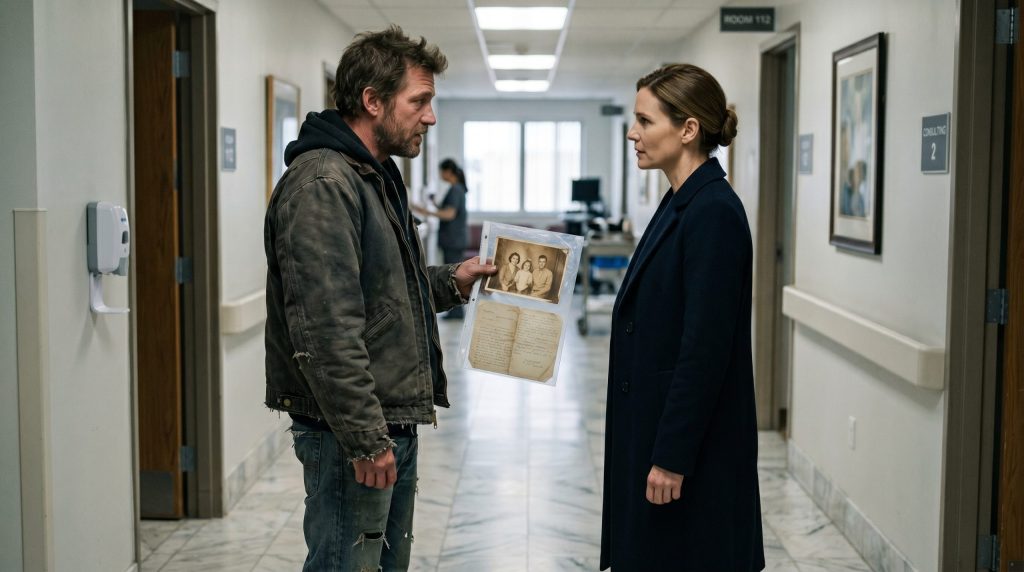
He had been given a room to wash in. Someone had found him a clean shirt. He still wore the boots with the separated sole — there had been no time for anything else — and he walked through the private hospital corridor the way he had stood at that highway pump: without apology, without performance, as though the marble floor and the hushed lighting were simply a surface that happened to be under his feet.
Nathan walked beside him. The plastic sleeve was in Nathan’s inside jacket pocket.
Dorothea was in the corridor outside Room 14 when they appeared at the far end of the hall.
She saw Daniel before he saw her. She had twenty years of practice reading the body language of incoming threat, and her first response was exactly what Nathan had noticed in the car park — she answered the situation before she had been asked a question. She stepped into the centre of the corridor. Arms slightly away from her sides. A woman occupying space she did not technically own.
— This is a restricted ward, she said. Visitors must be registered.
Daniel stopped six feet away. His eyes moved from her face to the room number behind her and back. He was calm. The kind of calm that precedes a decision already made.
— You were never family to him, Dorothea said. Her voice was level, corrective, the voice of historical record. — You were always the complication he outgrew.
The ward was not empty. A nurse stood at the station ten feet away. Two other visitors had paused at the end of the corridor.
Nobody moved.
Daniel looked at her for a long moment. Then he said, quietly: — She kept the copy.
Dorothea’s expression did not change. But her right hand — the hand nearest the wall — reached out and touched the surface. One small, involuntary contact. As though the building had tilted.
Nathan produced the plastic sleeve from his jacket pocket. He held it out.
Inside: the original photograph. And behind it — folded into the same sleeve — a document. Two pages. The provision letter, original, with the registrar’s seal still intact. And behind that: a scanned copy of the routing redirection. Timestamped. With a reference number that led back to a firm that had dissolved in the same year Dorothea had married Thomas.
The firm had two co-directors. One of them was Dorothea.
The other signature belonged to a name nobody in that corridor had spoken yet. Not Nathan. Not Daniel. Not the nurse who had stopped pretending to work and was watching with her hands still on her keyboard.
Daniel held the sleeve up. Not aggressively. The same way he had held it at the pump island — the way you hold something you have protected across twenty-six years of nothing.
— She knew before she died, he said. She left a copy with someone who wasn’t part of the firm.
Dorothea stepped backward. One involuntary step. Her heel contacted the wall behind her.
— Who? she said.
Daniel looked at her steadily.
— Read the third page.
What the Third Page Said
Thomas Harlow opened his eyes on day eleven at 7:42 in the morning.
The first person he saw was his brother.
He did not speak immediately. He looked at Daniel for a long time with the expression of a man reassembling a room he thought had burned down. Then, in a voice rough from eleven days of silence:
— You look terrible.
Daniel said: — You look worse.
They sat in Room 14 for two hours before anyone else came in.
The third page of the document Nathan had carried was not a legal filing. It was a letter. Handwritten. Three paragraphs, in the same hand as the original provision — their mother’s. Dated four months before she died, given to a woman named Margaret Solis, who had been the family’s housekeeper for thirty years and had kept it, sealed, in a waterproof envelope in a deposit box with a standing instruction: if Daniel Harlow ever reappears, give this to the firm’s opposing counsel.
Margaret had not known Daniel had reappeared. But she had seen the reconstruction filing Nathan was building — her solicitor had contacted her when the reference chain was matched — and she had handed it over three weeks before the convoy stopped at the highway pump.
The letter named what had been redirected. It named the case number. And in its final paragraph, in language that was quiet and specific and devastating in the way that only a mother’s written voice can be, it named the person she believed had done it.
Dorothea Vane was escorted from the hospital by Nathan and a senior partner from Thomas’s current firm at 9:15 that morning. She did not raise her voice. She walked to the car with her ankles together and her coat straight and her handbag on her arm, and the only outward evidence that anything had changed was that she did not look back.
The estate provision was reinstated through an emergency application submitted the same afternoon. Daniel Harlow was named as co-beneficiary of his mother’s estate, twenty-six years late, with interest calculated from the date of original filing.
Thomas signed the confirmation from his hospital bed. His hand was unsteady. The signature looked like it had been written by a different man than the one on the buildings outside.
Daniel stayed in the city. He took a room in a guesthouse three streets from the hospital and visited every day until Thomas was discharged.
The second co-director of the dissolved firm — the other signature on the routing redirection — was identified during the investigation. The name had appeared on one other document: a letter of engagement for the original estate filing, signed before Dorothea had joined the firm, by someone who had left legal practice entirely and was now living under a different professional registration.
Who had hired that person. And why. And what else they had touched in the years between.
Nobody outside the investigation knew yet. Nobody at all.