


The House That Had a Name
The mansion was the kind of house that had a name, and the people inside it had never questioned whether they deserved to be there.
Aldren Court had stood at the end of a private road in Connecticut for a hundred and twelve years. In November it showed its age honestly: the lime trees stripped bare, the gravel raked to a pale silver, the east wing’s windows reflecting the last hour of afternoon light without warmth. Inside, the charity gala for the Margaret Voss Foundation filled every ground-floor room with champagne and good intentions and the careful noise of people who had come to be seen giving.
Thomas Aldren arrived at seven forty-five. He came alone. He always came alone now.
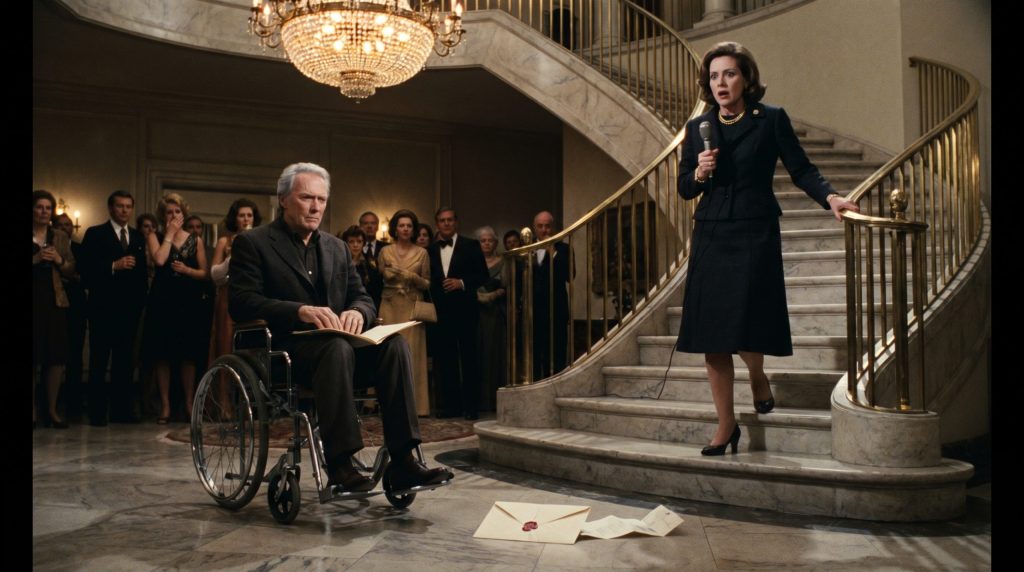
The chair was a manual one — he had refused the electric after the second surgery, some stubbornness he couldn’t fully explain — and the marble foyer gave him more resistance than he preferred. He didn’t ask for help. The room parted for him the way rooms do when they are not sure whether a person deserves acknowledgement or pity, and he had long since stopped being able to tell the difference.
He had helped found the Margaret Voss Foundation four years ago. He had funded every gala. He had written every cheque that kept the charity’s residential programme running. His name appeared on nothing — he had insisted on that. Margaret had always said that credit was the thing you gave away if you actually believed in something.
He believed in it. He had believed in her first, and then in this.
Claire Voss was already at the top of the staircase when he entered. She was Margaret’s older sister by six years, and she wore her grief the way she wore everything: with precision. Dark dress, simple gold at the throat, hair set to a standard that required maintenance he knew she undertook seriously. She had been the foundation’s public chair since the second year. She was very good at it.
“Thomas.” She came down three steps. Not all the way. “We weren’t certain you were coming.”
“I come every year,” he said.
“Of course.” The smile held. “Let me find someone to help you circulate.”
He didn’t need to circulate. He had come for one reason and she knew it, and the knowing of it was the thing neither of them would name yet.
He noticed, crossing toward the east drawing room, that his own photograph had been moved. It had hung beside Margaret’s portrait for three years — a photograph taken the summer before her diagnosis, both of them at the garden table, laughing at something he couldn’t remember. It was gone. In its place: a framed programme from last year’s gala.
Thomas froze.
Because the wall hadn’t been redecorated. Only the photograph had been removed.
What the Charity Was Built On
He had been a structural engineer before the convoy. Before Helmand. Before the thing that took the use of his legs and the hearing in his left ear and, for a long time, his ability to be in large rooms without watching every door.
The tribunal had taken six months. He had sat through every session without speaking — not because he had nothing to say, but because Margaret had told him once that the most powerful thing a person could do in a room that wanted to break them was simply to remain. She had been talking about her own cancer diagnosis at the time. He had applied the principle elsewhere.
He had survived the tribunal. He had come home to Margaret, and then Margaret had got sick, and then she had died, and then he had built something in her name because it was the only way he knew to continue the conversation.
He had not questioned Claire’s involvement. He recognised that now. She had been grieving. She had been capable. She had been present in a way that felt like loyalty, and he had confused presence with intention because he had been too tired and too broken to ask the harder question.
The envelope had arrived three weeks ago. It had been sent from Margaret’s solicitor — a firm in Edinburgh, retained separately from the estate, one Thomas had not known existed. Inside: a letter in Margaret’s handwriting, dated eighteen months before her death. And behind the letter, folded once, sealed with a wax stamp that bore Margaret’s initials: a second document.
He had read the letter four times. He had not yet opened the sealed document. Margaret had instructed him not to until he was in the room.
This room.
This gala.
In front of the people who needed to hear it.
He kept the envelope in his lap, beneath the folded programme he had picked up from the entry table. The wax seal was intact. He could feel the edge of it through the paper — the slight raised disc, the pressed initial, M.
⚡ CLOSE-UP — on the envelope resting in his lap, the wax seal catching the chandelier light. One crack running through the M, barely visible. It had been pressed hard, once, and held.
A woman beside him — mid-forties, a foundation board member named Grace Hollis — leaned down and said something about the residential programme’s expansion plans. He answered her without looking away from the stairs.
Claire was watching him from the first-floor landing. She had been watching him since he arrived.
He didn’t look up. Not yet.
The clock above the staircase struck eight.
The Announcement Nobody Was Supposed to Survive
At eight-fifteen, Claire Voss stepped to the microphone at the top of the staircase.
The room quietened in the particular way that rooms do when someone with authority over them signals they are about to speak. Thomas had seen it before — in boardrooms, in hearings, in the long pauses before verdicts. The room always quietened. The room always waited.
“Four years ago,” Claire began, “my sister Margaret died of a condition that was entirely treatable if she had been diagnosed six months earlier. The foundation in her name exists because of that injustice. And it will continue to exist — under new governance — because the right people are now in charge of protecting it.”
The phrase landed. New governance. Thomas heard Grace Hollis inhale beside him.
“As of this month,” Claire continued, her voice carrying the clean precision of someone who had rehearsed this many times, “the Margaret Voss Foundation has been restructured under the charitable trust model. Full operational control passes to the board — of which I serve as permanent chair. All prior patron agreements have been formally reviewed and — where they fell short of the new governance standards — superseded.”
She looked at him then. Not at the room. At him.
“The foundation honours its history. But the foundation is not a memorial. It is a living institution. And living institutions must be led by people who are present. Consistently. Physically. Capable of the full range of duties.”
The word capable fell like something dropped from a height.
Full range of duties. Physically.
Shock. Silence. Pain.
Thomas sat with it for six seconds. The clock ticked behind him. He was aware of the room not looking at him — the elaborate performance of people staring at the middle distance so that he would not catch them watching his face.
He thought about leaving. He had his wheels already angled toward the door, some muscle-memory of self-preservation from the months after the tribunal, when he had learned to identify exits before he identified anything else. The envelope sat in his lap. He set his hand on top of it.
He picked up his coat from the back of his chair. Began to fold it.
Then he stopped.
Because the woman at the microphone was still speaking, and she had just used the name of the residential programme — Margaret’s name, Margaret’s idea, the idea they had drafted together on a yellow legal pad at the kitchen table while Margaret was still in treatment — as though it were a concept she had originated herself.
“The Voss Residential Model,” Claire said. “Which I developed in partnership with our medical advisory board—”
He put the coat back.
He reached for the envelope.
And Grace Hollis, beside him, quietly placed her hand over his wrist and said nothing. She was the only person in the room who hadn’t looked away.
What Margaret Left in the Room
He didn’t open the envelope at the back of the room. He wheeled forward.
The crowd parted again — the same parting as before, but different now, because the room had heard what Claire said and the room was embarrassed and embarrassment makes people step aside faster than courtesy does.
He stopped at the foot of the staircase. He could not go up. He had never been able to go up, at any gala, and the architect who had restored this house had not considered him when they designed the ground-floor access.
Claire looked down at him from the landing. The microphone was still in her hand.
“Thomas.” Same voice. Same precision. “We can find somewhere private to—”
“My wife wrote this.” He held up the envelope. “Before she died. She asked me to open it here.”
“That’s a private matter—”
“She addressed it to the foundation. It’s dated fourteen months before the restructure you just announced.” He looked at her steadily. “Would you like to tell them what’s in it, or shall I?”
Claire’s hand tightened on the microphone. One small movement. Involuntary. Her eyes moved to the envelope — not to his face, to the envelope — and she answered too quickly: “Whatever Margaret wrote, it won’t change the legal status of—”
She stopped. Because she had already said too much. Because the speed of her answer had told the room she knew what was in it.
He broke the wax seal. He had not used his right hand that way in three years — the grip strength came back in the third month of physio and he had refused to show it to anyone until now. The seal cracked cleanly. The document unfolded in his lap.
He read the first line aloud. Margaret’s voice, as he remembered it: direct and without theatre.
— “I, Margaret Elaine Aldren, being of sound mind, state that the Voss Residential Model was developed solely by Thomas Aldren and myself between March and August of the year prior to my diagnosis. No other party contributed to its design. This document, countersigned by my solicitor and by a witness whose name is recorded separately, constitutes my formal statement of authorship and patron intent. The foundation exists because of Thomas. It must continue to exist because of Thomas. Anyone who removes him removes its reason for being.”
The room.
Held its breath.
Grace Hollis made a sound that was not quite a word.
Claire Voss had not moved. Her face was the face of someone who had prepared for every version of this moment except the version where the document actually existed.
Because nobody outside the family knew. Nobody.
The solicitor Margaret had used — the Edinburgh firm, separate from the estate — had kept a duplicate. The duplicate had been filed with the charitable commission eighteen months ago, before the restructure, before Claire had begun the governance review. Before any of it.
Thomas set the document on his knee. He looked up at the landing.
“She wrote it down,” he said.
⚡ CLOSE-UP — the document in his lap, Margaret’s signature at the bottom, the wax-sealed secondary page still folded beneath it. One name visible on the secondary page’s header: a firm he did not recognise.
The clock above the staircase struck the quarter-hour.
He had not finished reading.
The Second Signature
The charitable commission’s representative arrived at nine o’clock.
She had been called — Thomas learned later — by Grace Hollis, who had recognised the document the moment he held it up. Grace sat on three charitable trust boards. She had seen commission-filed statements before. She had stepped away from the room at the exact moment Claire began her speech about governance, and she had made two phone calls, and she had come back and put her hand on Thomas’s wrist, and she had been the only person in that room who hadn’t looked away.
The commission’s representative — a woman named Victoria Marsh — stood in the foyer with a leather briefcase and the particular stillness of someone who did not need the room to like her. She asked Claire Voss to remain on the premises. She asked, politely, for the governance restructure paperwork.
Claire provided it. Her face had not changed, but her hands had. They moved too carefully now, too deliberately — the performance of steadiness, which is different from steadiness, and Victoria Marsh watched them the way she was trained to watch hands in rooms like this.
The restructure, it emerged, had been filed through a secondary charitable vehicle — a dormant trust, incorporated eight years ago, in the name of a firm that did not share any of its directors publicly. Thomas had never heard of it. He had never been consulted. The foundation’s legal reincorporation had been executed without the patron agreement that Margaret’s original filing required.
The original filing, countersigned by the Edinburgh solicitor, was the document in Thomas’s lap.
By ten o’clock, the governance restructure had been suspended pending full review. By ten-thirty, Claire Voss had been escorted to a private room with Victoria Marsh and two commission officers. The gala guests drifted to the drawing room or into the gravel drive, speaking quietly.
Grace sat beside Thomas at the foot of the staircase.
“She planned this for you,” Grace said. “Margaret. She knew.”
“She always knew,” he said. “She just waited until she was certain I’d stay in the room long enough to use it.”
He looked at the secondary page of the document — the one still folded, the one with the unfamiliar firm’s name at the header. He had not read it aloud. He had not needed to. The commission had taken photographs of every page.
But the firm’s name sat in him like a stone, because it was not Claire’s name and it was not Margaret’s and it was not any name he had encountered in four years of building this foundation. Someone else had helped Claire structure the vehicle. Someone who knew charitable law well enough to make the restructure look legitimate for eighteen months.
The commission would find them. That was not his work. His work had been to stay in the room.
Margaret’s portrait was back on the wall when he turned to look. Grace had retrieved it from whatever back corridor it had been moved to, and hung it herself, slightly crooked, while the commission was still taking its notes. She had not mentioned doing it.
Thomas looked at the photograph — Margaret at the garden table, laughing, the summer before the diagnosis — and he thought: she would have found this very funny. She would have said he had waited too long and he would have said he was building the case and she would have said the same thing she always said, which was that he never did anything without a reason and she had loved that about him and also found it profoundly exhausting.
He hadn’t told her he’d recognised the case number on the commission’s internal correspondence. He had written the original patron-protection complaint himself, four years ago, under a different procedure, and it had been quietly archived. The same number. The same reference code. Re-opened.
Somehow, before he had known to re-open it.
He looked at the secondary page one more time.
He didn’t stay for the applause.