


Bridge Block
—the deed.
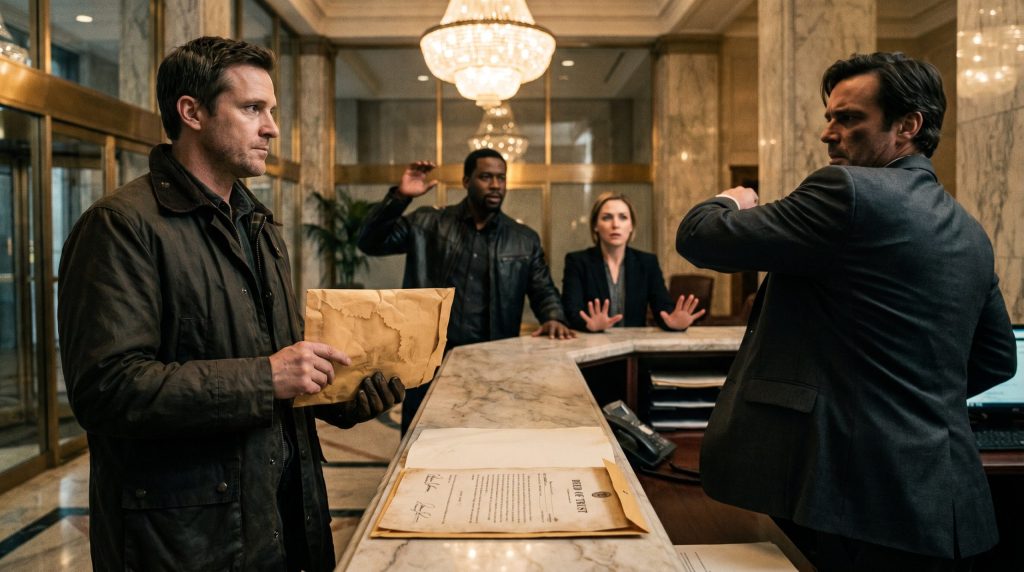
Not a copy. The original. Notarised in 1987, the ink brown at the edges, the signature in a hand that matched the one on every lease the building had ever issued. The receptionist had stopped reaching for the phone. The security guard had stepped back without being told. And the man in the lobby — the one they had been instructed to remove before nine o’clock — had not moved an inch.
He was looking at the woman across the desk. Not with triumph. Not with anger. With something quieter than either.
Recognition.
She had worked this desk for eleven years. She had greeted seven hundred clients, processed four building managers, and watched two different law firms cycle through the upper floors. She had been trained to decide who was allowed upstairs. Nobody had ever told her she was also deciding who was allowed to own the ground beneath her feet.
The biker standing at the door had his hand still raised — the gesture of a man who had been about to say something. He did not finish the sentence.
The Lobby
The office lobby was designed to make visitors feel observed, and it worked on everyone except the one person it was supposed to stop.
He had been there when Claire arrived at seven-forty. She saw him the moment the glass doors sealed behind her — a White man, sixties, wearing a waxed canvas coat with a broken zip, a sleeping bag roll bunched under one arm, a canvas bag on the other shoulder. He was sitting in the low chair beside the service entrance, the one nobody ever sat in. Not threatening. Not demanding. Just present, in the way that certain people are present — quietly, at great cost.
The lobby smelled of stone cleaner and cold air. The chandeliers were low-lit at this hour. The reception desk was pale marble, and Claire had learned in her first week that its purpose was as much theatre as function — she was the gate, and the desk was the stage she stood behind.
“Can I help you?” she said. It came out slightly differently than she intended.
“I’m here to see the building manager,” the man said. His voice was low and completely even. “Name’s Nathan Graves.”
Claire looked at her screen. There was no appointment under that name. There was no appointment for anyone before nine.
Behind her, the lift opened. Harrison Wolfe stepped out.
Harrison Wolfe. Chief legal officer of Wolfe Capital Group. One of the wealthiest men in the country — and the reason the building existed at all, according to every framed article in the seventh-floor boardroom.
He saw Nathan Graves and stopped.
Not the pause of a man processing an unexpected visitor. The pause of a man calculating how fast a problem had arrived.
“Claire,” he said. His voice was very controlled. “Call the service I gave you. The number is in the security drawer.”
She had thought it was a standard contractor referral. She had filed it without asking why.
She reached for the drawer.
Nathan Graves had not looked at Harrison Wolfe since he walked out of the lift. He was looking at Claire.
“Before you do that,” he said, “can I show you something?”
He set the canvas bag on the marble desk. Slowly. Like a man who has learned that slow movements keep rooms calm.
Claire froze instantly. Because the bag had a patch on the front — the patch from the old Royal Mail courier service, the kind phased out in the early nineties. Her father had carried one exactly like it for twenty-two years. He had been dismissed without pension when the building on Clyde Street was sold from under him.
The sale had been processed by Wolfe Capital Group.
She had known that for four years. She had told herself it did not matter.
The Number in the Drawer
The number in the security drawer connected to a company called Meridian Solutions. Claire had never googled it. She understood now that she should have.
She dialled. It rang twice. A man answered — one word, a name she didn’t catch — and she gave the address. She hung up. Harrison Wolfe nodded without looking at her and went back toward the lift.
“He’ll be back down in twenty minutes,” he told her. Not a prediction. An instruction. “Make sure our guest is comfortable until then.”
The lift closed.
Nathan Graves watched it go. Then he looked back at Claire.
“You can still call them off,” he said. “They won’t be here for another twelve minutes. That’s enough time.”
“I don’t know what you mean.”
“I think you do. I think you’ve been sitting at this desk long enough to understand what that drawer was for.”
She didn’t answer.
He reached into the canvas bag and set an envelope on the marble. Not tossed — set. Precisely, flat, the way a person handles something they have carried carefully for a long time.
The envelope was water-damaged. The edges were brown and slightly buckled, the seal re-glued at some point with a different adhesive. The kind of damage that comes from being hidden in outdoor conditions — behind a panel, under a mattress, inside a wall.
⚡ CLOSE-UP — the envelope on the marble. The water stain runs diagonally across the front. In the lower right corner, barely legible, a typed reference number: RG/87/CLYD.
Claire recognised the file format. It was the same system her father’s building had used. She had memorised it the year she applied for her first job — she had thought it would help.
“What is that?” she said.
“It’s a title deed,” Nathan said. “Original. Notarised. Registered at Land Registry in 1987.” He paused. “My name is on it. It’s been my name on it for thirty-seven years.”
Claire looked at the envelope. She did not touch it.
“He told me this building was purchased by Wolfe Capital in 2003,” she said carefully.
“It was,” Nathan said. “From a solicitor who did not have authority to sell it.”
The glass doors swung open behind him. Cold air came in.
Three men. Leather jackets. The one in front was broad, Black, with a shaved head and the particular stillness of someone who had done this before and had long since stopped enjoying it. His name — though she didn’t know it yet — was Thomas Reed. He had served twelve years in private security. He had a daughter in her first year of secondary school. He was not a cruel man.
But he had a job.
“Mr Graves,” Thomas said. “We’ve been asked to help you relocate.”
What Meridian Does
Thomas Reed had a voice built for small rooms. In the lobby it was very clear.
“This is private property,” he said. “You’re being asked to leave voluntarily. We’d prefer that.”
Nathan Graves turned to face him. He did not step back.
“Private property,” he said. “Yes. I’d agree with that.”
Thomas looked at the envelope on the desk. His expression did not change. But something behind his eyes shifted — the micro-adjustment of a man whose briefing has just developed a complication.
Harrison Wolfe reappeared from the lift. He had a phone in his hand and the expression of a man who had made several calls in twenty minutes and was now operating from a position of certainty.
“Thomas,” he said, “he’s a trespasser. You have full authority.”
Thomas didn’t move. He was looking at the envelope.
“That’s a Land Registry document,” he said. It wasn’t a question.
“It’s nothing,” Harrison said. The word came out too fast. “A forgery. We’ve dealt with this claim before. The courts dismissed it.”
Nathan said, quietly: “They dismissed a photocopy. This is the original.”
The lobby went very still.
Harrison Wolfe stepped forward.
“You’ve been a tenant of this building, Mr Graves. Or you were — when you could afford to be. You worked your way through whatever savings you had on a claim you cannot win. I paid for every legal challenge you mounted. The least you can do is accept that it’s finished.”
[LOUD — confident, dismissive]
Three seconds of silence.
Thomas Reed looked at Harrison Wolfe. Then at Nathan Graves. Then at the envelope again.
Outside Claire’s chest, the morning was continuing normally. Taxis moved. Pigeons landed and left. A delivery driver propped his bike against the railings.
Inside her chest, something had stopped.
She had her hand on the drawer — the one with Meridian’s number still on the notepad. She picked up the notepad. Walked to the small recycling bin behind the desk. Let it fall.
Then she sat back down and placed her palms flat on the marble.
She had almost walked out. She had found her coat while Harrison was upstairs, had picked up her keys, had stood at the staff door for forty seconds with her pulse in her throat and the genuine knowledge that what happened next would almost certainly cost her this job and possibly more.
She had put the keys down.
Because her father had stood at a desk exactly like this one, in a building exactly like this one, and the person behind the marble had not looked up.
She looked up now.
“Mr Wolfe,” she said, “I need you to stop speaking while I verify a document.”
The room froze. Harrison Wolfe stared at her. Thomas Reed’s chin dropped a fraction.
She picked up the envelope with both hands.
RG/87/CLYD
The Land Registry seal was intact inside the fold. The notarisation stamp was from a firm called Alderman & Carr — dissolved in 2001, but their stamps were valid in perpetuity for documents registered before dissolution. Claire knew this because she had looked it up two years ago when a client asked about a pre-2000 title.
She had not known then why that information would matter.
“This is a genuine notarised title deed,” she said. Her voice was very level. “Registered reference RG/87/CLYD. Issued in 1987. The registered holder is Nathan Graves.” She set it back on the marble. “Flat. So everyone can see it.”
⚡ CLOSE-UP — the document on marble. Both signatures visible. The top one: Nathan Graves. The one below it, on the transfer line — signed but not completed, initialled only.
Harrison Wolfe reached for it.
Thomas Reed’s arm came up — not fast, not aggressive. Simply there. Between Wolfe’s hand and the desk.
“Don’t,” Thomas said.
It was one word. It carried the weight of a man who had, somewhere in the last sixty seconds, made a decision about which side of something he was standing on.
Harrison Wolfe’s hand stopped. His face did not change immediately — the performance was excellent, and it had been running for a long time. But his eyes moved to the initialled line on the transfer document.
And his posture changed. One degree. Barely visible.
Villain betrayal: his right hand curled back toward his body. Slow. Involuntary.
Because nobody outside the family knew. Nobody.
The partial initial on that transfer line — the sale that had never been legally completed — was W. Not a solicitor’s initial. Not a trustee’s. His.
Harrison Wolfe had known about this building since 1987. He had not purchased it. He had intercepted a legitimate sale, appointed a solicitor without authority to complete it, and built an entire legal and property portfolio on a foundation that a single original document could collapse.
Nathan Graves had been carrying that document in a canvas bag under a railway arch for four years.
Thomas Reed stepped back from Harrison Wolfe. He looked at Nathan. He looked at Claire.
“I need to make a call,” Thomas said.
“Yes,” Nathan said. “You do.”
Harrison Wolfe said: “You don’t understand what you’re—”
Thomas held up one hand. Not aggressively. Just — stop.
Wolfe stopped.
The document had two signatures. Claire had read both. But on the third page, in the witness attestation box, there was a third name — a firm’s name, not a person’s — that she had not seen before.
She froze completely.
Because the firm’s name was Meridian Solutions. Dated 1987. Sixteen years before it was supposedly founded.
What the Witness Box Said
The police arrived at ten past nine. Two officers, a sergeant, and a solicitor from the Land Registry’s legal protection unit who had been called — Claire learned later — by Thomas Reed, forty minutes before she had opened the envelope.
Thomas had made his own enquiries. He had taken the job from Meridian believing it was a standard removal. He had run the address that morning, out of habit, the way he ran every job. What came back had not matched the briefing.
He had come anyway. To see.
Harrison Wolfe was escorted upstairs to his own boardroom, at his own request, with both officers. The lift doors closed. The lobby settled.
Nathan Graves sat back down in the low chair by the service entrance.
Claire brought him a glass of water. She set it on the side table beside him and did not say anything for a moment.
“The witness attestation,” she said finally. “Meridian Solutions. 1987.”
“I know,” Nathan said.
“That firm was registered as founded in 2003. It’s on their own website.”
“I know.”
“So either the registration date is false, or someone inserted that name retrospectively into a 1987 document.” She paused. “Neither of those is a small thing.”
“No,” Nathan said. “It isn’t.”
The quotable verdict: he had always known.
She looked at the water glass. The surface was perfectly still.
“What does Meridian actually do?” she asked.
Nathan was quiet for a moment.
“I’ve been trying to find out for four years,” he said. “Harrison Wolfe isn’t the top of this. He’s the floor.”
Heartbeat pounding louder.
Claire sat down in the chair behind the reception desk. The marble was cool under her palms. The chandeliers had come up to full brightness now — the automated morning cycle, indifferent to everything that had happened beneath them.
The document was in an evidence bag. The police had it.
But she had photographed every page before she handed it over. Every page including the third, with its witness box, with its impossible date, with the name of a company that should not have existed for another sixteen years.
She sent the photographs to her personal email. Then she sat very still.
Harrison Wolfe had built this building on a document he had helped falsify. He had spent thirty-seven years ensuring the man whose name was on the original title never had access to a room like this one.
The room she had been guarding without knowing what she was guarding.
She was finally about to understand who had put her here.
⚡ CUT TO BLACK.
And that was the question she had not yet asked: had someone placed her at this desk on purpose?