


The Ward That Remembered Nothing
The private hospital was too quiet for a building full of people trying not to die.
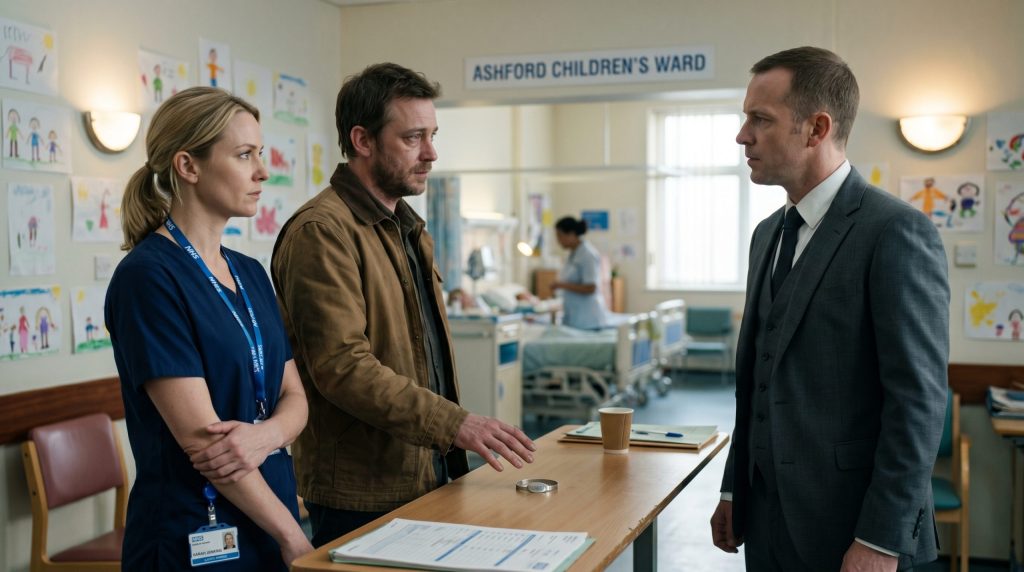
Soft light pooled along the corridor of Ashford Children’s Ward. Crayon drawings were taped to the walls — suns with too many rays, houses with smoke from chimneys, horses. The night nurse had hung them herself, years ago, in the belief that colour helped small lungs breathe. The ward smelled of antiseptic and warm air and something faintly floral that nobody had ever traced to a source.
Elena Marsh had worked this corridor for eleven years. She knew every hinge that creaked and every child who slept lightly. She walked the night rounds with the particular silence of a woman who had learned to move without disturbing things.
She stopped at the third bed from the window.
The girl was seven. Dark lashes against pale skin. A bracelet on her left wrist — thin silver, a name engraved on the flat disc — catching the low light like something that did not want to be missed. The girl’s name, according to the chart, was Rosie. She had been admitted four days ago. No parents had visited. The intake form listed a guardian — one Thomas Hale, listed as the child’s father. A contact number that rang out each time Elena tried it.
Elena recognised the bracelet before she recognised why she recognised it.
She froze completely. Because the name on the disc was not Rosie. It was Clara.
Her own niece had worn a bracelet exactly like this one. Same thin silver band. Same flat disc. Same script engraving. Clara had disappeared from a family holiday four years ago — seven days on the coast, a rented house, an afternoon when Elena had stepped inside to answer the phone and come back out to find the garden empty. The case file was still open. Elena had transferred to Ashford six months later, unable to stay in the city where every street corner held a version of that afternoon.
She stood at the foot of the bed for a long time. The girl’s chest rose and fell. Her small hand rested open on the blanket, the bracelet loose around the wrist.
Elena did not touch it. Not yet. She turned and walked back to the nurses’ station and pulled the intake form from the folder and read every line twice.
The admission had been processed by Dr. Victor Hale — Thomas Hale’s brother, listed as attending physician. Elena had never met him. She had worked with his registrar. She had signed off on two of his ward orders this week without looking closely at the name above the printed title.
She set the form down.
Then she reached for the internal directory and found the extension for hospital records.
What the File Said
The records room at Ashford was staffed overnight by a single clerk — a quiet man named Gerald who read crime novels at the desk and never asked why a nurse needed a file at two in the morning. Elena had covered for Gerald twice when he arrived late. He buzzed her in without comment and went back to his book.
The file for the girl admitted as Rosie Hale ran to forty-three pages. Elena stood at the counter and read it standing up, beginning at page one.
The medical history was thin in the way that suggested it had been assembled rather than accumulated. A GP registration dated eighteen months ago. A single set of vaccinations, administered by a private clinic that Elena had never heard of. A school enrolment form — one term at a school in the north of the city — listing Thomas Hale as sole guardian, the mother listed as deceased with no documentation attached.
Elena turned to page seven.
The intake photograph. Standard procedure — a digital image taken at admission, printed and attached to the physical file. The girl looked directly at the camera with the particular stillness of a child who had been told to sit still many times by people she did not trust.
Elena looked at the photograph for a long time.
The girl’s eyes were grey-green. Her hair, dark, was cut straight across the fringe. There was a small scar above her left eyebrow — crescent-shaped, from a fall against the corner of a garden step when she was three years old.
Elena had been there for that fall. She had been the one who pressed a cloth to the cut and carried her niece inside.
Her own son had stood at a desk exactly like this one, eleven years ago, and nobody had looked up. She had vowed then that she would always look. She had spent four years looking for Clara and finding nothing. And now here was a file with a wrong name on it and a familiar scar in a photograph and a bracelet that had been a Christmas gift from Elena herself, bought from a silversmith on the high street, engraved while she waited.
She photographed every page with her phone — cracked screen, slow shutter — pressing each image carefully, hands steady.
On page thirty-one she found a discharge plan. Signed by Dr. Victor Hale. Dated for the following morning. Nine o’clock.
It was currently twenty past two.
She closed the file, thanked Gerald without explanation, and walked back to the corridor.
The ward was still quiet. She stopped at the nurses’ station and picked up the phone. She put it down. She picked it up again. The number she dialled was not the hospital’s internal line. It was a mobile number she had kept in her personal phone for four years — the family liaison officer from the original missing persons case. She had never deleted it.
The call rang four times. Then a voice, sleep-thick but immediately alert.
— “Elena.”
— “I need you to come to Ashford. Before nine.”
A pause. The sound of sheets moving. “What did you find?”
Elena looked down the corridor toward the third bed from the window.
“I found her bracelet,” she said. “And I think I found her.”
The Doctor’s Arrangements
Dr. Victor Hale arrived at the ward at seven forty-five in the morning — earlier than his listed rounds, earlier than the day shift handover, early enough that the corridor still held its night stillness.
Elena was at the nurses’ station. She had not slept.
He was a tall man, White, mid-fifties, silver hair swept back from a high forehead. He wore his white coat as though it were a boardroom jacket — structured, unbuttoned, with the easy posture of someone accustomed to institutional deference. He carried a tablet and moved down the corridor without acknowledging her.
She stepped out from behind the station.
“Dr. Hale.”
He turned. His expression was the expression of a man who expected minor administrative friction and had already decided how to handle it. “Nurse — Marsh, is it? I’m early for rounds. I’d prefer not to be delayed.”
“The discharge for bed three is under review.”
Something moved across his face. Gone in under a second. “Under whose authority?”
“Mine. As the overnight supervising nurse, I’ve flagged the file for a secondary review before discharge. It’s standard procedure when a guardian cannot be reached during the admission period.”
This was true. It was also the sentence Elena had spent forty minutes constructing in her head while the corridor was quiet and the girl slept.
Hale studied her. His hand — the one holding the tablet — tightened slightly. Not a tremor. A grip adjustment. The kind of movement a person makes when they are calculating.
“The guardian has been in contact with my office,” he said. “Everything is in order.”
“Then the secondary review will confirm that quickly,” Elena said. “We can proceed at nine as scheduled.”
She held the folder — the copied file, the photographs from her phone printed at the ward’s printer at five in the morning — against her side with both arms. She had considered, at twenty past six, whether to simply leave. She had sat in the staff break room with her keys in her hand and the folder on the table and the clock on the wall showing exactly how many minutes she had before the day shift arrived and the ward became populated and her ability to act quietly expired. She had sat there for eleven minutes. Then she had gotten up and walked back to the station.
Hale’s expression had settled into something smoother and more dangerous than irritation. “I see. Then I’ll speak with the ward administrator directly.”
“Of course,” Elena said.
He turned and walked toward the administrator’s office at the far end of the corridor.
Elena waited until he had rounded the corner. Then she walked to the third bed from the window.
The girl was awake. Sitting upright, the bracelet on her wrist, both hands flat on the blanket. She looked at Elena with grey-green eyes that did not blink quickly.
“Are you going to make me go?” the girl asked.
“No,” Elena said. “Are you Clara?”
The girl went very still. In the particular way of a child who has been told not to answer to that name. Then, quietly: “He said I’m not supposed to be Clara anymore.”
Heartbeat pounding louder.
Elena pulled the chair close to the bed and sat down and took both of the girl’s hands in hers and said: “You don’t have to be anyone other than who you are. Not today. Not anymore.”
At the end of the corridor, a door opened. Then footsteps — more than one set.
The Bracelet and the Record
Detective Sergeant Claire Waverly arrived at Ashford at eight seventeen with a family liaison officer and a warrant. She was forty, Black, in a dark jacket and plain clothes, badge clipped to her belt. She walked quickly and spoke quietly and the ward administrator, who had been attempting to manage Dr. Hale’s escalating requests in the corridor, stood aside without being asked.
Elena met her at the entrance to the ward.
She handed Claire the folder. The printed photographs. The page from the file showing the discharge plan. The screenshot of the bracelet’s engraving — Clara, in the same script that matched the receipt she had found in her own email four years ago, the order confirmation from the silversmith on the high street, timestamped to the twenty-second of December.
Claire took the folder and read the first three pages standing in the corridor, the family liaison officer beside her.
She froze. Because the case number on the top of page one was the same case number that had been open for four years in the missing persons unit. A case number Claire herself had worked in her first month as a detective sergeant. A case that had gone cold. A case nobody had formally closed.
“Where is she now?” Claire asked.
“Third bed from the window,” Elena said. “She told me her name.”
Claire looked down the corridor. Then she looked back at Elena. “And Hale?”
“With the administrator. He arrived early. I think he knew something was wrong with the discharge flag.”
— “He’s not leaving this building.”
Claire was already moving.
What followed happened with the particular compressed efficiency of a situation that had been building for years finally meeting the people who could act. The warrant covered the hospital records, Victor Hale’s patient files across three wards, and the contact details of Thomas Hale, whose number had rung out every time Elena called it because — as the family liaison officer confirmed from the original case file — it was a number registered to a business address that had been dissolved two years ago.
Victor Hale was located in the administrator’s office. When Claire entered, he was standing with his back to the door, phone pressed to his ear. He turned. His expression performed composure for approximately two seconds. Then his eyes moved to the folder in Claire’s hand — specifically, Elena noticed, to the corner of the intake photograph visible above the folder’s edge. The photograph of the girl. The photograph of Clara.
His grip on the phone loosened. The phone dropped three inches before he caught it.
He had not been asked a question. His body had answered one anyway.
Claire placed the warrant on the administrator’s desk with two fingers. “Dr. Hale. I need you to sit down.”
He did not sit. He looked past Claire to Elena, who was standing in the doorway. Something passed across his face that was not composure and was not anger — it was the expression of a man who had constructed something elaborate and was watching the first brick shift.
“The discharge is cancelled,” Claire said. “The girl stays in this ward under protective custody until we have completed the identification process. You will remain on this premises until my colleagues arrive.”
— “You have no grounds,” he said. Quickly. Too quickly.
Claire looked at him steadily. “She told us her name,” she said. “That’s our grounds.”
The second warrant arrived at eight fifty-one. It covered Thomas Hale’s residential address — an estate outside the city, a gated property registered to a holding company. The name of the company appeared on the paperwork. Elena, reading it upside down from the doorway, recognised it. She had seen it on a letter that had arrived at her sister’s home eighteen months before Clara disappeared — a property dispute, a boundary disagreement, something her sister had mentioned once and then dropped. She had not connected the name then. She connected it now.
The file had her sister’s address on the third page. She had recognised the handwriting before she recognised the street name.
Clara
The formal identification took four hours.
Elena sat in the family room on the ground floor of Ashford and answered every question she was asked and produced every record she had — the email receipt from the silversmith, the Christmas photograph showing Clara wearing the bracelet on the morning she received it, the medical file from her sister’s GP that documented the crescent scar above the left eyebrow and its cause. A fall. A garden step. A Tuesday afternoon when Clara was three years old and Elena had been the one to press the cloth to the cut.
The family liaison officer sat across from her and wrote everything down and at one point stopped writing and said, quietly: “You’ve been carrying this for four years.”
Elena did not answer that. There was no answer that was also true and also short enough to say in a family room in a hospital at ten in the morning.
At twelve forty-three, Claire entered the family room and sat down and placed a printed document on the table between them.
The DNA match confirmation. Expedited. The sample had been taken from Clara with her consent — she had held out her hand and watched the swab and said, with the matter-of-fact precision of a child who had learned to be very careful with important things: “Is this how you find out who I am?”
Elena had said: “We already know who you are.”
The match was to Elena’s own sample, submitted to the missing persons database four years ago. First-degree relative. The report named the relationship: aunt.
Victor Hale had been arrested at nine forty. Thomas Hale was located at the estate outside the city at eleven fifteen. The details of how the arrangement had worked — the forged documentation, the private clinic registrations, the school enrolment — were a matter for the investigation that followed, and Elena was not present for most of it. What she knew was this: Thomas Hale had encountered her sister through the property dispute. What had begun as a legal disagreement had become something else. Clara had been taken as leverage. Leverage that had outlasted its original purpose and then become something more difficult to undo. Children had been placed before and moved before. The system that should have caught it had not caught it because the people moving through it wore white coats and held institutional authority and signed their own paperwork.
The ward administrator resigned three days later. The hospital trust opened an internal review. These things mattered and Elena followed them and gave her statements and answered every call from Claire’s office without delay.
But none of that was the moment she would remember.
The moment she would remember was at two forty-five in the afternoon on the day the identification was confirmed, in the corridor of the Ashford Children’s Ward, when Clara walked out of the room where the family liaison officer had been with her and saw Elena standing in the corridor and stopped.
The crayon drawings were still on the walls. Suns with too many rays. Houses with smoke from chimneys. Horses.
Clara looked at Elena for a long moment with grey-green eyes that did not blink quickly.
Then she crossed the corridor and put her arms around Elena’s waist and pressed her face against her and did not say anything.
Elena held her.
The ward was quiet around them. The same quiet it always was — the particular quiet of a building full of people trying very hard to make things right.
She remembered everything. All four years of it. Every unanswered phone call and every cold morning and every file that led nowhere. She remembered all of it, standing in that corridor with her arms around a seven-year-old girl who smelled of antiseptic and the faint floral scent nobody had ever traced to a source.
She never told Clara that she had recognised the bracelet before she recognised anything else. That the bracelet had been the thing that held her in place long enough to think clearly. That a small silver disc with a name on it, glinting in low light at two in the morning, had been the reason Clara came home.
Some things do not need to be said. They only need to have happened.
The bracelet remained on Clara’s wrist. It had always been hers.