


Rejected
The pharmacy counter had seen every kind of bad news, but the kind that came without warning was the kind that happened in front of a queue.
Fluorescent lights. The smell of antiseptic and carpet cleaner. Seven people behind Claire Marsh, all watching.
She pushed the prescription forward. The pharmacist — a young man with a lanyard and careful eyes — scanned it twice. Then he set it down.
‘This name isn’t in the system.’
‘It’s my name,’ Claire said. ‘It’s always been my name.’
‘The insurance is flagged. I’ll need you to step aside.’
She did not step aside. She’d been stepping aside her whole life — in the Whitmore estate kitchen at five in the morning, in the laundry room where the ceiling leaked, in every room of a house that had once, apparently, belonged to her family.
She knew that now. She had known it for eleven days.
The queue shifted. A woman in a camel coat exhaled loudly. Claire felt the heat of seven sets of eyes on the back of her neck.
Then—
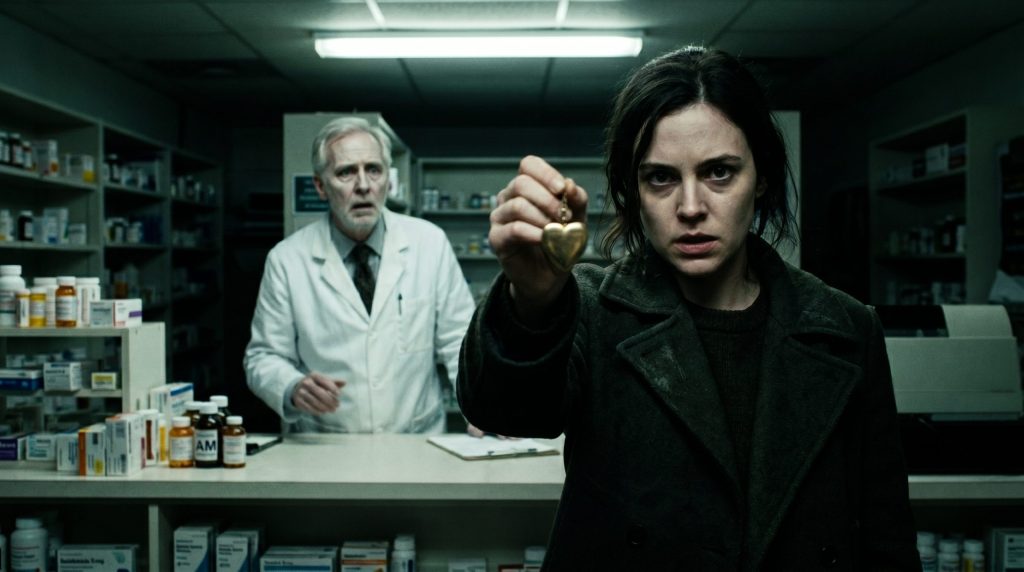
A door opened at the far end of the counter. Not the staff door. The private consulting room. And Dr. Gerald Howe walked out.
He saw her in the same instant she saw him.
He answered too quickly — ‘She’s not a patient here’ — before anyone had addressed him, before anyone had spoken his name.
Claire froze instantly. Because nobody had asked him.
He was sixty-three years old. Neat silver hair. The kind of man who had spent a career being trusted in rooms where other people were frightened. He had delivered Margaret Whitmore’s baby thirty years ago. He had signed the birth certificate. He had, Claire now understood, signed the wrong name on it — deliberately, carefully, and in exchange for enough money to retire.
He looked at the prescription on the counter.
His hand moved toward it — one involuntary reach — and then stopped.
‘Gerald,’ Claire said quietly. Just his name. Nothing else.
The pharmacist looked between them. The queue had gone completely still.
What the Locket Held
Claire had found the locket eleven days ago in a box of things the estate solicitor called ‘household effects’ — the polite phrase for what gets left when a rich family doesn’t want to claim something.
It was small. Gold, or gold-plated. A woman’s portrait inside — painted, not photographed — and on the back, engraved in letters so small she’d needed a lamp: M.W. to her daughter. Always.
She had assumed it meant nothing. Estate houses collected objects the way drains collected hair.
But the solicitor — an older woman named Grace Alderton who had handled Whitmore estate paperwork for twenty years — had gone very still when Claire placed it on her desk. The Freeze Technique, Claire thought later. Grace had simply stopped.
‘Where did you find this?’ Grace had said.
‘The laundry room. In a tin behind the boiler.’
Grace Alderton picked it up. Turned it over. Set it down carefully, the way you set down something that has suddenly become evidence.
Then she had asked Claire one question: ‘Do you know when you were born?’
Claire knew the date. She did not know, until that afternoon, that the date on her birth certificate had been altered. That the original — the one filed with the hospital, not the one registered later by Gerald Howe — listed her mother as Margaret Whitmore.
Not a servant. The owner.
The locket’s portrait was Margaret at thirty. Claire had her eyes exactly.
Grace had said it quietly, almost to herself: ‘He raised the wrong child.’ Then she’d looked up. ‘I mean — the estate raised no child at all. That’s the point.’
Claire had taken the locket home. She slept with it on the nightstand. She had not contacted Gerald Howe. She had not needed to — the document Grace pulled from sealed Whitmore estate records was a second birth certificate, original, stamped and witnessed, with Claire’s true parentage listed in ink that had not faded in thirty years.
She had come to the pharmacy today because she needed her prescription. Because she still lived like a person who needed to manage costs. Because some habits take longer to break than secrets.
The Private Room
Gerald Howe did not run. Men like him never ran. They redirected.
‘There’s clearly been an administrative error,’ he said to the pharmacist, his voice carrying the particular warmth of a man who had spent decades reassuring people. ‘I’m a physician. I can sort this out.’
He reached for the prescription again.
Claire placed her hand flat on the counter between his reach and the paper.
‘Don’t,’ she said.
The queue behind her had not moved. The woman in the camel coat had her phone out — not raised yet, just out. A teenage boy near the door had already lifted his.
‘Claire.’ Gerald’s voice dropped. ‘Let’s speak somewhere private.’
‘You’ve had thirty years of private.’
His jaw tightened. Something moved behind his eyes — not guilt, not yet, but calculation. He was still working out whether she could prove it. Whether she had the document or only the story.
She opened her bag. Not quickly. Not with any drama.
She removed the locket first — held it up between two fingers so he could see the engraving on the back. M.W. to her daughter. Always.
His face did the thing faces do when the body knows before the mind catches up. The color did not drain slowly. It left.
‘That’s — that belongs to the estate —’
‘It belongs to me.’ She set it on the counter. Then she placed the document beside it: the original birth certificate, photocopied and certified, Margaret Whitmore listed as mother, the date three weeks earlier than the one Gerald had filed. ‘So does the estate.’
He stepped backward. One step. Involuntary.
Phones rose in the background — one, then another, then three.
Grace Alderton. Claire had texted her from outside. The solicitor was already en route. The court filing had been submitted that morning.
Claire picked up the locket. Closed her fingers around it.
‘You falsified a birth certificate,’ she said. Not loudly. She did not need volume. ‘In front of a hospital witness. Who kept a copy.’
The pharmacist had completely stopped pretending to type.
The Witness Who Kept the Copy
The hospital witness was a woman named Dorothy Wells, now eighty-one, living in a care facility forty minutes outside the city.
She had kept the copy because she hadn’t trusted Gerald Howe from the moment he’d walked into the maternity ward with a second form and asked her to sign without reading it. She had signed. She’d been twenty-six and he had been her superior. But she had photographed the original first — with a camera she wasn’t supposed to have on the ward — and kept the film in an envelope addressed to herself, unopened, sealed with her own name across the flap.
Grace Alderton had found Dorothy through the hospital’s retired staff records. Dorothy had handed over the envelope without a single question. ‘I knew someone would come,’ she said. ‘I just didn’t know how long.’
The photograph, developed sixty days ago at Grace’s expense, showed the original form clearly. Margaret Whitmore’s signature. The attending nurse’s counter-signature. And Gerald Howe’s signature — on the original — next to a line he had removed entirely from the version he filed.
The line read: Father unknown. Mother: Margaret Elaine Whitmore. Sole heir.
Claire had read it four times before the words settled.
Sole heir.
The Whitmore estate: a house with eleven rooms, forty acres, and a trust that had been sitting in legal suspension for thirty years while the family’s distant relatives argued over paperwork none of them could make add up. Because one document was missing. Because one man had removed it.
Gerald had been paid well. Not well enough, as it turned out, to buy a twenty-six-year-old nurse’s instinct that something was wrong.
Claire thought about Dorothy Wells a lot in the days that followed. A young woman who had said nothing aloud — who had simply taken a photograph and sealed it and waited. Who had kept the secret not to use it, but to preserve it. For whoever needed it most.
She sent flowers to the care facility. Dorothy’s note back was three words: I knew, dear.
The Counter Remembers
The court filing moved faster than anyone expected.
Grace Alderton presented the two-stage evidence: the locket, establishing Claire’s connection to Margaret Whitmore through physical inheritance — and the original birth certificate photograph, establishing legal parentage. Gerald Howe’s legal team requested delays. The judge declined each one.
Gerald himself said very little in proceedings. His body had already said everything that mattered — the backward step at the pharmacy counter, the involuntary reach for the prescription, the color leaving his face before a single accusation had been spoken. His barrister worked hard to frame it as misremembering, administrative error, a different era’s paperwork standards.
The judge was a woman named Victoria Marsh — no relation — who had been on the bench for nineteen years and did not find the framing compelling.
The estate passed to Claire on a Tuesday. Quietly. The way most enormous things happen.
She went back to the pharmacy that afternoon. The same pharmacist was at the counter. He recognized her. His expression did something complicated.
She handed him a new prescription — same medication, reissued under the correct insurance.
He processed it without flagging anything.
‘It went through,’ he said.
‘I know,’ Claire said.
She waited at the counter while the prescription was filled. The fluorescent lights were still bad. The carpet still smelled like antiseptic. Seven people were in the queue behind her, each carrying their own kind of bad news, none of it hers.
The locket was in her coat pocket. She’d had the portrait inside re-examined by an art restorer who confirmed it was painted from life — a young woman in her late twenties, dark eyes, a particular set to the jaw that the restorer called unusual and distinctive.
Claire had not needed the restorer to tell her that. She had a mirror.
She put the prescription in her bag. She looked at the consulting room door — the one Gerald had walked out of, the one he would not be walking out of again.
She remembered everything.
And one thread remained: Dorothy Wells had mentioned, in her three-word note, that she had not been alone in the maternity ward that night. There had been a second witness. One who had never come forward. One who, Dorothy believed, was still alive.
Claire folded the note. Put it in her pocket beside the locket.
Some secrets have layers.