


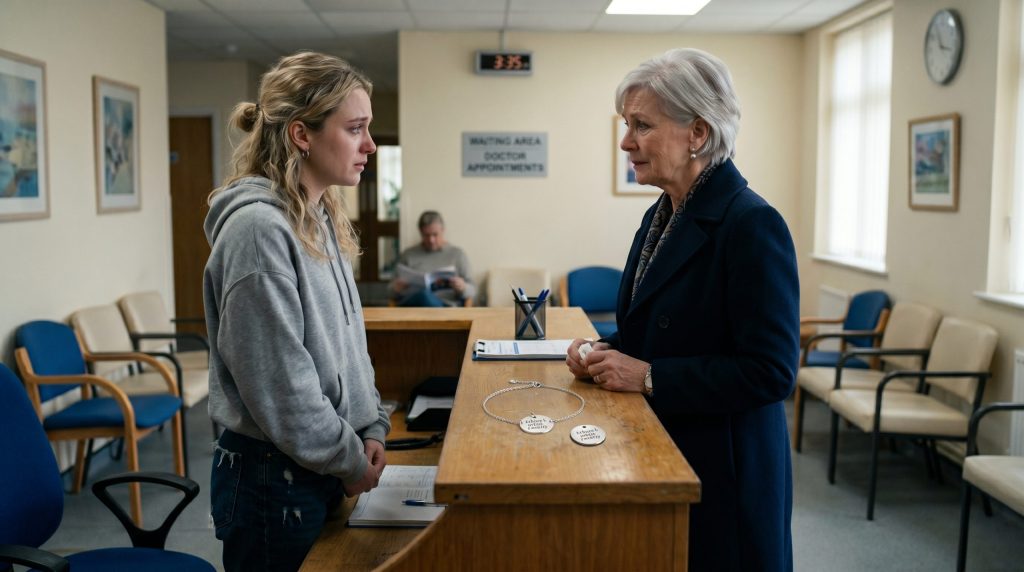
Too Quiet
The private hospital was too quiet for a building full of people trying not to die.
Soft lighting. Cream walls. The faint chemical smell of money trying to disguise itself as cleanliness. Chairs that cost more than most people’s monthly rent sat empty along the corridor, and a receptionist with a precise blowout typed without looking up.
Nadia Voss had been sitting in that waiting room for forty minutes.
She was not the kind of woman this room was built for. Worn canvas trainers with a separated left sole. Jeans with a frayed hem at the right ankle. A grey hoodie two sizes too large. She sat with her knees together and her hands flat on her thighs, watching the corridor the way a person watches something they have been watching for a long time.
She had found the hospital’s name on a printed discharge summary folded into the lining of a backpack — not her backpack. Her sister’s. The sister who had been declared dead seventeen years ago at the age of nine.
Nadia was twenty-six. So was the sister who was supposed to be dead.
She had not told anyone she was here. Not the foster families. Not the charity worker who had helped her track the placement records. No one.
Because the name on that discharge summary — the social worker who had signed off on the original removal order — was still employed here. Still active. Still signing things.
Caroline Reeves.
Nadia recognised the name the way you recognise a scar. Not with surprise. With the cold, flat certainty of something you had always known was there.
She reached into her hoodie pocket and pressed her fingers against the folded discharge paper. Still there. She had checked four times since she sat down.
The receptionist’s typing stopped.
— “Miss Voss? Dr. Hartley will see you now.”
Nadia stood. Straightened. Walked toward the corridor.
She did not know yet that Caroline Reeves was standing twenty metres away, watching her come.
The Name on the Third Page
Dr. Hartley’s office smelled of cedar and old paper — a careful smell, assembled deliberately. Framed credentials on the wall. A desk so wide it functioned as a barrier. The kind of room that said: decisions are made here, and they are not questioned.
Dr. Hartley himself was a White male in his late fifties. Silver hair swept back from a high forehead. A white coat hanging open over a dark suit underneath, stethoscope coiled in the breast pocket. He gestured to the chair across the desk without standing.
Nadia sat.
She placed the discharge summary on the desk between them. She did not slide it — she placed it. Two fingers only. Then she withdrew her hand.
— “I’m looking for information about a patient who passed through this facility. Seventeen years ago.”
Dr. Hartley glanced at the document without touching it.
“We don’t discuss historical patient records with members of the public,” he said. Unhurried. The tone of a man who had said this exact sentence many times. “If you have a formal enquiry, there is a process.”
“I know there is,” Nadia said. “I filed one. Fourteen months ago. I received a letter saying the records had been archived and were not accessible.”
A pause. Small.
“Then you have your answer.”
“I have a letter,” Nadia said. “That’s not the same thing.”
She watched him. He had not touched the discharge summary. Most people touched it — reflexively, to look closer, to confirm or dismiss. He had not moved his hands at all.
That told her something.
She had been sitting with that knowledge for three weeks before she came here — the knowledge that the file she had received in response to her formal enquiry was incomplete. Seventeen pages. The original intake record for a nine-year-old girl admitted under emergency custody transfer should have been at minimum forty pages.
Something had been removed.
And the signature on the removal authorisation — the name authorising which pages were archived — was Caroline Reeves.
Nadia had not mentioned Caroline Reeves yet. She was watching what Dr. Hartley did with his hands.
He folded them on the desk.
Deliberately. Carefully. The way a person does when they are deciding not to reach for something.
Nadia reached into her hoodie pocket and unfolded a second document. She placed it beside the first.
“This is the intake record I was sent,” she said. “Page seventeen is the last page. But the footer on every page says: Page [X] of 41.”
Dr. Hartley’s hands did not move.
“Twenty-four pages are missing,” Nadia said. “I’d like to know what’s on them.”
The door behind her opened.
The Woman Who Signed
She didn’t need to turn around. She knew from the way Dr. Hartley’s eyes moved — a fraction upward, a fraction left — that whoever had entered was someone he deferred to.
Nadia turned anyway.
Caroline Reeves was a White woman in her early fifties. Structured navy blazer. Dark trousers, pressed. A lanyard with an ID badge worn around the neck — the badge face turned inward so the name was not readable from across the room. Hair precisely set. Not a strand displaced.
She stood in the doorway with the calm of someone who had walked into many rooms and been the most important person in all of them.
Her eyes went to the documents on the desk. Then to Nadia.
“Miss Voss,” she said. Not a question.
“You know my name,” Nadia said.
“Reception informed me you were here.” A brief, managed smile. “I’m Caroline Reeves. I understand you have some questions about historical case files.”
— “You signed the removal order. You authorised the custody transfer. And you signed off on the archiving decision that removed twenty-four pages from my sister’s intake record.”
Caroline Reeves stepped further into the room. She reached past Nadia — not quite touching her — and picked up the discharge summary. She looked at it. Then she set it down.
“These documents are taken out of context,” she said. “Placement decisions in complex cases involve dozens of professionals. I was one of many.”
“You were the only one who signed all three,” Nadia said.
Silence.
And then: — “You’re a former care recipient. You’re not a solicitor. You’re not law enforcement. This conversation isn’t something I’m obligated to have.”
The line landed like a door closing.
Nadia felt it. The precise calculation of it — the ranking, the dismissal, the assumption that the category she had been placed in as a child was still the category that defined her access to a room like this.
She had sat in her car for eleven minutes before coming inside today. Engine running. Hand on the gear shift. She had thought about everything she could lose — the legal complaint she had spent fourteen months building, the contact she had made at the regulatory board, the careful paper trail. All of it could be compromised if she mishandled this conversation.
Then she had looked at the time. She had a meeting with the regulatory board in two hours. She turned the engine off.
She was not here to argue. She was here to confirm one thing.
Nadia reached into the inner pocket of her hoodie — not the front pocket, the inside seam pocket, the one with the zip — and withdrew a small USB drive.
“I know,” she said. “I’m not here as a solicitor. I’m here because I found something in my sister’s backpack three weeks ago, and I needed to confirm one detail before I submitted it to the board this afternoon.”
Caroline Reeves’ eyes moved to the USB drive.
“The discharge summary has your signature,” Nadia said. “I needed to confirm your handwriting in person. Against the original.”
The room was completely still.
“I have it now.”
Caroline Reeves reached for the discharge summary a second time. Her hand was faster than she intended it to be.
Nadia had already taken it off the desk.
Outrage. Recognition. Then — something worse for Caroline Reeves than either of those things.
Fear.
What the Drive Contains
The regulatory board offices were twelve minutes from the hospital by car. Nadia had timed it.
She sat in the waiting area on the fourth floor — different chairs here, functional rather than expensive — and held the USB drive between two fingers. She had not looked at what was on it in full. Not yet. She had seen enough when it auto-opened on her laptop three weeks ago, the morning after she found it tucked into the lining of her sister’s backpack.
Her sister — Maya, who had been called by a different name for seventeen years — had left the backpack with Nadia two nights before she disappeared again. Not fled. Disappeared. There was a difference, and Nadia understood it better than most.
Maya had left the bag deliberately. She had left it and she had not said why, but she had looked at Nadia for a long moment before she walked out of the café, and Nadia had understood the look the way younger siblings understand the things that are never spoken.
The USB drive had a crack across the top right corner. The case was slightly warped — water damage, or heat, or both. The files had transferred cleanly anyway. Seventeen documents. A folder of audio files. A photograph.
Nadia had looked at the photograph once. Then she had closed the laptop and sat in her kitchen with the lights off for a long time.
The photograph showed two girls. One approximately six years old, one approximately nine. Both in the same placement home — she recognised the kitchen tiles from case files she had obtained separately. The photograph had a date stamp in the lower right corner.
The date was four months after Maya had been officially declared dead.
The audio files she had not yet played in full. She had heard enough of the first one to understand the shape of what was there: a voice she now recognised as Caroline Reeves, recorded without her knowledge, speaking to someone on a telephone. Two sentences. Clear as tap water.
— “The older one is a problem. Move her before the review.”
Nadia had written those words down on a piece of paper and folded the paper into her wallet. She wanted to be certain she had them exactly right when she read them aloud in this room.
The board officer — a Black woman named Margaret Olu, whom Nadia had spoken to three times on the phone over fourteen months — came through the door and extended her hand.
“Miss Voss. Thank you for coming in.”
Nadia stood. She felt the floor solid under her feet. She felt the USB drive between her fingers.
“She kept every recording,” Nadia said. Not to Margaret Olu, not exactly. More to confirm it to herself.
Margaret Olu looked at her carefully. “Who did?”
Nadia held up the drive.
“My sister,” she said. “For six years.”
Margaret Olu’s hand stilled on the door handle.
Because six years of recordings was not a person protecting themselves.
Six years of recordings was a person building a case.
Margaret Olu stepped back from the door and held it open. “Come through,” she said. “Bring everything.”
The Verdict
The formal investigation was opened within forty-eight hours of Nadia’s submission.
It took eleven weeks.
Nadia knew the shape of those weeks not because she was inside the process — she was not — but because Margaret Olu called her every Thursday morning at ten o’clock, brief and professional, to confirm the investigation was active and to ask if Nadia had received any contact she had not reported. She had not. Caroline Reeves had gone very quiet.
The audio files were authenticated on week three. The voice analysis confirmed Caroline Reeves as the speaker on all fourteen recordings. The seventeen documents on the drive — internal memos, placement decisions, transfer authorisations — contained her signature on nine of them and her handwriting in the margin notes of four more.
The twenty-four missing pages from Maya’s intake file were recovered from a physical archive in week seven. They had not been destroyed. They had been misfiled — in a folder under a different name, in a cabinet that had not been opened in eleven years. Someone had placed them there. The folder label was in Caroline Reeves’ handwriting.
On week eleven, Margaret Olu did not call on Thursday morning. She called on Wednesday evening instead.
“The findings have been referred to the Crown Prosecution Service,” she said. “Caroline Reeves has been suspended from practice pending the outcome. Her access to all current case files has been revoked.”
Nadia was standing in her kitchen. The same kitchen where she had sat with the lights off three weeks after finding the drive.
“And the placement authority?” Nadia asked.
“The full referral includes three other signatories who appear in the documentation,” Margaret Olu said. “The investigation is expanding.”
Nadia had expected that. The discharge summary had never been about one person. The removal order, the archiving decision, the misfiled pages — none of it was the work of one person acting alone. She had known that since week one. She had told Margaret Olu in week two. The Conspiracy Thread had been the hardest part to sit with — the knowledge that the document had other signatures she had not yet named, that the room that had made the decisions about Maya’s life was larger than one office, larger than one woman with a precisely pressed blazer and a lanyard turned inward.
She had let the investigators name the others. That was their work to do.
“Miss Voss,” Margaret Olu said. There was a pause — small, deliberate. “Your sister’s original identity is being restored through the formal process. She will need to engage directly with the authority when she is ready. But the record is being corrected.”
Nadia set the phone down on the counter and stood very still.
She kept every recording.
Five words. That was what it came down to. Maya had been nine years old when she was moved to the first placement. She had been fifteen when she started keeping the recordings — old enough to understand what was being done, young enough that no one had thought to watch what she was doing with her phone. Six years. Fourteen recordings. Seventeen documents. A photograph with a date stamp that proved she had been alive four months after the system declared her dead.
Maya had not been building a case for herself. Nadia understood that now. Maya had not known if she would ever be in a position to use it. She had built it because someone needed to know, and the most reliable person to ensure that was the case was herself.
She had left the backpack with Nadia because Nadia was the only person she trusted to walk into that hospital and confirm a handwriting sample in person without blinking.
She had been right.
Nadia picked up her phone and opened the message thread with the number she had for Maya — a number that had not responded in three weeks. She typed: It’s done. The record is being corrected. You don’t have to keep it anymore.
She sent it.
The message sat on the screen with one grey tick. Undelivered. The number was likely changed by now.
Nadia left the message sitting there anyway.
Margaret Olu called again on Friday to confirm that two additional signatories had been formally named in the expanded referral. One of them was Dr. Hartley.
Nadia had known his name would be there. She had known from the way he folded his hands on the desk — carefully, deliberately, the way a person does when they are deciding not to reach for something.
She had written his name down too. Three weeks ago. On the same piece of paper as Caroline Reeves’ two sentences.
She had folded it into her wallet, and she had waited.
She never told Margaret Olu she had suspected him from the first meeting. It wasn’t the kind of thing that needed to be said. The documents said it. The handwriting in the margins said it. The investigation said it, eleven weeks later, in formal language on a referral document that would be part of the public record.
That was enough.
The boy she had been the day she sat in that waiting room in worn trainers with the separated sole — she was still that person. She would always be that person. But she had walked out of that building with the discharge summary in her hand, and she had driven to a regulatory board office, and she had placed a USB drive on a table in front of a woman who knew how to use it.
And the record was being corrected.
That was the verdict. Not loud. Not announced in a room full of witnesses. Just a Wednesday phone call and a single sentence spoken by a woman named Margaret Olu who had answered every call for fourteen months.
The record is being corrected.
Nadia did not hear from Maya again for two years. When the letter came, it had no return address. Inside was a single photograph — a different one from the one on the drive. This one was recent. Maya, standing in a garden somewhere, squinting slightly in the sun. On the back, in small careful handwriting: I’m here. Thank you for walking in.