


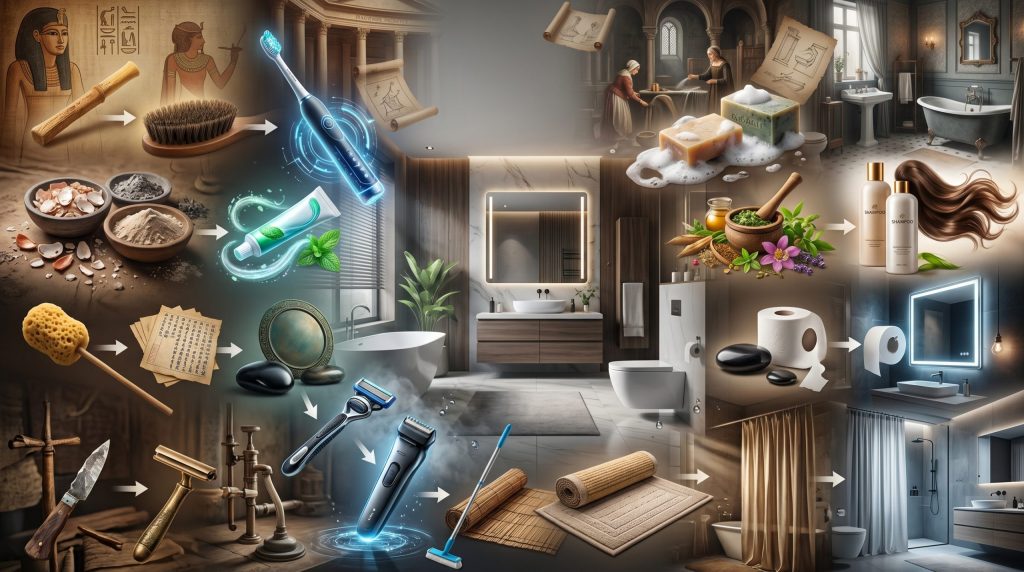
Ever stopped mid-shower and wondered where all this stuff came from? Your bathroom is like a mini museum of human ingenuity, packed with items that have bizarre backstories stretching back thousands of years. From chewing on twigs to fend off bad breath to using sponges on sticks for… well, you know… the origins of bathroom items are full of surprises. We’re talking ancient rituals, quirky inventions, and even a bit of royal drama. Let’s dive into the wild history of those random things lurking in your loo, exploring how they’ve evolved from crude tools to the essentials we can’t live without. Trust me, after this, you’ll never look at your toothbrush the same way again.
The Toothbrush: From Twigs to Tech
Picture this: You’re in ancient Egypt, around 3500 BC, and your breath is kicking after a feast of garlic-laced bread. What do you do? Grab a frayed twig, of course! That’s right, the history of the toothbrush kicks off with “chew sticks”—simple branches from trees like the Salvadora persica (miswak) that people gnawed on to clean their teeth. These weren’t just random sticks; they had natural bristles from fraying the end and even contained mild antiseptics. Archaeologists have dug them up in tombs, proving oral hygiene was a big deal even then.
Fast forward to China in the 1400s, where the first bristle toothbrush popped up. Folks there used boar hairs attached to bamboo or bone handles—stiff, sure, but effective. Europeans caught on during the 17th century, swapping boar for softer horsehair, but it was still a luxury item for the elite. Can you imagine paying a fortune just to scrub your chompers?
The modern toothbrush as we know it? Thank William Addis in 1780. Legend has it he was jailed for rioting in England and carved a bone handle, drilled holes, and stuffed it with bristles to pass the time. Boom—mass production followed, and by 1844, we had the three-row bristle design. Nylon bristles arrived in 1938, making things hygienic and soft, and electric ones buzzed onto the scene in the 1950s. Today, with smart toothbrushes tracking your technique via apps, it’s wild to think it all started with a humble twig. If you’re starting a healthy routine, remember: those ancient chew sticks were onto something—brushing twice a day keeps the dentist away!
Surprising Toothbrush Facts
- In Siberia, hog bristles were prized for their firmness due to the cold climate.
- Early models in Europe used feathers—talk about ticklish teeth!
- The average person spends 38.5 days of their life brushing. Worth it?
Toothpaste: Ancient Abrasives and Modern Mints
No toothbrush is complete without its sidekick, toothpaste. But forget minty fresh—this stuff started gritty. Around 5000 BC in Egypt, folks mixed crushed oxen hooves, eggshells, pumice, and myrrh into a powder for scrubbing. Ouch! The Greeks and Romans upped the ante with crushed bones and oyster shells, while ancient Chinese and Indians tossed in ginseng and salt for flavor.
By the 9th century, Persian musician Ziryab popularized a toothpaste-like mix in Islamic Spain, but it was the 1800s when things got tube-ready. In 1824, Dr. Peabody added soap to chalk-based pastes, and Colgate jumped in 1873 with jars of the stuff. The game-changer? The collapsible tube in 1890 by Dr. Washington Sheffield—hygienic and portable. Fluoride hit in 1956 with Crest, slashing cavities worldwide.
I’ve tried natural toothpastes mimicking ancient recipes, and let’s just say modern ones are a blessing. They not only clean but prevent decay, whiten, and freshen—evolution at its finest. If you’re curious about benefits of balanced oral care, think back to those eggshell scrubs; we’ve come a long way!
Toothpaste Through the Ages
- Ancient Egypt (5000 BC): Hooves and shells for abrasion.
- China (500 BC): Herbal mints with salt.
- 1800s Europe: Chalk and soap in jars.
- Modern Day: Fluoride, flavors, and eco-friendly options.
Soap: From Animal Fat to Luxury Lathers
Ah, soap—the slippery savior of cleanliness. Its origins? A happy accident around 2800 BC in ancient Babylon, where fats boiled with ashes created a sudsy goop for washing wool. Romans legend says it came from Mount Sapo, where animal sacrifices mixed rain, fat, and ash into a cleansing runoff.
By 600 BC, Phoenicians were pros at mixing goat tallow with wood ashes. The Gauls used it for hair dye (red tint, anyone?), and by the Middle Ages, soap-making guilds in Europe turned it into a trade. But it wasn’t always for bathing—early uses were medicinal or for laundry. Personal hygiene soap boomed in the 19th century with industrial production, like Pears’ transparent bars in 1807.
Today, from artisanal goat milk soaps to antibacterial wonders, it’s essential. Ever wonder why it lathers? Saponification—the reaction of fats with lye—creates that magic. If you’ve got dry skin, opt for moisturizing varieties; ancient folks would’ve envied our options!
Fun Soap Tidbits
- Egyptians bathed with animal oils and salts by 1500 BC.
- “Soap operas” got their name from radio shows sponsored by soap brands.
- Global soap market? Over $50 billion—clean business!
Shampoo: Indian Roots and Sudsy Surprises
Shampoo’s name whispers its origins: From the Hindi “champo,” meaning “to massage,” it entered English in 1762 via colonial India. There, folks boiled soapberries with herbs like gooseberry for a natural cleanser—used for centuries before Europeans knew what hit ’em.
In the 1500s, Indians mixed fruits and flowers for luxurious lathers, while Chinese used rice water. Europe lagged until the 1920s, when Hans Schwarzkopf launched liquid shampoo in 1927, ditching powders. Procter & Gamble’s Drene in 1934 used synthetic surfactants, making it soap-free and gentle.
Now, with clarifying, volumizing, and color-protecting formulas, shampoo’s a $80 billion industry. I’ve switched to sulfate-free ones—feels like a nod to those ancient herbal mixes. For healthy hair tips, start with roots: Massage like the originals did!
Shampoo Milestones
- 4th Century BC: Greek mentions of Indian shampooing.
- 1927: First liquid shampoo in Germany.
- 1934: Synthetic Drene in the US.
Toilet Paper: Wipes Before Rolls
Toilet paper’s history is… cheeky. In 6th-century China, scholar Yen Chih-Thui warned against using sacred texts for wiping, implying paper was already in use. By the 14th century, they mass-produced it for emperors—720,000 sheets yearly!
Before that? Romans used sponge-on-a-stick (tersorium), Greeks pottery shards, and others leaves or corncobs. In the West, catalogs and newspapers sufficed until 1857, when Joseph Gayetty sold aloe-infused sheets for hemorrhoids. The perforated roll? Scott brothers in 1890.
Splinter-free came in 1935—phew! Today, bidets and fancy TP abound, but remember: In pandemics, it’s gold. Stock up wisely!
Wacky Wipes
- Ancient Greeks etched enemies’ names on pottery.
- 19th-century farmers used corncobs—ouch!
- China invented it centuries before the West.
Mirrors: Reflections of the Past
Mirrors started simple: Polished obsidian in Turkey around 6000 BC, buried with women—perhaps for divination. Egyptians used copper discs by 3000 BC, symbolizing the sun god.
Glass mirrors? Romans in the 1st century AD coated metal with glass, but true backed glass hit in 16th-century Venice—secret recipe guarded under death penalty! Louis XIV’s Hall of Mirrors? 357 panels, showing off French prowess.
Now, from smart mirrors to infinity ones, they’re everywhere. Ever break one? Seven years’ bad luck stems from Romans believing mirrors held souls.
Mirror Magic
- Ancient Chinese mirrors warded off evil.
- First selfies? Victorian hand mirrors.
- Largest? Hubble Space Telescope’s—space reflection!
Razors: Sharp Edges Through Time
Shaving’s ancient: Flint blades from 30,000 BC, but bronze razors in Egypt by 3000 BC for priests’ cleanliness. Romans introduced daily shaves around 300 BC, per Livy.
Straight razors ruled from the 18th century, Sheffield steel kings. Safety razors? Jean-Jacques Perret in 1762 added a guard. Gillette’s disposable blades in 1901 changed everything—billions sold.
Electric? 1920s. Now, multi-blades and lasers. Ladies’ razors boomed post-WWI for fashion.
Razor Lore
- Alexander the Great shaved troops to avoid beard-grabs in battle.
- “Occam’s Razor”—philosophical principle, not shaving tool!
- Global market: $18 billion—sharp business.
Plungers: Unclogging History
The humble plunger? Patented in 1874 by confectioner John Hawley as a “vent-clearer,” with a rubber cup for suction. Earlier, ancient Greeks used siphons for drains.
Samuel Prosser gets credit for a 1777 flushing system, but Hawley’s design stuck. Bellows-style came later for power.
Tip: For clogs, hot water and dish soap first—saves elbow grease!
Plunger Perks
- AKA “plumber’s friend”—ironic!
- Modern ones: Accordion for toilets, flat for sinks.
Bath Mats: Slippery Stories
Bath mats trace to ancient Mesopotamia, woven rushes for floors around 6000 BC. Japanese tatami from the 8th century for sitting.
Victorian baths had rugs for warmth; hygienic rubber ones post-1900. Now, memory foam and anti-slip—safety first!
Mat Matters
- Tatami scent on rainy days? Divine.
- Eco-mats: Bamboo’s rising.
Shower Curtains: Splash Guards Evolved
Shower curtains emerged in the 19th century with indoor plumbing—fabric first to contain water. Privacy too, in shared baths.
Vinyl in the 1940s for durability. Now, liners prevent mold; designs from art to clear.
Pro tip: Wash monthly—keeps ’em fresh!
Curtain Calls
- Early ones: Oiled cloth.
- Hitchcock’s “Psycho”? Iconic curtain scene.
We’ve journeyed from ancient twigs to high-tech hygiene, proving bathroom essentials have epic tales. Next time you grab that soap or unroll TP, think of the wild origins. What’s your fave bathroom fact? Share in the comments—maybe it’ll spark your own history hunt!