


Bad Coffee and Borrowed Time
The private hospital was too quiet for a building full of people trying not to die.
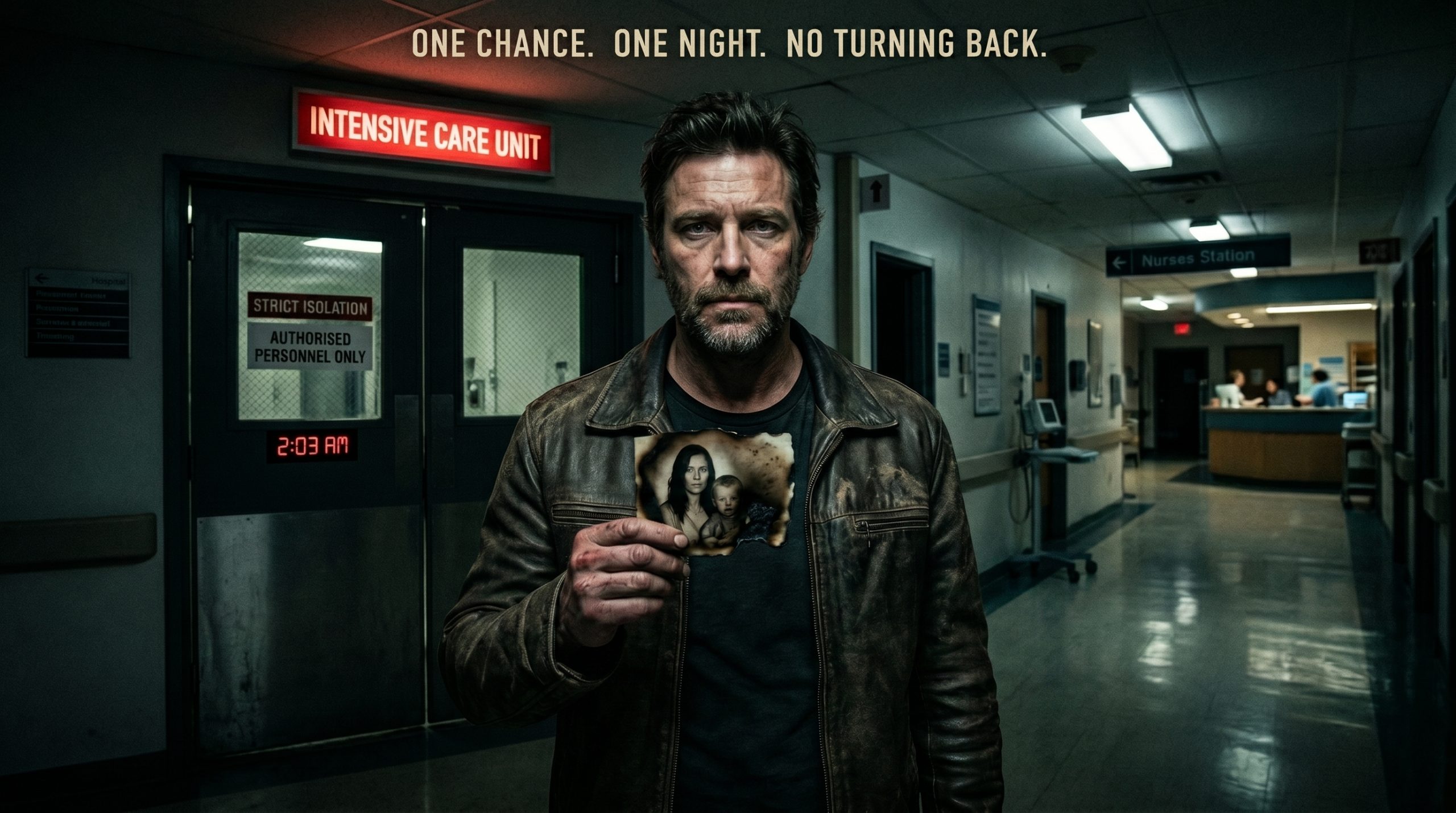
The ICU corridor smelled like antiseptic and old carpet. Fluorescent lights hummed at a frequency designed to make everyone feel slightly ill. Plastic chairs lined the wall — the kind that cost nothing and gave back exactly that. A coffee machine in the corner dispensed something brown that nobody pretended was coffee.
Claire Whitmore had been sitting in chair seven for eleven hours. Her coat was still on. She hadn’t noticed.
Her brother Thomas was behind the sealed doors at the end of the hall. Cardiac arrest at fifty-one. The doctors used words like ‘stable’ the way people use umbrellas — hopefully, while knowing it might not help.
She was staring at the floor when the elevator opened.
Then—
The man who stepped out did not belong here. Worn leather jacket. Road dust on his boots. A jaw that hadn’t seen a razor in four days. He carried nothing except a helmet and the particular stillness of someone who had driven a very long way and hadn’t stopped to think about what came next.
A nurse moved to intercept him. ‘Visiting hours are—’
‘Thomas Whitmore.’ His voice was flat. Not rude. Just done.
Claire looked up.
Close-up on her face. Something shifting behind her eyes — not recognition. Not yet. Something older than recognition.
The man stood at the reception desk with his back to her, helmet hanging from two fingers. The nurse typed. Clicked. Frowned.
‘Are you family?’
‘I don’t know,’ he said.
Claire stood up. Chair scraped. The sound was loud in the corridor silence.
‘Who are you?’ she asked.
He turned.
She had seen her brother’s face every day for fifty years. She knew its shape the way she knew her own name — without thinking, without needing to.
This man’s face was not her brother’s face.
But the eyes.
The eyes were the same pale grey. The same slight downward pull at the outer corners. The same quality of watching everything and giving nothing back.
She sat back down. Hard.
Because she suddenly understood that Thomas had been keeping something from her for a very long time.
The Enforcer at the End of the Hall
His name was Nathan. He didn’t offer a last name.
He took the chair beside Claire without asking and set the helmet on the floor between them. Up close he was older than he’d looked from across the corridor — mid-forties, a scar running along his left jawline that looked like it had been earned, not accidental.
Claire looked at the scar. Then at his eyes. Then at the scar again.
‘How do you know Thomas?’ she asked.
‘I’m not sure I do.’ He picked up a paper cup of something that wasn’t coffee and didn’t drink it. ‘I know the name. I know this hospital. Someone told me to come here.’
‘Who?’
Before he could answer, the elevator opened again.
This man was different. Expensive jacket over a frame built for intimidation. He moved down the corridor with the unhurried purpose of someone who has never had to hurry because doors open before he reaches them.
Nathan went very still.
The enforcer — because that was exactly what he was, Claire understood it without being told — stopped two metres away and looked at Nathan the way a man looks at a problem he has already solved.
‘You’re a long way from your route,’ the enforcer said.
Nathan set down the paper cup. Carefully. ‘I’m visiting a patient.’
‘You don’t have patients.’ The enforcer’s voice was smooth and unhurried. ‘You have a debt. Forty-eight hours, Nathan. That was the arrangement.’
Claire looked between them.
‘He’s not going anywhere,’ she said.
The enforcer looked at her for the first time. His eyes moved across her the way eyes move across furniture.
‘Stay out of family business,’ he said.
She almost laughed. ‘Whose family?’
Nathan reached into his jacket pocket. The enforcer’s hand moved — fast — and Nathan stopped. Held both hands open. Slow. Deliberate.
‘Just a letter,’ Nathan said.
The letter was folded many times, the paper worn soft at the creases. Claire could see that the handwriting on the outside was Thomas’s — she’d know it anywhere.
The enforcer looked at the letter.
For one fraction of a second, something crossed his face. Then it was gone.
But she had seen it.
He’d recognised the handwriting too.
What the Letter Knew
The enforcer’s name was Marcus. Claire learned this from the hospital security guard, who took one look at Marcus standing in the ICU corridor and immediately found somewhere else to be.
Marcus did not touch the letter. That was the tell.
A man who had come here to collect a debt — a man whose entire profession was taking things people wanted to keep — did not reach for that letter. He looked at it the way you look at something you were told no longer existed.
Nathan unfolded it slowly.
The paper was old. The handwriting was Thomas’s, but younger, less certain — the hand of a man writing something he was terrified to write.
Nathan read two lines aloud.
‘If you’re reading this, I didn’t come back from the night of the fourteenth. The child is real. His name is Nathan. His mother was Margaret Hale, and she has a photograph of all three of us that Marcus burned — or thought he burned.’
Silence.
The fluorescent light hummed.
Claire froze completely. Because Thomas had been in hospital the night of the fourteenth — twenty years ago. She had sat in a chair exactly like this one. She had been told he’d been alone.
‘Who burned the photograph?’ she asked, though she already knew.
Marcus answered before Nathan could speak. Answering too quickly — the words out before any pause, before any consideration.
‘That letter is fabricated.’
Nathan looked up from the paper. He had the same quality of stillness as the letter — something that had been folded away for a long time, waiting.
‘Then you’ve read it before,’ Nathan said.
Marcus said nothing.
Nathan reached into his jacket again. This time Marcus did not stop him. Because Marcus was staring at what Nathan drew out — not another document, not a phone.
A photograph.
⚡ CLOSE-UP — the photograph. Water-stained at one corner. One edge charred black, the burn stopped midway. Three people visible: Thomas, a woman, and a child of about two.
The child had the same pale grey eyes as the man holding the photograph.
And standing at the edge of the frame, half-cut off by the camera angle, was a younger version of the man now standing in this corridor pretending none of this was familiar.
Marcus stepped backward.
One step. Involuntary. The tell that mattered.
Twenty Years of Silence
The photograph had a story before it had an owner.
Margaret Hale had taken it on a Sunday morning — Claire pieced this together from what Nathan knew and what the photograph’s back confirmed in faded ballpoint. She had mailed it to Thomas. Marcus, who at that time worked for the man Thomas owed money to, had intercepted it.
He burned it.
Except he burned a copy. Thomas had kept the original inside a book nobody would ever open — a dense legal text, third shelf, home office. Claire had dusted that shelf herself for fifteen years without curiosity.
Nathan had found it three weeks ago. After Margaret died.
‘She kept every letter,’ Nathan said. He wasn’t talking to Marcus anymore. He was talking to the sealed ICU doors at the end of the hall.
Claire sat with that. Thomas had written. Margaret had kept everything. Nathan had grown up knowing a name but not a face, a city but not an address.
A debt had kept them apart. Marcus had enforced that distance for twenty years for a man no one in this corridor dared name aloud.
‘What was the debt?’ Claire asked.
Nathan glanced at Marcus.
Marcus’s jaw tightened. He was recalculating something behind his eyes — she could see the arithmetic of it, what he could deny, what was already proven.
‘It doesn’t matter,’ Marcus said.
‘It matters to me,’ Nathan said. Quiet. Level. ‘He’s my father.’
The word landed in the corridor like something physical.
Marcus looked at the photograph in Nathan’s hand. Then at Nathan’s face. The pale grey eyes, the jawline — the resemblance that didn’t need a DNA test to argue its case.
He reached for the photograph.
Nathan’s hand closed around it first.
Heartbeat pounding louder.
‘That’s not yours,’ Nathan said.
Marcus pulled his hand back. Slow. The gesture of a man who has just understood that the leverage has moved.
Behind the ICU doors, a monitor beeped steadily — Thomas Whitmore, alive, unaware that his son had ridden four hundred miles on a road tip from a dying woman to sit in a plastic chair outside the room where his father was trying not to die.
And that the man paid to keep them apart was now standing two feet away, out of moves.
The Name Nobody Said
Claire made the call herself.
She didn’t ask Marcus’s permission. She walked to the window at the end of the corridor, put her phone to her ear, and spoke for three minutes to a solicitor whose name had been in her contacts for a decade and whose voice, when she explained what she held in her hand, went very quiet in a particular way.
The debt was real. Thirty-one years old. Thomas had borrowed money from a man named William Greer — a name people said carefully, if they said it at all — to save a business that didn’t survive the saving. Marcus had collected interest on that debt for three decades. The arrangement had expanded, over time, to include silence. Margaret’s silence. Thomas’s silence.
Now Margaret was gone. Thomas was behind a sealed door. Nathan was sitting in chair seven with a burned photograph and his father’s grey eyes.
Martin Greer’s name would be in a court filing by morning. Claire’s solicitor was certain of this with the same calm certainty that expensive solicitors use when they know they are looking at something winnable.
Marcus left the corridor at some point. Claire didn’t watch him go.
At eleven-forty, a doctor came through the ICU doors and said Thomas was awake. Asking for water. Asking if anyone was waiting.
Claire looked at Nathan.
He was still holding the photograph. He was looking at the ICU doors the way a person looks at something they have wanted for so long that the wanting has become the permanent state and the getting seems almost impossible to imagine.
‘He doesn’t know you’re here,’ Claire said.
‘No.’
‘Do you want me to come with you?’
Nathan stood. The helmet stayed on the floor. The photograph went into his jacket pocket, over his heart.
‘I’ve been doing things alone for forty-five years,’ he said. It was not a complaint. Just information.
He walked to the ICU doors.
The doctor held one open.
Nathan stopped in the doorway — one second, two — and Claire saw his shoulders drop by exactly the amount a person’s shoulders drop when they finally, after a very long time, stop carrying something alone.
Then he stepped through.
The door sealed behind him.
Claire sat down in chair seven and stared at the photograph Marcus had tried to burn twenty years ago — still in her hand, the charred edge cold against her fingers — and wondered what Thomas’s face looked like right now, in that room.
She would never be able to ask him. Because Thomas would never be able to find the words for a moment like that.
But Nathan would remember it for the rest of his life.
