


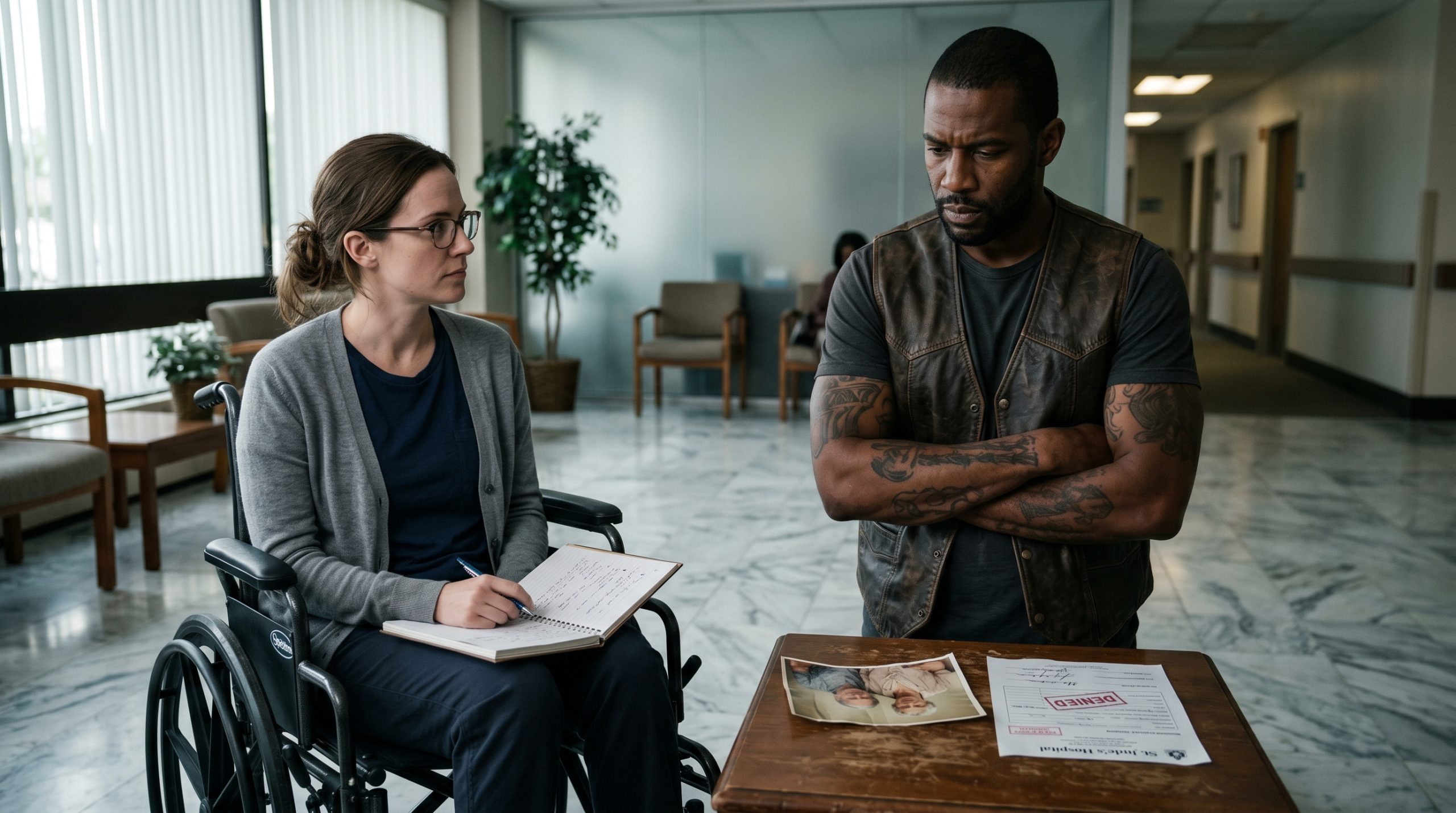
The Waiting Room
The private hospital was too quiet for a building full of people trying not to die.
Marble floors. Cream walls. A single orchid on the reception desk that had never once dropped a petal, because nobody real enough to cause a mess was supposed to be here. The waiting room smelled of antiseptic beneath a layer of something expensive — cedar, maybe, or money pretending to be cedar.
Claire Morrow had been here before. Not this exact waiting room, but rooms like it. Rooms where the furniture cost more than her annual salary and the silence was the point — designed to make certain people feel they didn’t belong.
She had been told, twice in writing, that the hearing had been rescheduled. She had received no formal notice of either rescheduling. She had attended anyway. Both times. And the time before that, when they moved it without telling her at all. She kept a notebook — a plain black one, spiral-bound, the kind you buy in a pharmacy — with every date, every time, every name of the person behind the desk who had looked at her wheelchair and spoken slowly, as if her spine and her mind were the same thing.
The notebook was in her lap now.
She heard them before she saw them. Two men, big in the shoulders, wearing leather — not the expensive kind — coming through the main entrance with the particular stillness of people who are comfortable being looked at. The taller one stopped just inside the door. He looked at the room the way someone looks at a room they have been told lies about. His name was Nathan Voss. He was forty-one, wide-jawed, with a black eagle tattoo covering his left forearm, and he had driven four hours because Claire had left him a voicemail at six in the morning that said only: *They’re doing it again.*
He had understood immediately.
Six years earlier, Claire’s sister had sat in a room almost exactly like this one and been told, very politely, that her treatment plan had been revised. She had not been consulted about the revision. She had died eight months later. The coroner’s report cited a delay in care. The delay had never been formally investigated. Claire had tried. Nathan had helped her try. The case had been closed by a review board whose chairman, she later discovered, served on the hospital group’s advisory committee.
That chairman’s name was Dr. Harrison Wells.
Dr. Harrison Wells was currently seated across the waiting room, speaking quietly into his phone, not looking up.
Claire looked at Nathan. Nathan looked at Claire. Neither of them spoke.
Then—
The double doors at the far end of the waiting room opened, and a woman in a structured charcoal coat walked through them without pausing. Margaret Holt. Lead counsel for the hospital group. She had handled the original review. She had also, Claire had recently discovered, co-signed the revised treatment protocol that had been applied to Claire’s sister without consent.
Margaret Holt looked at Claire Morrow in her wheelchair.
She looked at Nathan Voss in his leather vest.
She looked at the notebook in Claire’s lap.
And she smiled the smile of someone who has never once lost.
What the Notebook Held
Margaret Holt did not walk toward Claire. She walked toward the reception desk, spoke briefly to the woman behind it, and then turned — as if remembering — and crossed the marble floor in Claire’s direction. Her heels were precise on the tile. Each step measured.
“Ms. Morrow.” She did not sit. “I wasn’t aware you’d been given a confirmed time for today.”
“I wasn’t,” Claire said. “That’s the point.”
Margaret’s expression did not shift. “The hearing has been rescheduled again. You should have received —”
“Notification number fourteen,” Claire said. She opened the notebook. “The first was sent by email at 11:47 p.m. on a Friday. The second arrived by post, dated the day of the original hearing. The third —” She turned a page. “The third was delivered to my previous address, which I had updated in writing seven months prior.”
Margaret looked at the notebook.
For exactly one second, something moved behind her eyes. Not concern. Not guilt. Something more like recalculation.
“I understand your frustration —”
“I don’t need you to understand my frustration,” Claire said. “I need you to explain why the revision to my sister’s treatment protocol bears your signature alongside Dr. Wells’s.”
Across the room, Dr. Harrison Wells stopped talking into his phone.
He did not look up. But he stopped.
Nathan had not moved from his position near the entrance. He stood with his helmet held at his side, weight forward, arms slightly away from his body — the particular posture of a man who has decided he is not leaving. Behind him, through the glass entrance, his motorcycle was visible at the kerb.
Margaret Holt turned very slightly toward him, then back to Claire. “Any questions about the protocol should be directed to the clinical committee —”
“The clinical committee was chaired by Dr. Wells,” Claire said. “Whose appointment to that committee was approved by the board. Whose board seat was renewed — three weeks after my sister’s case was closed without investigation — by a unanimous vote.” She turned another page in the notebook. “I have the minutes.”
The orchid on the reception desk had not moved. The cream walls had not changed. The antiseptic smell beneath the cedar was still there, doing its quiet work.
But the room felt different now.
Margaret Holt looked at the notebook again. This time she looked at it the way you look at something you thought you had already dealt with.
She had not dealt with it.
Claire had spent three years making sure of that.
The notebook contained dates. Names. Meeting minutes obtained through a formal disclosure request that had taken eleven months to process. A letter, folded inside the back cover, from a junior clinician who had been present when the protocol revision was discussed — and who had, quietly, been reassigned to another facility six weeks later. And on the final page, in Claire’s own handwriting, a case number.
The same case number that appeared on a complaint filed four years ago.
Filed under a different name.
Claire’s name, before she was married.
She had written the original complaint herself.
The Outrage
Margaret Holt reached for the notebook.
Not a grab — a smooth extension of the hand, the gesture of someone accustomed to taking things off tables in boardrooms and not being questioned about it. Her fingers closed around the cover.
Claire did not pull it back. She let her.
Nathan Voss took one step forward. One. He didn’t need to take another. The sound of his boot on the marble was enough. Margaret’s hand stilled.
“You want to put that down,” Nathan said. He was not loud. He was the opposite of loud. He was the kind of quiet that fills a room the same way a large animal fills a corridor — not by making noise, but by being present enough that noise becomes unnecessary.
Margaret set the notebook down.
“This is a private medical facility,” she said. Her voice had found its edge again. “You have no standing here. Either of you. Ms. Morrow’s claim was reviewed and closed. The process was —”
“Conducted by the man who signed the order.” Claire’s voice was level. “Dr. Wells chaired the review of a protocol revision he co-authored. That is not a process. That is a performance.”
Across the room, Dr. Wells stood up.
He was a tall man — silver-haired, straight-backed, with the particular ease of someone who has spent forty years being the most important person in any room he walked into. He crossed the waiting room without hurry. He stopped beside Margaret Holt, looked at Claire, and then looked at Nathan with the expression of a man who has summoned security before and found it effective.
“Ms. Morrow,” he said. “I understand this is a painful time for your family. But the decisions made regarding your sister’s care were made by a qualified clinical team, in accordance with —”
“She told me,” Claire said.
He stopped.
“My sister. She told me, six weeks before she died, that she had asked three times to review her revised treatment plan with an independent specialist. She was told the request had been processed. It had not been processed. I have her written requests. I have the response letters — all three of them — signed by a patient liaison who, I have since established, had no clinical qualification and was not authorised to make decisions regarding specialist referrals.”
She opened the notebook to the back cover. She removed the folded letter.
“And I have this.”
It was a single page. Handwritten. From the junior clinician who had been present in the room when Harrison Wells had said — quietly, calmly, in front of four other people — that the patient’s requests were “an administrative inconvenience” and that the revised protocol would proceed regardless.
She had written it down. Word for word. And then she had given it to Claire, two years later, when she no longer worked for the hospital group.
Claire set it on the table between them.
Dr. Harrison Wells looked at the letter.
He did not reach for it. He did not speak.
But his hand, resting at his side, closed into a fist so slowly that she almost missed it.
Almost.
He answered too quickly. “That letter has no legal standing —”
“It has a witness,” Claire said. “And she’s prepared to give evidence.”
She had known for three years. She had waited until there were people in this room who could not look away.
Heartbeat pounding louder.
Margaret Holt turned to Wells. Wells turned to Margaret. The look that passed between them was not a strategy. It was a recognition — a two-person understanding that the thing they had each believed was buried had just walked back into the room on four years of accumulated evidence and sat down in a wheelchair in their waiting room and waited for them to make the first move.
They had made it.
Claire closed the notebook.
