


Nobody Was Eating
Nobody at the reception was eating the food, and nobody was talking about why.
The estate dining room smelled of white lilies and cold canapés. Linen napkins folded into swans. Three bartenders standing at attention behind a table nobody approached. Outside the tall windows, the grounds were grey and still, the kind of grey that comes before rain and stays.
Harrison Vane’s funeral had drawn eighty people who did not grieve him.
They stood in clusters near the walls, drinking slowly, keeping their backs to the room’s center. Voices stayed low — not from respect but from something closer to surveillance. Eyes moved. Hands held glasses without lifting them.
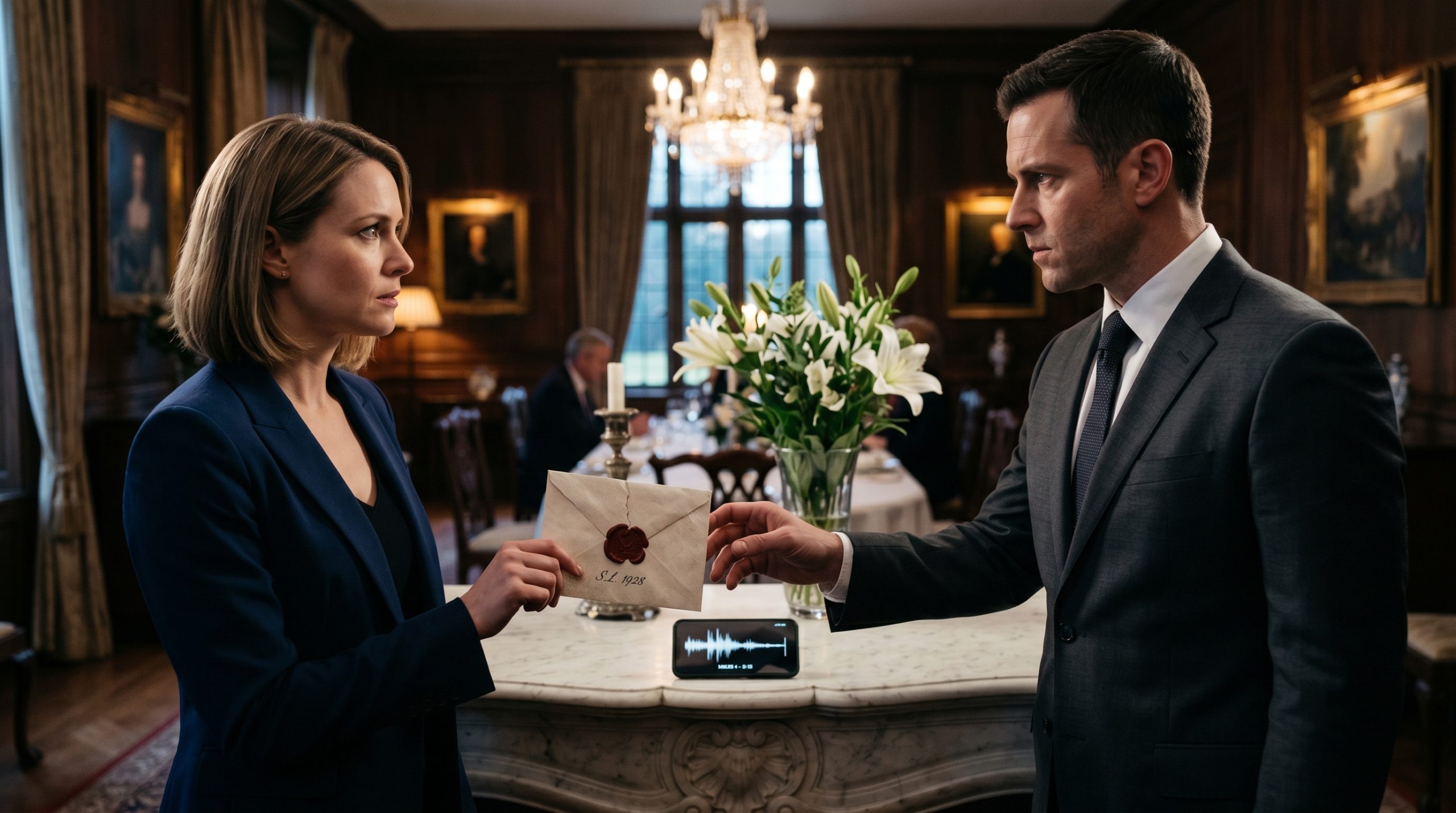
Grace Whitmore stood near the fireplace with a glass of water she had not touched. Thirty-four years old, junior archivist at a military records department in a converted building outside Bristol, she wore a dark blazer that did not fit the estate and flat shoes that had never seen carpet this thick. She had no reason to be here that she could explain to anyone in this room — not without showing them the document she had found six weeks ago, buried in a transfer box labelled VANE, H.A. — DECLASSIFICATION PENDING.
She had recognised the case number on page four.
Not because of the file. Because of her brother. Because eleven years ago, a coroner’s report had used that same number in a footnote and her brother’s name had been in the body text and nobody had been able to tell her why those two things belonged in the same sentence.
She had not told her supervisor she was coming here.
She had not told anyone.
At the far end of the room, a man in a leather vest moved through the crowd with the ease of someone who had never been asked to leave a room and had never expected to be. Broad. Unhurried. A black eagle tattoo covered his left forearm, the wing curling toward the wrist. He was not holding a drink. His eyes moved the way a trained person’s eyes moved — from door, to face, to door.
He stopped near the fireplace.
Three feet from Grace.
She did not look up.
But she noticed his shoes. Heavy boots with visible heel wear. And beneath his open vest, on the right side of his ribs, a scar she could see through the thin fabric of his shirt — curved, white, old.
Grace froze completely.
Because she had a scar in exactly the same place. Same curve. Same age. And she had never in her life been able to explain how she had got it.
The Sealed Envelope
His name was Daniel Marsh.
She learned that in the next four minutes, standing close enough to the fireplace that the warmth justified neither of them moving away. He told her almost nothing. He worked collection. He said it the way a person says they work construction — a noun, not a confession. The leather vest was not a costume. The tattoo was not decoration.
She told him she worked in records.
Neither of them mentioned the scar.
What Grace did not tell Daniel — what she had told no one — was what had been inside the VANE, H.A. transfer box alongside the classified mission file. There had been a sealed envelope. Thick, cream-coloured, sealed with wax that had cracked at one edge from age. Her name was on the front in handwriting she did not recognise. Not her office address. Her childhood address. The house her mother had sold when Grace was nine.
She had not opened it at the office.
She had carried it home in the inner pocket of her coat, pressed against her ribs all the way on the train, aware of every bump and corner. She had set it on her kitchen table and made tea she did not drink and sat across from it for forty minutes.
She had not opened it then either.
The envelope was in her bag now. She had brought it here because the file had told her Harrison Vane had requested it be delivered to his estate upon unsealing — and because something in her had understood, reading page four, that the person who needed to hear whatever was inside it was not a records department.
It was whoever had been in that room with her brother the night the coroner’s report was filed.
The man across the estate — the one standing near the tall windows with his back to the room, suit precisely fitted, silver watch catching the grey light — had not spoken to anyone. He had arrived after everyone else and had not signed the guest book. Three people had glanced at him and looked away quickly. One woman had left the room entirely after noticing him.
Grace watched him without appearing to watch.
Daniel Marsh watched him too. She could feel it in the way Daniel’s body had gone very still.
William Farrow. The name appeared on page eleven of Harrison Vane’s classified file, in a section that had not been fully redacted — someone had been careless, or someone had been deliberate.
William Farrow. Private contracting. Debt enforcement. A man the file described as operating under the protection of a procurement agreement that had never been entered into public record.
Grace reached into her bag.
The envelope was still there. She closed her fingers around it without pulling it out.
The wax seal had one small crack along the left edge — it had been there when she found it. Someone had tried to open it once. Had stopped.
What Farrow Said
He crossed the room at 4:17 in the afternoon, and Grace knew it was deliberate because every other person in that room had been avoiding crossing it.
William Farrow moved like a man who had never been told no by a room. Fitted charcoal suit, not a crease in it. Face angled toward her. Cold pale eyes set wide, sharp jaw, silver-blond hair swept back from a high forehead. He stopped in front of her with the particular stillness of a person who had rehearsed nothing because they had never needed to.
He looked at the bag in her hands.
— “You’re an archivist. This isn’t your case.”
The room did not freeze dramatically. Glasses continued to be held. But in a radius of six feet, conversation stopped. One woman near the window turned her face away but did not move her feet.
Grace said nothing.
Farrow reached for her bag.
Not a lunge. A smooth, practiced extension of one arm — the gesture of a man who had reached for things that belonged to other people many times and had always received them. His hand closed over the strap.
Daniel Marsh took one step forward.
Farrow’s hand tightened.
“That envelope,” Farrow said quietly, “was misfiled. It belongs to the estate.”
Grace pulled the bag back. Not violently. She simply did not release it.
“The estate solicitor will confirm that,” Farrow said. His voice had not changed. It never did. She understood, reading his face, that this was a man who had never needed to raise his voice because every room he entered had already agreed with him before he arrived.
Her brother’s name. A coroner’s footnote. A case number that had no business being in a classified mission file.
She thought about all three of those things.
Then she thought about the car park outside. She had parked close to the exit deliberately. She had the envelope. She could walk to her car right now, drive to her supervisor’s office, hand it over through proper channels, file the query through the declassification desk, wait the standard four-to-six weeks—
She picked up her bag fully. Shifted it to her shoulder.
Farrow watched.
Daniel Marsh was still beside her, not touching her, not speaking. Just present.
Grace thought about proper channels. She thought about the four-to-six weeks. She thought about the eleven years she had already given to proper channels and the footnote that had never been explained.
She set the bag back down on the mantelpiece.
And reached inside it.
Farrow’s eyes moved to her hands a half-second too quickly — not a flinch, something quieter than a flinch, the involuntary tracking of a man who knew exactly what was in that envelope and had known before she had.
His glass tilted slightly in his hand. Not dropped. Adjusted. But the adjustment was wrong — a quarter-inch too late, a quarter-inch too far.
Grace noticed.
She did not reach for the envelope. She reached for her phone.
