


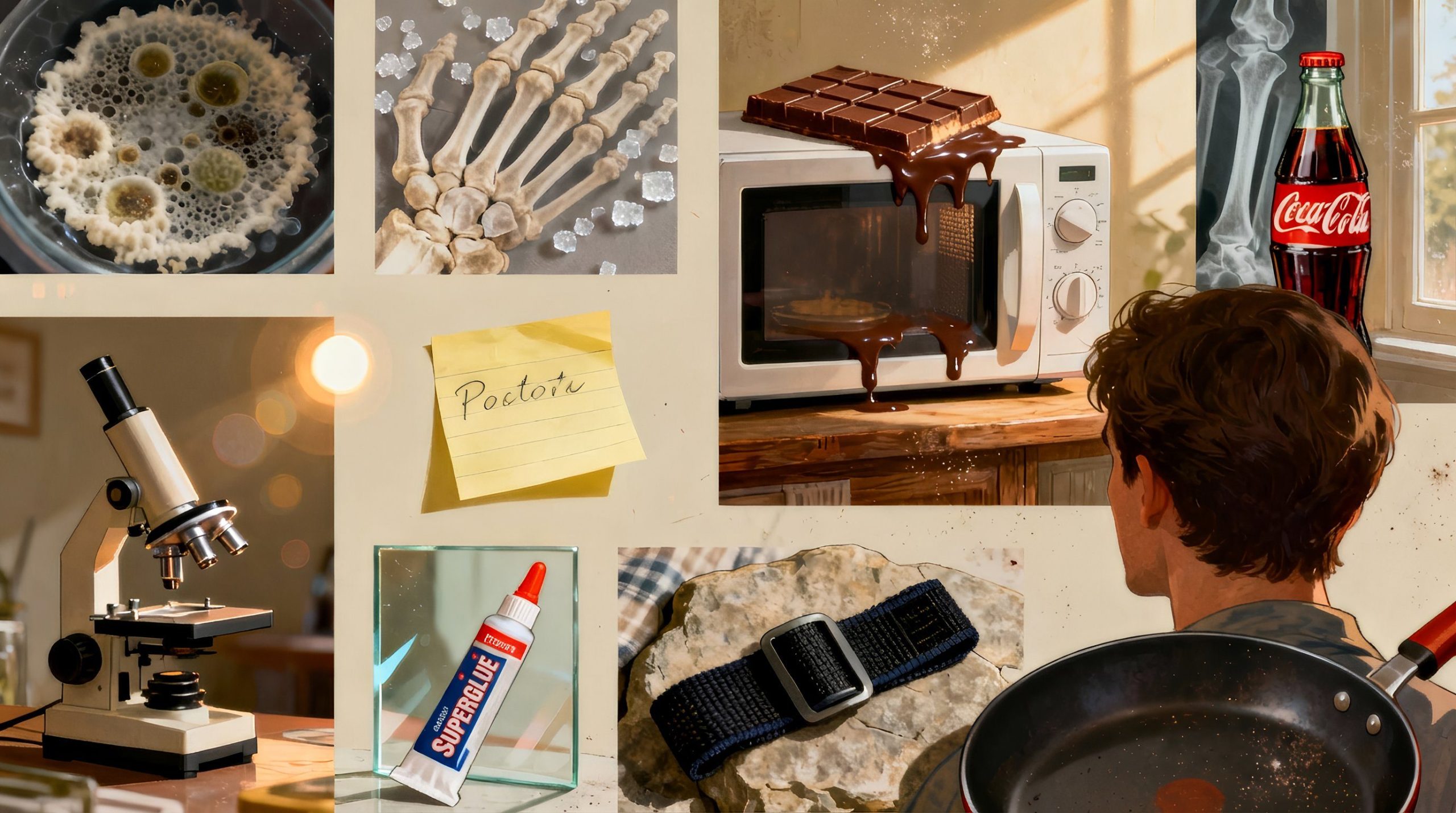
Ever bitten into a chocolate bar that melted in your pocket and sparked a kitchen revolution? Or noticed a weird mold on a forgotten lab dish that ended up saving millions of lives? Some of the biggest game-changers in history didn’t come from careful planning—they were total flukes.
Welcome to the fascinating world of 10 life-changing inventions that were complete accidents. These “oops” moments turned into everyday essentials we can’t live without. Let’s dive into the surprising backstories that prove mistakes can be magical.
Penicillin: Mold That Fought Bacteria
Alexander Fleming was exhausted after a long holiday in 1928. He came back to his London lab and spotted fuzzy blue-green mold on a petri dish he’d left out. Instead of throwing it away, he looked closer. The bacteria around the mold had vanished!
That mold was Penicillium notatum, and it was secreting a bacteria-killing juice. Fleming called it penicillin. Years later, scientists figured out how to mass-produce it, and it became the first true antibiotic.
Fun fact: During World War II, penicillin saved countless soldiers who would have died from infected wounds. Today it’s still a frontline weapon against infections.
Post-It Notes: The Glue That Refused to Stick
In 1968, 3M chemist Spencer Silver was trying to create the world’s strongest glue. He ended up with the opposite—a weak, reusable adhesive that stuck lightly and peeled off cleanly. For five years it sat on a shelf, labeled “failure.”
Then colleague Art Fry got annoyed when his choir bookmarks kept slipping out of his hymn book. He coated paper with Silver’s weak glue and—bam!—the first Post-it Note was born in 1980.
Offices, fridges, and school lockers everywhere thank this happy accident.
Microwave Oven: A Melted Candy Bar Mystery
Percy Spencer was standing near a magnetron (a radar tube) in 1945 when he felt something warm in his pocket. A chocolate bar had melted! Curious, he tried popcorn kernels next—they popped. Then an egg exploded all over his face.
He realized microwaves could heat food from the inside out. The first commercial microwave (the Radarange) was huge, weighed 750 pounds, and cost $5,000 in today’s money. Now we have countertop versions in almost every kitchen.
X-Rays: Invisible Rays That Revealed Bones
Wilhelm Roentgen was playing with cathode-ray tubes in 1895 when a nearby fluorescent screen started glowing—even though it was shielded. He put his hand in front of the tube and saw the bones of his hand on the screen. He called the mysterious rays “X” because they were unknown.
Doctors immediately started using X-rays to find broken bones without cutting anyone open. Roentgen won the first Nobel Prize in Physics in 1901.
Velcro: Burrs That Inspired Sticky Magic
Swiss engineer George de Mestral took his dog for a walk in 1941. When they got home, both were covered in burrs. Under a microscope, de Mestral saw tiny hooks grabbing onto loops—just like nature’s own Velcro.
After years of trial and error, he patented the hook-and-loop fastener in 1955. NASA used it on spacesuits, and today it’s on kids’ shoes, medical braces, and even airplane seats.
Coca-Cola: Headache Tonic Turned Soda Empire
Pharmacist John Pemberton was mixing up a syrup in his Atlanta backyard in 1886 to ease headaches. He added coca leaves, kola nuts, and carbonated water. Customers at his pharmacy loved the fizzy drink so much he sold the recipe for $2,300.
By 1899, Coca-Cola was a national sensation. The secret formula is still locked in a vault today!
Saccharin: The Sweet Taste on Unwashed Hands
Russian chemist Constantin Fahlberg was studying coal-tar compounds in 1879. He skipped washing his hands before dinner and noticed his bread tasted sweet. He rushed back to the lab and isolated saccharin—the first artificial sweetener.
It became a lifesaver for diabetics who wanted sweetness without sugar. You’ll still find it in those pink Sweet’N Low packets.
Safety Glass: Shattered Flask That Didn’t Break
French chemist Édouard Bénédictus dropped a glass flask in 1903. It cracked but held together because cellulose nitrate coating had dried inside. He realized laminated glass could stop dangerous shards.
Car windshields started using it in 1927. Today it’s in every vehicle, skyscraper windows, and even bullet-resistant glass.
Superglue: Sticky Failure That Became Super
During WWII, Harry Coover was trying to create clear plastic gun sights. Instead he made a chemical that glued everything instantly. The military said “no thanks” for sights, but in 1958 it hit stores as Eastman 910—later renamed Krazy Glue and Super Glue.
Surgeons even use medical versions to close wounds without stitches!
Teflon: Slippery Gas That Changed Cooking
Roy Plunkett was storing refrigerant gas in 1938 when the can wouldn’t release any more. He cut it open and found a waxy white powder that was super-slippery. DuPont branded it Teflon.
The first non-stick pans arrived in 1958. Today Teflon is also in space suits, pipes, and even heart stents.
What These Accidental Discoveries Teach Us
- Curiosity wins. The people who changed history didn’t ignore weird results—they investigated.
- Failures aren’t final. A “bad” glue or melted candy became billion-dollar ideas.
- Nature and chance are brilliant teachers. Burrs, mold, and cracked flasks had lessons to share.
- Timing matters. Some inventions waited years for the right person to see their potential.
FAQ: Your Burning Questions About Accidental Inventions
What was the most life-saving accidental invention? Penicillin. It has saved an estimated 200 million lives since its widespread use began.
Which accidental invention made the most money? Coca-Cola. The brand is now worth over $100 billion.
Are there any accidental inventions still being discovered today? Absolutely! Scientists find new uses for graphene and even some cancer drugs started as “failed” experiments.
Did any of these inventors get rich from their accidents? Not all. Fleming never patented penicillin, and de Mestral earned royalties but not billions. Many companies profited more than the inventors themselves.
Can I try to make my own happy accident? Yes! Keep a notebook, experiment freely, and never throw away a weird result without asking “What if…?”
These 10 life-changing inventions that were complete accidents remind us that the best ideas often sneak up on us. Next time something goes wrong in your kitchen, lab, or garage, pause. That “mistake” might just be the start of something incredible.
