


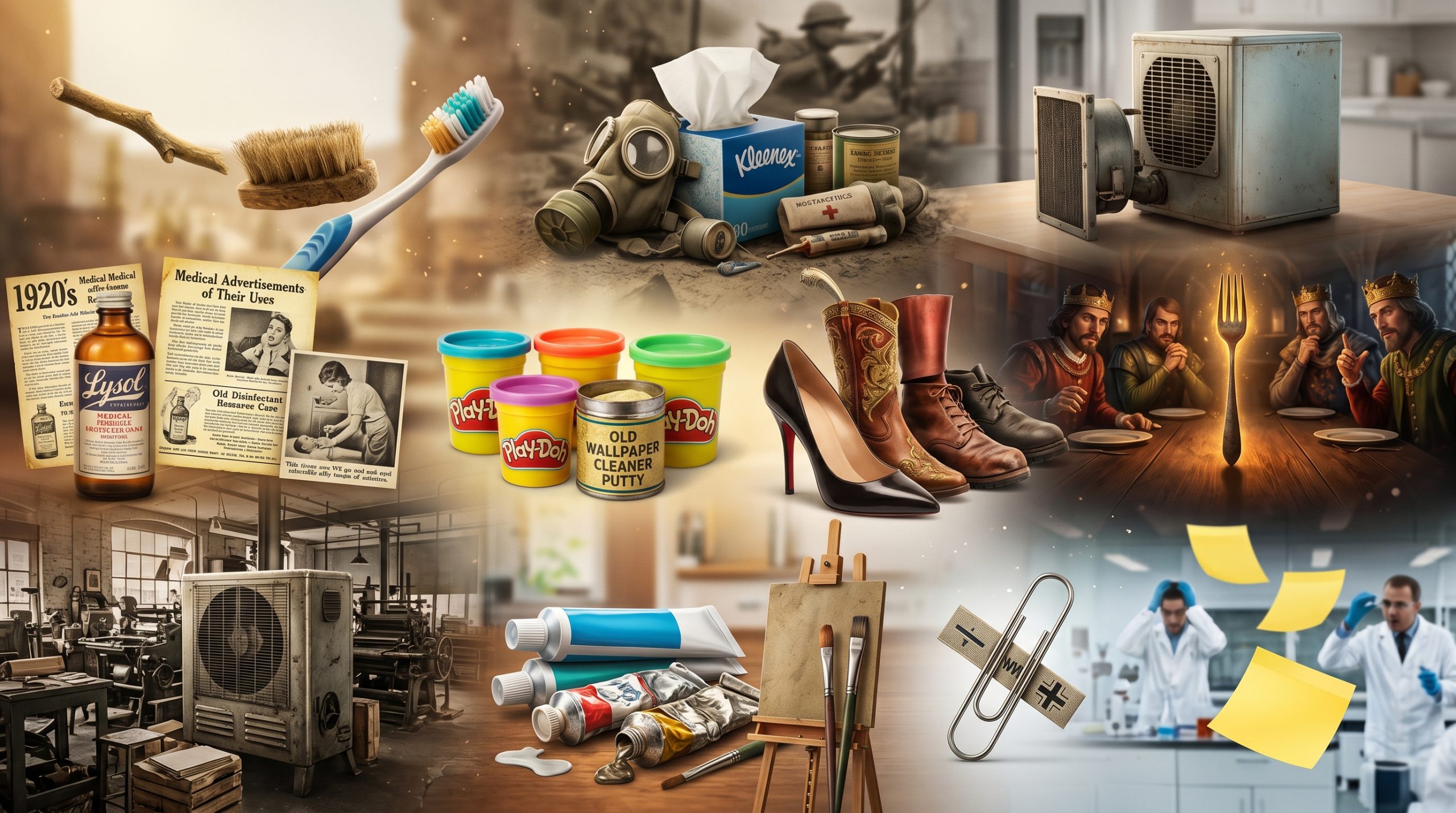
Have you ever stopped mid-brush with your toothbrush or while spritzing some disinfectant and wondered, “Where did this thing even come from?” It’s easy to take the stuff around our homes for granted, but dig a little deeper, and you’ll uncover some wild stories. From accidental inventions born out of wartime necessities to quirky fixes for everyday problems, the histories behind these common objects are anything but ordinary. In this article, we’ll dive into the surprising origins of household items you probably use every day, revealing how they evolved from odd beginnings into the essentials we can’t live without. Trust me, some of these tales will make you see your kitchen or bathroom in a whole new light. Let’s jump in and explore the fascinating history of everyday objects that shape our routines.
1. The Toothbrush: From Twigs and Hog Hair to Modern Bristles
Picture this: thousands of years ago, people were scrubbing their teeth with whatever they could find in nature. The origins of the toothbrush date back to ancient civilizations like the Egyptians and Babylonians around 3500 BC, who chewed on frayed twigs from aromatic trees to freshen their breath and clean their mouths. Fast-forward to the 15th century in China, and things got a bit more structured—they started attaching coarse hog hairs to bamboo or bone handles. Yeah, you read that right: bristles from pigs’ necks were the go-to for centuries because they were tough yet flexible.
It wasn’t until the 1930s that nylon replaced animal hair, thanks to DuPont’s invention of synthetic fibers, making toothbrushes more hygienic and mass-producible. I’ve always found it amusing how something as simple as oral hygiene evolved from gnawing on sticks to the electric wonders we have today. If you’re curious about upgrading your routine, think about how far we’ve come—no more hog hair required!
2. Lysol: A Disinfectant with a Shocking Medical Past
Lysol is that trusty spray we grab to wipe down counters or freshen up the bathroom, but its history is way more intense than a quick clean. Back in the late 19th century, it was developed in Germany to combat a cholera outbreak in Hamburg. By the early 1900s, it gained fame during the 1918 Spanish flu pandemic, advertised as a household savior against germs.
But here’s where it gets really surprising—and a bit uncomfortable. In the 1920s and ’30s, Lysol was marketed as a feminine hygiene product for “marital hygiene,” essentially as a form of birth control. Ads promised “complete freshness” and even implied it could prevent unwanted pregnancies, though it was ineffective and dangerous. Thankfully, by the mid-20th century, regulations shifted its focus back to safe disinfection. Next time you use it, remember: this bottle has seen some wild pivots in its lifetime. It’s a reminder of how product histories can reflect changing societal norms.
3. Kleenex: Born from World War I Gas Masks
Tissues seem so innocuous, right? Just a soft square for sniffles or spills. But Kleenex’s origins tie back to the trenches of World War I. In 1915, Kimberly-Clark developed a thin, absorbent material called Cellucotton as a filter for gas masks and a substitute for cotton bandages, which were in short supply.
After the war, with stockpiles left over, they repurposed it. First, in 1920, as Kotex sanitary pads, and then in 1924 as Kleenex facial tissues—initially pitched as a cold cream remover for Hollywood stars. It wasn’t until consumers started using them for noses that the company caught on and rebranded. I love how wartime innovation turned into something as everyday as blowing your nose. It’s like a little piece of history in every box.
4. Play-Doh: From Wallpaper Cleaner to Kid’s Plaything
If you’ve ever molded a wonky sculpture out of Play-Doh, you might be shocked to learn it started as a household cleaner. In the 1930s, when homes were heated by coal, sooty residue built up on wallpaper. A Cincinnati company created a pliable putty made from flour, water, salt, and other ingredients to wipe it away without damaging the walls.
By the 1950s, with gas and electric heating replacing coal, sales tanked. But a nursery school teacher (the inventor’s sister-in-law) discovered kids loved playing with it. They added colors, removed the detergents, and voilà—Play-Doh was born in 1956. It’s one of those happy accidents that turned a failing product into a creativity staple. Makes you appreciate how necessity (or in this case, boredom) sparks invention.
5. High Heels: Practical Footwear for Butchers and Soldiers
High heels scream fashion today, but their roots are grounded in functionality—and not for women initially. In the 10th century, Persian cavalry wore heeled boots to secure their feet in stirrups while shooting arrows on horseback. By the 16th century, European butchers adopted them to elevate their feet above blood and muck in slaughterhouses.
It was King Louis XIV of France in the 1600s who popularized them as a status symbol for men, adding red soles to show off wealth. Women adopted the style later, but the practical origins? Totally surprising. I’ve worn heels that felt like torture devices, so knowing they started as work boots for messy jobs adds an ironic twist.
6. Forks: Once Seen as the Devil’s Tool
Eating with a fork feels second nature, but in medieval Europe, it was downright scandalous. Forks originated in the Byzantine Empire around the 4th century for spearing sticky fruits, but when an 11th-century Byzantine princess brought them to Italy, the church condemned them as “instruments of the devil”—unnatural and effeminate compared to using hands or knives.
It took centuries for forks to catch on; by the 1600s, they spread via French royalty. Thomas Coryat, an English traveler, introduced them to Britain in 1611, but even then, they were mocked. Next time you twirl pasta, think about how this simple utensil overcame religious backlash to become a dining essential.
7. Air Conditioning: Invented to Fix Printing Problems
On a sweltering day, AC is a lifesaver, but it wasn’t created for human comfort. In 1902, Willis Carrier designed the first modern system for a Brooklyn printing company plagued by humidity warping paper and smearing ink during summer.
His “Apparatus for Treating Air” controlled temperature and moisture, boosting productivity. It spread to factories, then theaters in the 1920s (drawing crowds for “cool” movies), and homes by the 1950s. Carrier’s invention literally changed how we live and work. It’s funny how a business headache led to something we now can’t imagine summers without.
8. Toothpaste Tubes: A Painter’s Bright Idea
Toothpaste in a tube? We owe that to an American painter named Washington Sheffield in 1892. Before then, toothpaste came in jars, which was messy and unhygienic. Inspired by artists’ paint tubes, Sheffield adapted the collapsible metal design for his dental cream.
Colgate adopted it in 1896, making oral care portable. Plastic tubes came later in the 1950s. It’s a small change that made a big difference—imagine dipping your brush into a shared jar! This crossover from art to hygiene shows how ideas bounce between fields.
9. Paperclips: A Symbol of Resistance in WWII
The humble paperclip, patented in 1899 by Norwegian Johan Vaaler (though similar designs existed earlier), has a heroic twist. During World War II, Norwegians wore paperclips on their lapels as a subtle protest against Nazi occupation—symbolizing “sticking together.”
Post-war, it became a national emblem. Today, it’s just for holding papers, but that backstory adds depth. I’ve clipped countless documents without thinking twice, but now it feels like a tiny badge of unity.
10. Post-It Notes: An Accidental Adhesive Breakthrough
Those sticky notes cluttering your desk? They stem from a 1968 lab flop at 3M. Scientist Spencer Silver aimed for a super-strong glue but got a weak, repositionable one instead. Years later, colleague Art Fry used it to bookmark hymns without damaging pages.
Launched in 1980, Post-Its became office staples. It’s a classic tale of turning failure into fortune. I can’t count how many reminders they’ve saved me from forgetting—proof that mishaps can lead to genius.
There you have it—10 eye-opening origins of household items that prove history hides in the mundane. From wartime repurposing to quirky inventions, these stories remind us how innovation often springs from unexpected places. Next time you grab a tissue or click on the AC, you’ll have a fun fact to share. What’s the most surprising one to you? Drop it in the comments below—I’d love to hear your thoughts or any other origins you know!
