


The Gala
The charity gala cost more to attend than most people made in a year, and everyone there had agreed not to think about that.
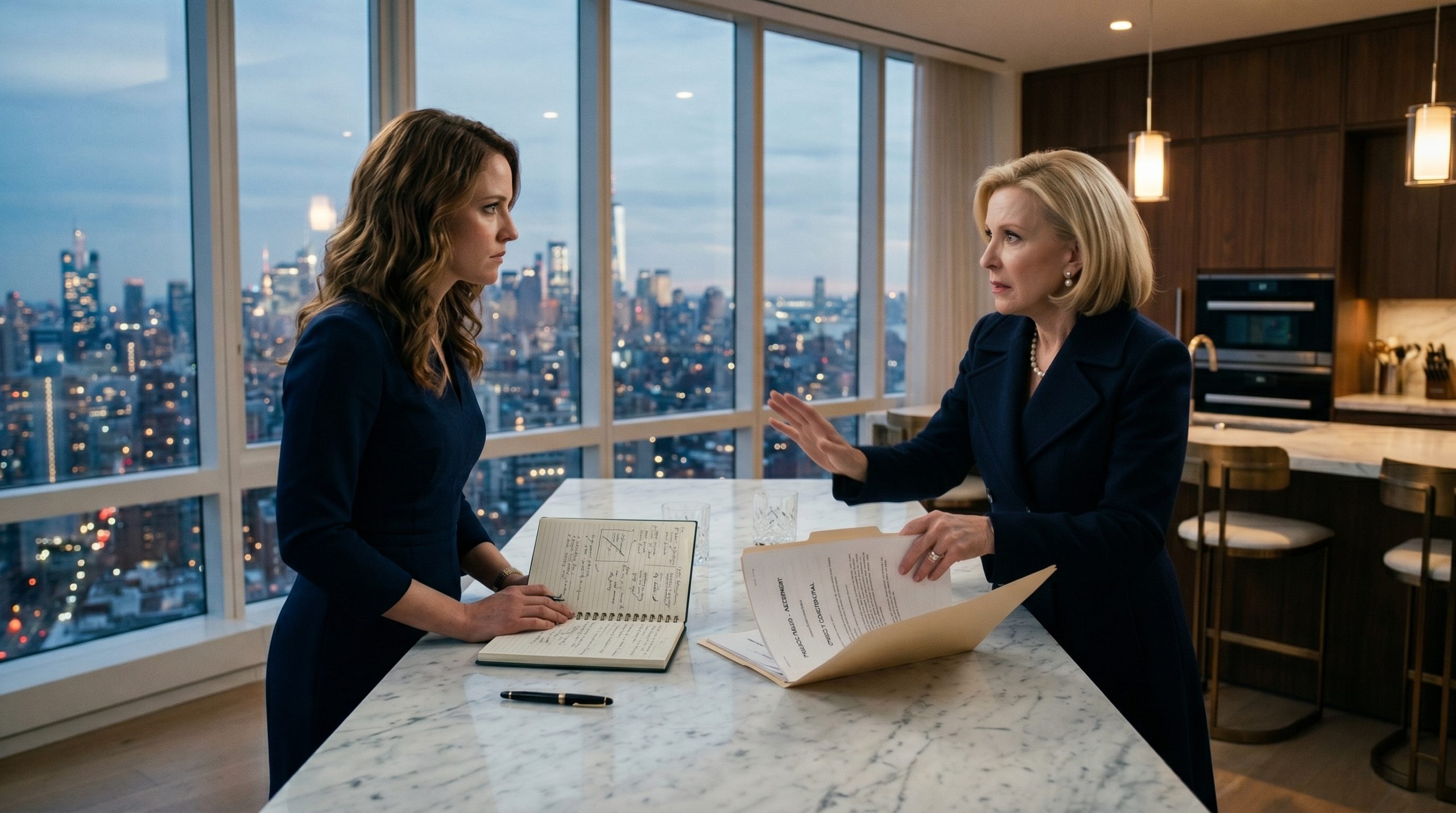
Crystal hung from the ceiling of the Meridian Tower penthouse like frozen rain. The marble counters ran the full length of the kitchen — twenty feet of white Carrara, not a mark on them. Floor-to-ceiling windows held the city at arm’s length, all glass and distance and controlled light. Champagne moved on silver trays. Conversations moved faster.
Claire Hargrove stood near the window with a glass she hadn’t touched. She was wearing the navy dress she’d bought the week after the custody judgment, the one she’d promised herself she’d wear when it was over. It wasn’t over. But she needed to feel it tonight.
She had driven two hours for this. She had not been invited.
The name on the donor register she’d found in the court file — Voss & Partners — had led her here. Not directly. It had taken eleven months of requests, redacted responses, and one paralegal who’d accidentally left a filing reference unredacted before someone caught it. Eleven months to place a name on a building.
And then — a face.
Victoria Hargrove moved through the room the way she always had: as if the room had arranged itself for her. Dark hair. Pearls. A designer coat worn indoors because she had never adjusted for a room in her life. She was laughing at something. Her hand was on the arm of a man Claire didn’t recognise — older, silver-haired, the kind of comfortable that came from never having been refused anything.
Claire had last seen Victoria in a courtroom. Victoria had been composed then too. She had sat behind her solicitor and looked at the judge and not once at Claire, and the judge had granted the emergency custody variation because Victoria’s legal team had filed a welfare concern that cited — among other things — Claire’s “emotional instability” and “pattern of erratic behaviour.”
The welfare concern had been submitted on a Thursday. Claire had been served on the Friday. Her daughter had been collected from school by Victoria’s driver the following Monday, before Claire could file a response.
That had been fourteen months ago.
She set her glass down on the nearest surface without looking for a coaster.
Then—
Victoria turned. And saw her.
What the File Said
The recognition on Victoria’s face lasted exactly one second before it was replaced by something else. Not surprise. Victoria Hargrove had not been surprised by anything in twenty years. What replaced it was the specific expression of a woman recalibrating — assessing threat, measuring distance, deciding how to make the problem smaller.
She excused herself from the silver-haired man with a touch on his arm and crossed the room toward Claire. Unhurried. Smiling at two people she passed, laughing lightly at something unsaid.
Claire did not move.
“You look well,” Victoria said, when she was close enough that no one else would hear. “Considering.”
“I need five minutes.”
“This isn’t the place.”
“You’ve been making sure there is no place. For fourteen months.” Claire kept her voice even. She had rehearsed this. Not the words — she had long since stopped trusting rehearsed words — but the register. The stillness. She had sat in her car in the car park of her solicitor’s office three days ago and decided that she would not raise her voice. That whatever happened tonight, Victoria would not get the performance she wanted. “I have something I want to show you.”
Victoria’s gaze moved briefly to the leather folio under Claire’s arm. “Whatever you think you have—”
“It’s not what I think.” Claire held the folio in both hands. She did not open it yet. “It’s what I know. And what I can prove.”
A waiter passed between them with a tray. Victoria took a glass she didn’t intend to drink from. The social instinct was so deep it was automatic.
“You should leave,” Victoria said. “Before this becomes embarrassing for you.”
Claire didn’t answer. She was looking past Victoria to the silver-haired man across the room. He was speaking to two other men now, gesturing broadly. Comfortable. Authoritative. The name on his lanyard was partially visible from this distance: ELLISON — and then the rest was folded behind his jacket lapel.
She had seen that name. Not here. In a document she had spent four months trying to obtain.
She looked back at Victoria.
“I know about Ellison,” she said quietly.
Victoria’s champagne glass shifted. Almost imperceptibly. A millimetre of movement, a small correction. But Claire had been watching Victoria Hargrove for fifteen years and she knew every register of that face.
She had hit something.
“Enjoy the evening,” Victoria said. And turned away.
Claire let her go. She had not come here to have the conversation in a corner. She reached into the folio and checked — for the third time that hour — that the document was still there. Folded in thirds. The top edge visible just inside the leather cover.
It was there.
She closed the folio. Waited.
Chapter 3 was the one nobody saw coming.
The Outrage
The speech happened at nine o’clock.
The silver-haired man — Ellison, she now confirmed from the programme she’d lifted from a display table — was introduced as the evening’s principal benefactor. Sir Richard Ellison. His firm had donated the lead gift for the new children’s wing at the hospital the gala was ostensibly supporting. He spoke briefly, warmly, and well. People applauded with genuine feeling.
Victoria stood at the edge of the applauding crowd and watched Claire across the room. Measuring.
Then the applause ended and the room broke back into conversation and Claire crossed the floor toward the centre of the room where the drinks station was positioned, and where — crucially — thirty people stood within earshot.
Victoria followed. Of course she did. Because the alternative was to let Claire move freely, and Victoria Hargrove had never permitted that.
“I told you to leave,” Victoria said, arriving at her shoulder.
“I heard you.”
“You were always like this. Persistent past the point of reason.” Victoria’s voice was smooth. She was facing the room, not Claire, speaking from the side of her mouth. The performance of casual conversation. “It’s why the judge found against you. It’s documented.”
“It’s documented because your firm filed the documentation.”
“My firm filed the truth. Your behaviour—”
“I have the original referral.” Claire opened the folio. One motion. She did not look at it — she had read it enough times to have it memorised. She held it at her side, visible, unshowy. “The welfare concern your solicitor filed. The one that removed my daughter from my home.”
Victoria’s voice dropped a degree. “Put that away.”
“It has two signatures. I only asked my solicitor about one of them.” Claire turned the document toward Victoria. Not theatrically — practically, the way someone shows a receipt. “The second signature is a consultant sign-off from Ellison Advisory Group. That’s Sir Richard’s firm. The man who just spoke about giving generously to protect children.”
The silence that followed was not dramatic. It was operational. Victoria was recalculating.
“That referral was filed appropriately, through proper channels—”
“By a firm that had a concurrent financial relationship with yours.” Claire kept her voice exactly where it was. Level. Quiet. Not a performance. “That’s not a procedural complaint. That’s a conflict of interest in a child custody determination. That’s a different category of document entirely.”
Nearby conversations had not stopped. But two people had shifted their angle slightly. The human instinct toward tension, involuntary as breathing.
Claire recognised the moment. She had thought about it for eleven months. She had sat in her car and almost turned the engine back on more times than she could count. She had drafted messages to her solicitor saying she had found nothing, that it wasn’t worth pursuing, that she was tired.
She had deleted every one of them.
“This is a room full of people who trust Sir Richard Ellison,” Claire said. “I think some of them would find this interesting.”
Victoria reached for the document.
Claire took one step back. The document stayed in her hand.
“You were never going to win this,” Victoria said. Her voice had changed. The smoothness was still there but something underneath it had shifted — a tightness at the jaw, a stillness that was not calm but control. “You’re a secondary school teacher with legal aid. I have four partners and thirty years of precedent. Whatever you think that document says—”
“It says what it says.” Claire folded it back into thirds. Precisely. Slowly. “Your name. His name. The date. Which happens to be six days before the welfare concern was filed.”
Victoria’s glass was in her hand. She became aware of it. Set it down on the nearest surface with a small, involuntary sound.
Something in her had already understood what was happening. Her body had registered it before her words caught up.
“I want my daughter back,” Claire said. “That’s all I have ever wanted. And you have had fourteen months to understand that I will not stop.”
She closed the folio.
Then she walked toward Sir Richard Ellison.
