


The Light They Bought
The chandeliers glowed with the kind of light that only money can buy, and everyone beneath them pretended not to know it.
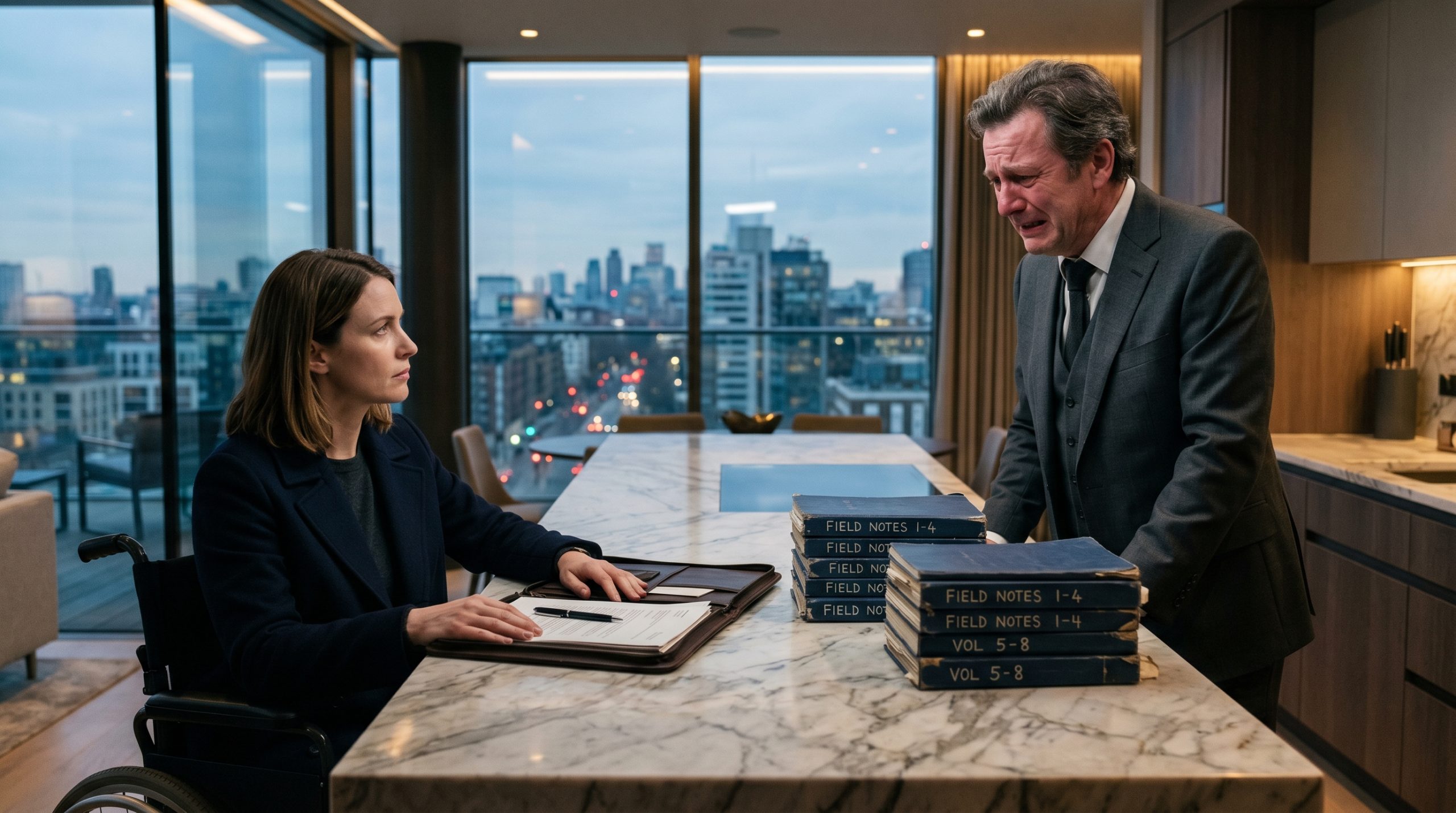
The penthouse kitchen occupied the entire north face of the building — floor-to-ceiling windows, marble counters the colour of old bone, a city sprawled forty floors below like something offered up as tribute. Edmund Harlow moved through the space the way men do when they have never needed to ask permission for a room. He set a glass on the counter without looking at it. He straightened his cufflinks. Outside, November pressed against the glass and left nothing.
Elena Marsh had been in this building twice before. The first time, she had been twenty-six and employed here — personal assistant to Edmund’s late wife, Catherine. The second time, she had been twenty-seven and handcuffed.
Tonight she was thirty-seven, and she had come in a wheelchair she had used for the past nine years — a fact Edmund’s PA had mentioned three times in the invitation, as though repetition might discourage her from attending.
She had not been discouraged.
The dinner was a charity event — one of Edmund’s annual performances of grief, held in Catherine’s name, attended by people who had never met Catherine and would not have liked her if they had. Twenty-six guests in dark coats, champagne flutes catching the chandelier light, a string quartet near the east window playing something no one listened to.
Elena sat near the back of the room beside her companion, James Whitfield — her solicitor, her witness, a man who had learned ten years ago to carry a second phone charged to one hundred per cent.
On her lap sat a document case. Black. Unadorned. Closed.
She had not opened it yet.
Edmund saw her from across the room at eight minutes past seven. She watched his face do several things in a very short time — recognition, then recalculation, then the settling of an expression she recognised as the one he used for people he had already decided were beneath a response.
He crossed the room toward her.
The quartet played on.
And Elena’s hand rested on the document case and did not move.
What She Carried
Edmund stopped three feet from her chair. Not two — three. The distance of a man who will not be seen to step back.
— “Elena.” The name arrived without warmth, the way a person uses a word to mark territory rather than greet. “I wasn’t told you had been invited.”
“I invited myself,” she said. “I sent the form. I paid the table fee. Everything above board.”
He looked at the document case on her lap. A brief look — involuntary, corrected quickly — but she had been watching for exactly that look for a long time.
“Catherine’s evening,” he said. “I’d ask you to be respectful of that.”
“I’ve been respectful for ten years,” Elena said. “I thought tonight I might try something else.”
He left without answering. Across the room, James caught her eye. She gave a small shake of her head. Not yet.
The document case had a combination lock, three digits, and contained the following: two hundred and forty-one pages of handwritten notes, dated by day and hour, running from the week after Elena’s conviction to the morning she had arrived here tonight. Every hearing she had attended — the ones Edmund’s legal team had assumed she was too tired, too ill, too broken to attend. Every procedural irregularity. Every witness statement that did not match the one filed before it. Every name that appeared in documentation and then, quietly, did not.
She had started the notes from a hospital bed, her left hand doing the writing because her right was occupied with other concerns. She had continued them from a rehabilitation ward, then a rented flat in Coventry, then a smaller flat when the rented one became unaffordable. She had never missed a hearing. She had arrived at every single one in whatever vehicle could accommodate her chair, wearing whatever she owned that looked most like someone who expected to be listened to.
The reason she could not stop — the reason walking away had never once felt possible — was a drawing she kept folded inside the front cover of the first notebook. A child’s drawing in orange crayon, the paper soft from handling: two figures, one large, one small, beneath a yellow circle of sun. On the back, in a child’s careful printing: *For Elena. From Grace.*
Grace had been seven when she drew it. Elena had never been told where Grace was now.
She pressed her palm flat against the case. The lock was cold.
The string quartet ended their piece. Someone applauded. Edmund, across the room, raised his glass toward the windows and said something that made three people laugh.
Elena watched him.
And waited.
The Worst Thing He Said
Edmund made his speech at half past eight.
He stood at the head of the kitchen island — the marble counter behind him catching the chandelier light — and spoke about Catherine with the practiced fluency of a man who had told this story so many times it had become comfortable. The accident. The grief. The foundation bearing her name. His voice carried the precise weight of public sorrow: present enough to move a room, controlled enough to stay dry.
Elena had heard this speech, or versions of it, eleven times.
When the applause faded and the guests returned to their conversations, Edmund approached her again. James had stepped away briefly — a fact Edmund had clearly noted.
He crouched to her level. Not with kindness. With the deliberate condescension of a man who believes eye contact requires an adjustment in his favour.
— “You should know,” he said, low enough that only she could hear, “that nothing you think you have will change anything. The conviction stands. The file is closed.”
— “The file has been reopened,” Elena said. “Formally. Three weeks ago.”
Something crossed his face. She filed it away.
— “You were never a witness,” he said, the words arriving in the past tense, as though he were correcting a historical error. “You were always the liability.”
The room continued around them. Nobody heard it. Nobody was meant to.
Elena looked at him for a long moment. Then she said: “I know.”
He stood, adjusted his jacket, and walked away.
She sat with the document case on her lap and thought about what she was about to do. James was at the far end of the room, near the door to the east corridor. She could signal him. They could leave. The formal review was already in motion — the notes had been filed, the procedural irregularities documented, the case transferred to a barrister who had read every page and used the word *substantial* twice in their first call.
She did not need this room.
Her hand found the wheel of her chair. She could go.
Then Edmund raised his glass again, and a woman near the window laughed at something he said, and Elena looked at the drawing she kept folded inside the front cover — visible for just a moment in the lamplight — two figures, one large, one small.
She put her hand back on the case.
She turned the combination lock to the correct sequence: zero, nine, zero — the date of the accident.
And she waited for James to come back.
