


The Recording
The phone in Claire’s bag had been recording for forty-seven minutes.
She had started it in the car park, before she came inside. Not because she had known exactly what would happen — she had not — but because she had sat in that car park for eleven minutes with the engine running, her hand on the gear shift, running through every version of walking away. She had drafted a message to Nathan three times. Each version said some variation of the same word: *enough*. She had deleted all three.
Then she had looked at the photograph on her phone’s lock screen. Her sister, laughing, at a barbecue two summers before the diagnosis. The photograph was three years old now.
She had turned the engine off.
The phone was a cracked-screen model — the screen had fractured when she dropped it eight months ago, and she had not replaced it, partly because she couldn’t afford to and partly, she suspected, because the crack had started to feel like a kind of record. Evidence of impact. It was pressed flat against the side of her bag now, propped at an angle that kept the microphone clear.
It had recorded Margaret Holt saying: *Any questions about the protocol should be directed to the clinical committee.*
It had recorded Dr. Harrison Wells saying: *The decisions made regarding your sister’s care were made by a qualified clinical team.*
And it had recorded — most importantly, most irreversibly — Wells saying: *That letter has no legal standing.*
Because that was the line. That was the line that told her he had read it fast enough to assess its threat. That he knew exactly what the letter said. That he had been in that room when those words were spoken.
An innocent man would have asked what the letter was.
Harrison Wells had not asked.
Nathan had seen it too. He had been watching Wells’s face from across the room — not with hostility, just with the steady attention of someone keeping an accurate record of what they were seeing — and he had watched Wells’s eyes move to the letter before Claire had finished unfolding it. The read was too fast. Too practiced. The way you read something you have already memorised.
He stepped forward now. Not toward Wells. Toward Claire.
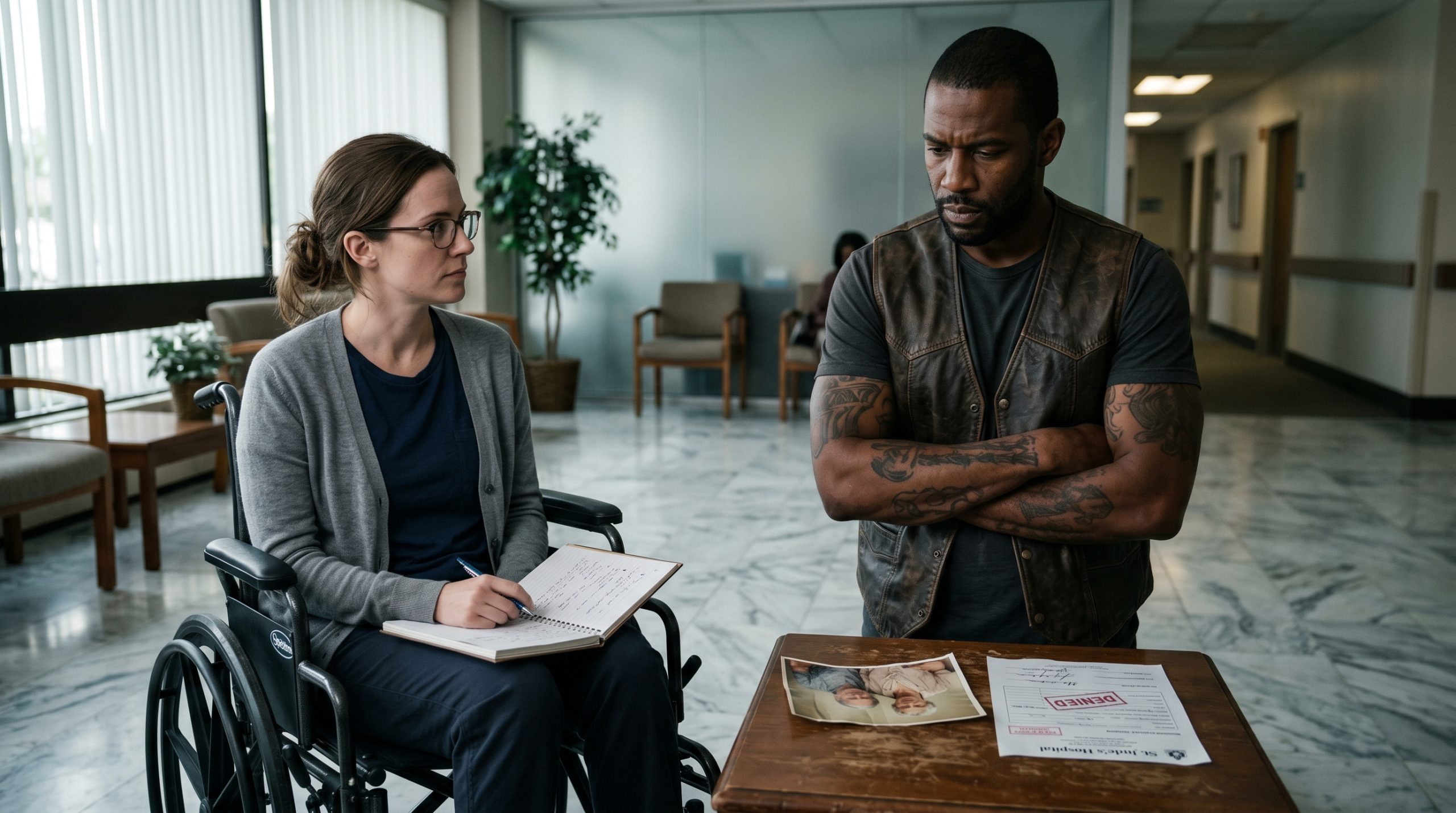
He crouched beside her wheelchair — lowering himself to her level, not in deference, but in the deliberate physical signal of *this person is not alone* — and he spoke quietly, so that only she heard.
“Claire. The solicitor is outside.”
She had not told Margaret Holt that. She had not told Harrison Wells. She had spent three years not telling certain people certain things, and the discipline of that — the long, exhausting, unglamorous discipline of knowing what to withhold and when — was the only thing that had kept this alive.
She reached into her bag. Past the phone. To the envelope beneath it.
It was a sealed manila envelope, the kind with the metal clasp, and it contained a single document: a formal complaint, already filed with the medical regulatory body, stamped received, with a case reference number in the upper right corner.
⚡ CLOSE-UP — her thumb running along the sealed edge of the envelope.
She placed it on the table.
“The complaint was filed three weeks ago,” she said. “The case is already open. What happens in this room today is on the record regardless of what either of you decide to do next.”
Margaret Holt looked at the envelope. She looked at it the way you look at a door that has already been locked from the other side.
Dr. Wells took one involuntary step back. Just one. His coat shifted with the movement. Then he went very still.
“The document had two signatures,” Claire said. “I’ve only asked about one.”
She let that sit.
The second signature on the protocol revision was not Harrison Wells. It was not Margaret Holt. It was a name that neither of them had mentioned, because neither of them had expected her to have reached that far.
She had reached that far.
The Verdict
The regulatory case was formally heard six weeks later.
The hearing room was smaller than the hospital waiting room — beige walls, a long table, three people seated at one end and Claire Morrow at the other. Nathan Voss sat behind her in the public gallery. The junior clinician, whose name was Dr. Grace Fielding, sat beside him. She had not been subpoenaed. She had come voluntarily.
Margaret Holt attended with two solicitors. Dr. Harrison Wells arrived alone.
The recording was submitted as evidence. Not as the primary evidence — the formal complaint, the disclosure documents, the board minutes, and Dr. Fielding’s written statement were the primary evidence. The recording was supplementary. But it was the recording that the panel asked to hear twice. The second time, they did not look at their notes. They looked at Harrison Wells.
Wells had prepared a statement. He read the first three paragraphs. Then the panel chair — a White woman, mid-fifties, with the still, patient expression of someone who has heard every variation of this particular performance — held up her hand.
“Dr. Wells,” she said. “The letter. When Ms. Morrow placed it on the table — your response was that it had no legal standing. Can you explain how you arrived at that assessment before reading it?”
The room was very quiet.
Wells opened his mouth. He closed it. He opened it again.
He had no answer that did not confirm what the recording had already established: that he knew what the letter said because he had been in the room when those words were spoken. That the “administrative inconvenience” was his phrase. That he had overridden three written requests from a patient who was now dead.
Margaret Holt looked at the table.
The panel chair made a note.
The formal outcome arrived in writing thirty-one days later. Dr. Harrison Wells was suspended from clinical practice pending a full investigation. His position on the hospital group’s advisory committee was terminated. The original review of Claire’s sister’s case was formally reopened under independent oversight — a thing Claire had been told, four separate times by four separate people, was not possible.
The second signature on the protocol revision — the name Claire had not yet named aloud in that waiting room — belonged to a senior administrator who had left the hospital group eighteen months earlier to join a private equity firm that held a stake in three other medical facilities across the country. That name was referred separately to the regulatory authority. That case was still open.
“She kept every record,” the panel chair said quietly to her colleague as the room cleared. She did not say it to Claire. She said it the way you say a thing when you want someone to hear it but cannot address them directly. Claire heard it.
She kept every record.
Outside the building, on the pavement, Nathan handed her the notebook. She had left it on the table by accident — or not quite by accident. She had not been sure, at that moment, whether she still needed it.
She took it. She held it in her lap for a moment.
Dr. Grace Fielding paused beside them on her way to her car. She did not say anything. She put her hand briefly on Claire’s shoulder. Then she walked on.
Nathan looked at the sky. It was overcast — the flat white English sky that means rain is thinking about it.
“What now?” he said.
Claire looked at the case reference number she had written on the notebook’s inside cover. The second name. The private equity firm. The three other facilities.
“Now,” she said, “we start again.”
She had not told him she had been watching the second name for eight months. She had not told anyone. Some things you keep until you know exactly where to put them.
The rain began. Soft at first. Then steady.
