


The Smell of Butter and Someone Else’s Morning
The bakery smelled like warm butter and expensive coffee, and the people inside it had never once thought about where either came from.
Grace Holloway had been on her feet since four in the morning. She moved between tables the way water moves — quietly, without complaint, filling cups before anyone thought to ask. Her uniform was pressed. Her ponytail was tight. The circles under her eyes were the only thing she hadn’t been able to iron out.
The Gilded Crumb sat on the corner of Marchmont Street, all polished marble and crystal chandeliers and the kind of cinnamon warmth that made people feel they deserved to be there. The clientele came in from the law offices and investment houses on either side. They wore watches that cost more than Grace’s monthly rent. They ordered in half-sentences and expected complete understanding.
She gave it to them. Every time.
Table seven wanted oat milk, no foam, and a second pastry he hadn’t ordered yet but always did. She brought it before he looked up. He didn’t look up.
Table four — the one by the window where morning light hit the marble like something from a magazine — that table had been empty for an hour. Now a man sat down in it. She noticed him because he sat with his back to the wall and watched the door. People who sat that way weren’t eating. They were waiting.
She brought him a coffee anyway. He didn’t order one. He looked at the cup, then at her, and something behind his eyes went briefly very careful.
“Complimentary,” Grace said, and moved on.
The morning continued. The chandeliers caught the light. The cinnamon smell moved through the room. A child at table two pressed her nose against the pastry case. Grace crouched down to the child’s level and pointed at the one with the pink icing, and the child’s entire face reorganized itself into pure joy.
Then—
Grace’s phone buzzed once. She pulled it from her apron pocket out of habit. The name on the screen stopped her hand mid-reach.
Harrison Vane. Estate Attorney.
She hadn’t spoken to Harrison Vane in eleven years. She hadn’t spoken to anyone connected to the Vane family in eleven years. That had been the arrangement. That had been the price.
The man at table four was still watching the door.
Her hand closed around the phone. The message sat unopened. One sentence visible in the notification preview.
*The reading of the will has been moved. You are named in it.*
Shock. Cold. Then nothing — the careful, practiced nothing of a woman who had learned to feel things privately or not at all.
She pocketed the phone. Refilled table seven’s cup. Smiled at the child with the pink icing.
The man at table four ordered nothing. He stayed for forty minutes. When he left, he left a fifty on the table and no eye contact. Grace stood at the register and watched the door close behind him.
Something moved at the base of her spine. Not fear, exactly. Recognition.
What the Estate Left Unsaid
Harrison Vane’s office was the kind of place that had been designed to make people feel small. Ceiling-high bookshelves, a mahogany desk the size of a dining table, and nothing soft anywhere — no cushions, no rugs with any give, no colour that wasn’t the colour of old money and older silence.
Grace arrived seven minutes early. She sat in the waiting room with her hands flat on her knees and her coat still on.
Five other people sat around her. She recognized two of them — Richard Vane, the eldest son, and his wife Miriam. Richard looked at Grace the way people look at something they expected to have already been removed. Miriam looked at the wall.
Grace had worked in the Vane house for two years, eleven years ago. She had been twenty-three and grateful for the pay and careful to stay invisible. She had not stayed invisible enough.
Harrison Vane entered and closed the door with the kind of firmness that meant he already knew this was going to be difficult.
“Thank you all for coming,” he said, not looking at anyone in particular. “Before I begin the formal reading, I need to confirm that all parties named in the document are present.”
He named them. Richard Vane. Miriam Vane. Three charitable trusts. And then:
“Grace Holloway, named guardian of the estate’s minor beneficiary.”
The room did not move. Richard’s jaw was very still. Miriam’s hand, holding a small clutch bag, tightened until her knuckles shifted.
“Minor beneficiary,” Richard said. The words came out too quickly — not a question, a correction being prepared.
“Yes,” Harrison said.
“There is no minor beneficiary in this family.”
Harrison set a manila envelope on the desk. He did not open it. He looked at it for a moment with the expression of a man who had known this was coming and had made his peace with it anyway.
“There is now.”
Grace’s fingers went cold. She pressed her palms harder against her knees.
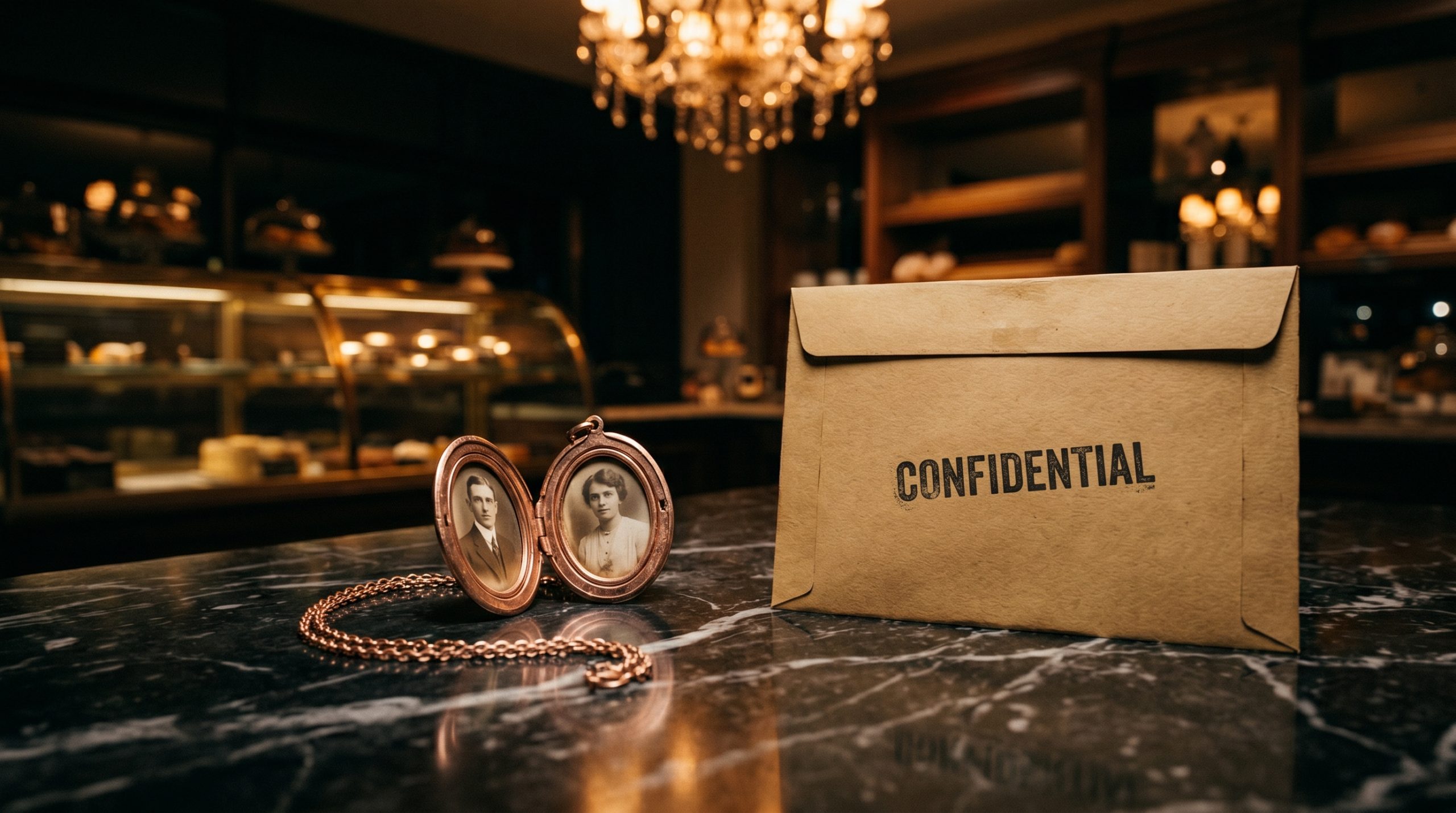
The envelope sat in the centre of the desk. The morning light from the single tall window caught the edge of it — the paper pale and dense, the kind of document that had been prepared carefully, over time, by someone who knew they were running out of it.
Richard reached for the envelope.
Harrison’s hand moved first. Quiet. Final.
“Not yet, Richard.”
Across town, at that precise moment, Grace’s daughter Lily was in school, sitting in the third row, drawing a horse in the margin of her mathematics notebook. She was ten years old. She had her mother’s hands and her father’s eyes and she had never once been told who her father was, because Grace had made a promise. Because the promise had felt, at the time, like the only way to keep them both safe.
She had been very wrong about what safety looked like.
The Man at Table Four Was Never Just Passing Through
The man at table four’s name was Cole Drayden. Grace found this out two days after the will reading, in a way she had not planned.
She was walking to her car at half past nine at night when she heard the motorcycles. Not one. Three. Parked on the street that ran behind the Gilded Crumb, engines idling, facing her direction. She kept walking. Her keys were already between her fingers.
One of them cut the engine and got off. Tall, composite jacket, the kind of unhurried walk that means a person is certain they don’t have to rush.
“Ms. Holloway.”
She stopped. Turned. Looked at him the way she had learned to look at men who used her last name like they owned it.
“You know who I am,” he said.
“I’ve seen you in the bakery.”
“Then you know we’re not here by coincidence.”
She did not answer. She was doing the calculation that women do — distance to the car, angles, whether her phone was accessible.
His name, she would learn later from a card that appeared under her apartment door the following morning, was Cole Drayden. The card had a phone number and three words: *It protects her.* It had been slipped under the door between 2 and 4 a.m. The door had been locked. She had checked it herself.
She did not call the number that day. She called it the day she came home to find her apartment door standing open by three inches and nothing visibly moved inside — just the open door and the very deliberate suggestion of entry.
The message was from Richard Vane. She understood that without anyone spelling it out. Cole Drayden and his two associates were the message. Richard’s approach to inconvenient problems had always been removal, not resolution. The inheritance, the minor beneficiary, the documentation Harrison had declined to hand over — these were the problems. Grace was the thread that held them together. If she could be made to disappear quietly, or frightened into refusing the guardianship, then the thread dissolved.
What Richard had not accounted for: Grace Holloway had survived eleven years of keeping a secret that could have unravelled her, and she had done it without flinching. She was not going to flinch now.
She called Cole Drayden on a Thursday afternoon from the back room of the bakery. He picked up on the second ring.
“Why the card?” she said. “You could have just watched.”
A long pause. Then: “Because watching wasn’t the job anymore.”
She sat very still with that sentence.
“Whose job is it?” she said.
Another pause. Longer this time.
“It was,” he said finally. “Past tense.”
The cinnamon smell from the front of the bakery moved through the gap under the back room door. Grace pressed her free hand flat on the prep table and thought about Lily drawing horses in the margins of her mathematics notebook, and about whether safety and courage were ever really the same thing.
The Locket That Was Never Supposed to Survive
The secret object had been in Grace’s possession for ten years and two months. She had never worn it. She kept it in the bottom of a ceramic mug on the highest shelf in her kitchen — the shelf Lily couldn’t reach, the shelf Grace herself only touched when she needed reminding of what she knew and why she had stayed silent.
It was a locket. Small, oval, rose gold. On its face, engraved in a hand she had recognized instantly: the initials *E.V.* — Eleanor Vane, the matriarch. Dead now nine months, which was why Harrison Vane was reading a will at all.
The locket opened with the small pressure of a thumbnail to its left side. Inside: two photographs, each the size of a thumbnail. On the left, a baby. On the right, a woman holding that baby — young, tired, fiercely careful. The woman was Grace. The baby was Lily.
The locket had been pressed into Grace’s hand by Eleanor Vane herself, on the night Grace had left the Vane house with a travel bag and four months of unpaid wages and a sealed envelope she had been instructed never to open until Eleanor was gone.
*When I am gone,* Eleanor had said, *everything in the envelope becomes yours to use. Until then — keep the child invisible. Richard will not accept what he cannot control.*
Grace had kept that promise for ten years. She had kept it through the poverty of the first two years, through the part-time jobs and the single room and the years of careful, grinding accumulation back toward something stable. She had kept it because Eleanor had looked her in the eye and used the word *safe*, and Grace had understood exactly what Eleanor had understood: that Richard’s capacity for cruelty was systematic and patient, and the only protection against it was time and secrecy.
But now Eleanor was gone, and the will had been read, and the locket and the sealed envelope were the only things standing between Lily and the kind of legal erasure Richard’s attorney was very good at engineering.
Grace unsealed the envelope the night after Cole Drayden’s card appeared under her door.
Inside: a DNA registration document, dated ten years ago, signed by Eleanor and witnessed by Harrison Vane. It named Lily as the biological granddaughter of Eleanor Vane, daughter of the late Daniel Vane — Richard’s younger brother, dead in a car accident three months before Lily was born.
And at the bottom, in Eleanor’s careful script: *She has Daniel’s eyes. I have always known. I should have said so sooner. Forgive an old woman her fear.*
Grace froze. Completely.
Because the DNA document wasn’t the only thing in the envelope. There was also a phone. Small, older model, its screen cracked in a long diagonal from corner to corner — the crack old enough that the edges had gone dark with time. Eleanor’s handwriting on a sticky note attached to its back: *The recording. March 14th. Richard’s voice. He does not know I had a second phone.*
The screen, when Grace pressed the power button, lit up. The battery was at eleven percent. The voice memo app was already open.
What the Room Heard
Grace asked Harrison Vane for one meeting. She gave him twenty-four hours’ notice. She told him what she had.
He was quiet for a long moment on the phone. Then: “Bring everything. I’ll make sure Richard is there.”
She did not ask how he would manage that. Harrison Vane had been Eleanor’s attorney for thirty years. He had ways of managing Richard that Grace did not need to understand.
The second meeting in Harrison’s office had a different quality of stillness than the first. Richard arrived five minutes late, which meant he had made Harrison wait on purpose. He sat with one ankle on his knee and his arm along the back of the empty chair beside him, the physical language of a man who considered the space around him to be his by default.
Miriam was not present this time. In her place: Richard’s personal attorney, a sharp-faced woman named Claudia who set a leather portfolio on her knee and held a pen like it was already writing something useful.
Grace arrived last. She set her bag on the chair beside her and left her coat on.
Harrison opened the meeting with the formal language. Richard cut through it within four sentences.
“Whatever documentation you think you have,” Richard said, looking at Grace with the particular contempt of a man who has never had to revise his opinion of anyone, “is going to be challenged. The DNA claim alone will take eighteen months to litigate. You don’t have the resources for that, and we both know it.”
He said it smoothly. Evenly. The way people deliver lines they have rehearsed.
Grace reached into her bag.
She placed the locket on the desk. The rose gold caught the morning light from the tall window — the same window, the same angle of light as before. She let it sit there for a moment. Nobody spoke.
Then she placed the DNA document beside it.
Claudia’s pen stopped moving.
Then Grace placed the cracked phone on the desk. The long diagonal crack across the screen was visible to everyone in the room. She pressed the power button. The screen lit up. The voice memo was already queued.
She pressed play.
The voice that came through the small speaker was unmistakably Richard Vane’s — the same even register, the same self-possessed certainty. The recording was fourteen months old, from a meeting Grace had not been present at, between Richard and a woman named Patricia, who had been Eleanor’s private nurse in the final year of her life.
*The old woman’s going to try and leave something to the girl,* Richard’s voice said. *We both know what the documentation says. I need you to make sure those files don’t survive the estate process. Do you understand what I’m asking?*
A pause on the recording.
*Don’t make me explain it twice, Patricia. You’ve been very well compensated for simpler things.*
Richard’s glass of water slipped. He caught it — barely — and it made a sharp sound on the marble desktop. His eyes moved to the phone before he could stop them. Then to Harrison. Then, for the first time since Grace had entered the room, to her.
She had not looked away from him once.
Claudia’s portfolio was closed. Slowly. With both hands.
“The recording is time-stamped,” Harrison said, very quietly. “The voice analysis is already on file.”
Richard said nothing.
The room held the silence the way rooms hold smoke — completely, and in every corner.
Heartbeat pounding louder.
Then Richard reached — not for the phone. For the locket.
Grace’s hand was already there.
What Lily Drew in the Margin
The guardianship was formalized on a Tuesday morning. Harrison Vane handled the paperwork himself. He did not charge Grace for it. He said this without looking at her, in the way that people make gestures of restitution when they know they waited too long.
Richard’s challenge collapsed faster than he had projected. The DNA registration, witnessed and dated ten years prior, was impeccable — Eleanor had made sure of that. The recording, once formally submitted, produced exactly the kind of silence from Richard’s legal team that precedes a settlement offer. The offer came within six days. Grace declined it.
What she wanted was not money. What she wanted was for Lily to know the truth about her father — that Daniel Vane had been kind, and young, and had died before he knew Lily existed. That Eleanor had known and had loved Lily from a careful, secret distance, because that was the only distance Richard had allowed.
She sat across from her daughter on a Sunday afternoon in their kitchen, the locket open between them on the table. Lily was ten and had her mother’s hands and her father’s eyes, and she was looking at the two photographs with the focused attention she brought to everything.
“That’s us,” Lily said. Pointing at the left photograph, then the right.
“When you were three days old.”
Lily looked up. Her face was doing the quiet calculation of a child absorbing something large. She pointed at the tiny engraved letters on the locket’s face.
“E.V.,” she said. “Who is E.V.?”
“Your grandmother,” Grace said. “She kept this safe for a long time. She kept you safe for a long time, in the only way she could.”
Lily turned the locket over in her hands. The rose gold was warm from the kitchen light.
“Did she know me?”
Grace paused.
“She saw photographs. She knew your name. She knew you liked drawing horses.”
Lily went quiet. Outside, the Sunday afternoon moved slowly past the window — the ordinary sounds of the street, a neighbour’s dog, someone’s radio.
“I’m going to draw her a horse,” Lily said finally, with the complete conviction of a ten-year-old who has identified the correct response to grief. “Even if she can’t see it anymore.”
Grace did not speak for a moment.
“She’d have liked that,” she managed.
Cole Drayden sent a message three days after the formalization. No greeting. Four words: *The job was wrong.* Grace read it twice, set her phone down, and went back to the morning prep at the Gilded Crumb. The chandeliers were catching the early light. The cinnamon smell was already moving through the room. A couple at table three were sharing a single pastry and a newspaper.
She refilled their coffee before they asked.
She did not hear from Richard again. The settlement remained declined. The estate’s legal team sent one further letter, which Harrison handled. The locket stayed on the kitchen shelf — not in the ceramic mug anymore, but in a small wooden box that Lily had painted with a horse on its lid.
The unresolved thread: Patricia, the private nurse, had been well compensated for simpler things. The recordings that had survived were the ones Eleanor had managed to preserve. The ones that hadn’t — what Richard had asked Patricia to destroy, and whether Patricia had destroyed all of it — those questions had no answers yet.
Grace knew it. She lived with it the way she lived with most things: steadily, and with her eyes open, and without letting it show at the tables where people needed their coffee cups filled.
