


What the Room Heard When She Opened It
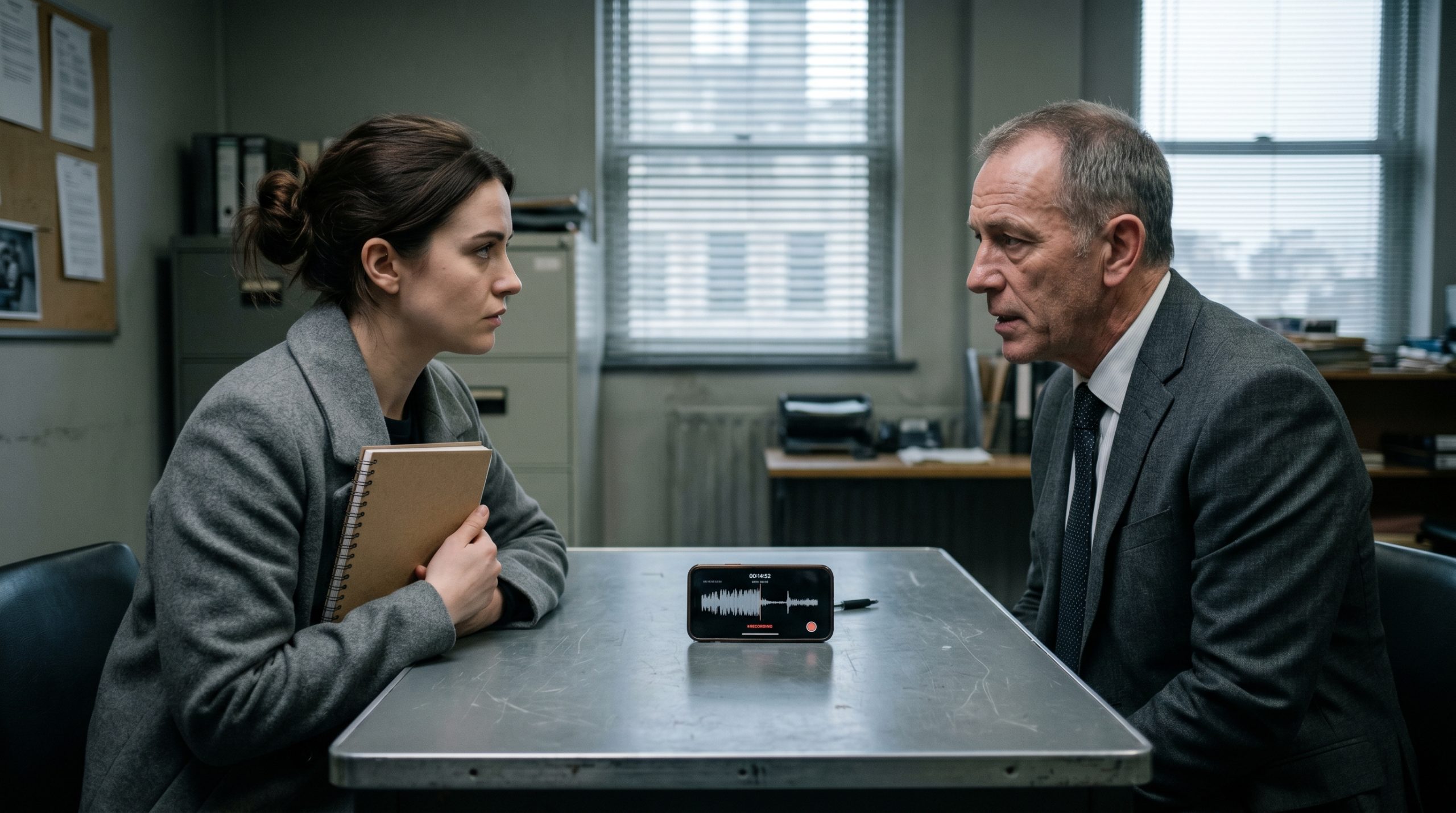
Detective Sergeant Claire Okafor’s office was on the fourth floor of a building that smelled like carpet adhesive and recycled air. Nine a.m. The morning came in grey through institutional blinds.
Elena sat across from Okafor with the notebook on the table between them, closed.
Okafor was reading the transcribed summary — twelve pages, typed, that Elena had prepared over three sleepless nights — and her face was very still. The kind of still that meant she was working to keep it that way.
Then the door opened without a knock.
Two men. One Elena recognised immediately — the left forearm tattoo, the black eagle, same man from the Manchester coffee shop. The other was taller, older, wearing a suit that did not belong to a police building.
The suited man — late fifties, iron-grey hair, voice that filled a room without effort — set a business card on Okafor’s desk without looking at her. He was looking at Elena.
‘You’ve been writing about my client for four years,’ he said. ‘Did you really think that made it evidence?’
Elena looked at him. She felt the room’s attention shift, felt Okafor go very still beside her.
She reached into her bag.
She did not take out the notebook.
She took out a phone. She placed it on the table, face-up, and pressed play.
Victor Renwick’s voice filled the room. Clear, unhurried, the exact cadence she had transcribed six weeks ago.
*’She’s deaf. Whatever she wrote down is hearsay from a woman who cannot verify the source — and if she brings it to Okafor, the Carver Group makes that conversation disappear too.’*
The suited man froze.
Because he had been in that room. His voice was not on the recording. But his name was — Victor had said it once, briefly, at the end of a sentence Elena had not included in the played excerpt, because she was not ready to play that part yet.
Elena watched his left hand. The fingers opened. One by one. The way a grip releases when the body understands something the mind has not admitted yet.
Okafor stood up.
The man with the eagle tattoo took one step backward toward the door.
‘There are two more recordings,’ Elena said. She said it quietly, the way she said everything — controlled, projected, every word distinct. ‘The second one has your name in it. The third one has a name I don’t recognise. Yet.’
She looked at the suited man.
‘The notebook,’ she said, ‘has three hundred and forty-seven pages. I’d like to start from the beginning, if that’s all right.’
The suited man’s mouth opened.
Nothing came out.
Elena picked up the phone and pressed pause.
The eagle tattoo on the forearm of the man near the door caught the grey morning light for just a moment — and Okafor’s hand was already moving toward her radio.
What Four Years of Silence Sounds Like
Victor Renwick was arrested at his home at eleven forty-three that morning. His solicitor, Daniel Howe, was brought in for questioning within the hour. The man with the eagle tattoo — whose name, Elena learned, was Gary Peel, with three prior convictions and a documented affiliation with a Manchester-based gang hired for contract intimidation — was already in custody by the time Okafor’s sergeant reached the stairwell.
Elena sat in a small room with a plastic cup of tea and waited.
She did not feel triumph. She felt something quieter than that — the particular exhaustion of having held something very carefully for a very long time and finally being allowed to set it down.
Claire Okafor came back at two in the afternoon.
‘The recording is admissible,’ Okafor said. ‘The notebook — all three hundred and forty-seven pages — is being processed as documentary evidence. Your mother’s case is being referred for appeal review. That’s not a guarantee, but it is a formal process now.’
Elena nodded.
‘The name on the last page of your notebook,’ Okafor said. ‘The one in red. I need you to tell me how you got it.’
Elena had been waiting for this question.
‘Victor said it once,’ she said. ‘In a phone call. I was outside the window. I only caught the last name — Carver.’ She paused. ‘The same name as the organisation he mentioned on the recording. I don’t know if they’re the same person or a different one. But the notebook entry is dated eight months before he says the name on the recording.’
Okafor was quiet for a moment.
‘That means he’d been in contact with Carver for at least eight months before your mother’s case went to trial,’ Okafor said slowly. ‘Before the charges were even finalised.’
Elena watched Okafor’s face work through that arithmetic.
‘Yes,’ Elena said.
The silence that followed was the most significant silence in four years.
Margaret Marsh was released on conditional bail pending appeal review six weeks later. She walked out of the prison gates on a Tuesday morning into flat grey light, and Elena was standing ten feet away with the notebook in her bag — all three hundred and forty-seven pages, plus a new entry, the first one in months, written that morning in the car park.
Margaret stopped when she saw her daughter.
She had not cried once in the visiting room. Not in three months. She cried now, standing on the pavement in a borrowed coat, without making any sound at all.
Elena crossed the ten feet between them.
The investigation into the Carver Group was ongoing. Okafor had told her that much and nothing more — that the name connected to documents predating the Renwick fraud case by several years, that there were other names attached, that it was larger than one man and one conviction.
Elena didn’t know yet how large.
But she knew how to wait. She knew how to watch. She knew how to sit in a room where the powerful said things they thought no one could hear, and write every word down, and remember the date.
She had been doing it her whole life.
She never told her mother that she’d always been able to lip-read. That was the one thing she kept.
