


The Weight of What Was Seen
Martin spent forty minutes on the phone in the service corridor. He called the staff roster coordinator, who gave him Frances Webb’s personal contact number only after Martin explained that her son was in the dining room alone. He called the number twice. No answer. He left a message that was calm and specific — Eli is here, he is safe, call this number when you can.
Then he went back to the boy.
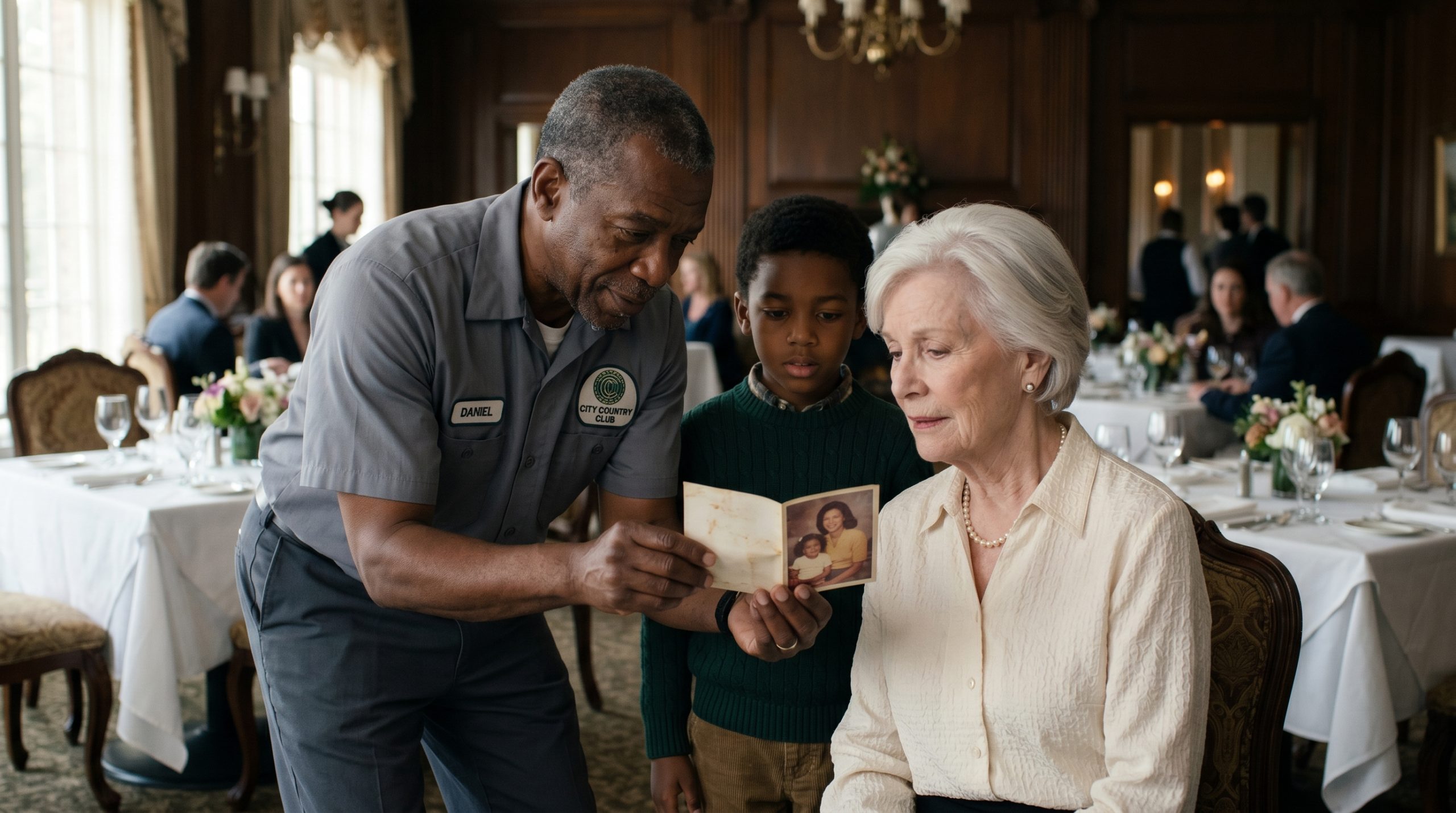
Eli had finished the bread. He had straightened the small plate and folded the linen napkin the way he had seen Martin fold his — precisely, corners aligned. He was sitting with his school bag in his lap, both hands on the strap, waiting.
“She’s not answering,” Martin said. “But she’ll see the message. She’ll come.”
Eli nodded. “She always comes.”
There was an absolute certainty in the way he said it — the certainty of a child who has tested that statement against real situations and found it true every time. Martin felt the weight of it settle in his chest like something placed there deliberately.
He had been considering, for the last thirty minutes, whether to tell Gerald that he had given away his own lunch money and offered a credit he didn’t have. He had been considering whether any of this would cost him the job — the stepping out of the service corridor, the sitting at a member’s table, the claiming of an account that didn’t exist.
He sat in the car park in the service lane for the equivalent of eleven minutes in his mind, running through every version of what came next. The gear shift. The engine running. The thing a reasonable man with a daughter’s birthday dinner on Friday and eleven years of careful invisibility would do.
Then he picked up the folded napkin Eli had left on the table and carried it back to the linen cart. That was the decision. He would stay until Frances came, or until he could be sure the boy was safe. Whatever came after that, came after that.
Gerald appeared at the service corridor entrance at three forty-five. His expression had shifted from irritation to something more complex. “There’s a member asking for you,” he said. He paused. “By name.”
This had never happened. Not once in eleven years.
Gerald said: “Mr. Whitfield.”
Martin straightened his uniform jacket. He walked back through the porthole door into the dining room, across the polished floor to the corner table where Harrison Whitfield sat in his uncrumpled suit with his still-untouched water glass.
Up close, the man looked like someone who had not slept particularly well for some time — not from illness but from thought. He had the face of a person who has recently been asked a question he cannot answer with the resources he currently has.
“Sit down,” Whitfield said. Not unkindly. “Please.”
Martin sat.
“That boy,” Whitfield said. “He came here looking for his mother.”
“Yes, sir.”
“And she doesn’t work here anymore.”
“No, sir. Three weeks ago.”
Whitfield looked at the water glass. He turned it once with two fingers on the base. “I watched the room when he walked in,” he said. “Forty-six people. I counted. Not one of them looked up.” He paused. “Then you walked out of that corridor.”
Martin said nothing.
“You gave him your lunch money,” Whitfield said. It was not a question.
“I had it with me.”
“You told Gerald to put it on your account. You don’t have an account here.”
Again, Martin said nothing. There was nothing to say that would improve the situation.
Whitfield reached into the inside breast pocket of his jacket and produced a small white card and a sealed envelope. The envelope was plain — no address, no marking. He set both on the table between them.
“The card is for Frances Webb,” he said. “My assistant’s direct line. There is a position available in the administrative office of my foundation. Good hours. Significantly better pay than a pastry station. If she calls before Friday, the position is hers.”
Martin looked at the card. He did not reach for it yet.
“The envelope is for you,” Whitfield said.
“I didn’t do it for—”
“I know,” Whitfield said. “That’s the point.”
He stood. He straightened his jacket — one precise tug at the hem. He looked once more toward the table where Eli was still sitting with his bag in his lap, waiting for his mother the way he always came.
“Nobody in this room did anything,” Whitfield said quietly. Not to Martin specifically. More to the room, which was not listening. “Nobody except you.”
He walked out. The untouched water glass sat on the table and caught the afternoon light.
Frances Comes
Frances Webb arrived at four twenty-two. Martin heard her before he saw her — the quick flat sound of her shoes on the marble entrance floor, the breath she let out when she saw Eli stand up from the table.
She crossed the dining room in ten steps. She did not look at the members. She did not look at Gerald. She wrapped both arms around her son and held on with the specific force of a woman who had seen his name on an unknown number’s voicemail and driven thirty minutes without once feeling the road under her.
“I’m fine,” Eli said, into her shoulder. “A man helped me.”
Frances looked up. Her eyes found Martin, standing at the service corridor entrance with the white card and the sealed envelope in his hand.
“He left something for you,” Martin said. He walked to her and held out the card. “A job. Real hours. The assistant’s direct line — call before Friday.”
Frances took the card. She read the name on it — Harrison Whitfield’s foundation, printed in clean small type. She read it twice. Her expression moved through several things that had no single word — disbelief, then a recognition that this was real, then something that arrived quietly and stayed.
“Why?” she said.
“He was here,” Martin said. “He saw.”
Frances pressed the card flat against her chest with one hand, the other still on Eli’s shoulder. She did not ask more questions. Some things answer themselves if you let them.
Martin held out the sealed envelope. “This one’s mine,” he said. “But I haven’t opened it yet.”
He opened it there, in the dining room, in front of Frances and Eli and the forty-six tables and Gerald and the silverware and all the afternoon light. Inside was a handwritten note — three lines in a precise, unhurried hand — and a cheque.
The note said: *You didn’t look the other way. That is the whole of it. — H.W.*
The cheque was for an amount that would cover his daughter’s birthday dinner. And the month’s rent. And the three months after that.
Martin folded the note carefully and put it in his breast pocket, over the embroidered name.
Eli looked up at him. “Did he pay for the bread?”
“He did,” Martin said.
“Good,” said Eli, with the complete satisfaction of a child for whom the accounting has now been resolved.
Frances called the number on Friday morning. The position was still available. She started the following Monday.
Martin went back to his cart. He pushed it along the service corridor — the same corridor, the same squeak of the wheel, the same porthole windows with their circular view of a room that mostly forgot he existed. He did not tell anyone what had happened. There was nothing to tell that the afternoon hadn’t already said.
He had one daughter. She was turning nine on Friday. He had the money for the dinner now, and he had the note in his breast pocket, and he had the particular knowledge that a debt he had been carrying for eleven years had finally, quietly, found somewhere to go.
He never sent Harrison Whitfield a message. It did not seem necessary. The man had been in the room. He had seen what there was to see.
Some receipts don’t need to be signed.
