


The Bench
The corridor outside Courtroom Four smelled the way institutions always smell: floor wax and paper and something underneath that, something older, that no amount of cleaning had ever reached. Fluorescent light pressed down from above. A radiator ticked against the far wall. A woman in heels moved past without looking at the boy on the bench, and the boy did not look up.
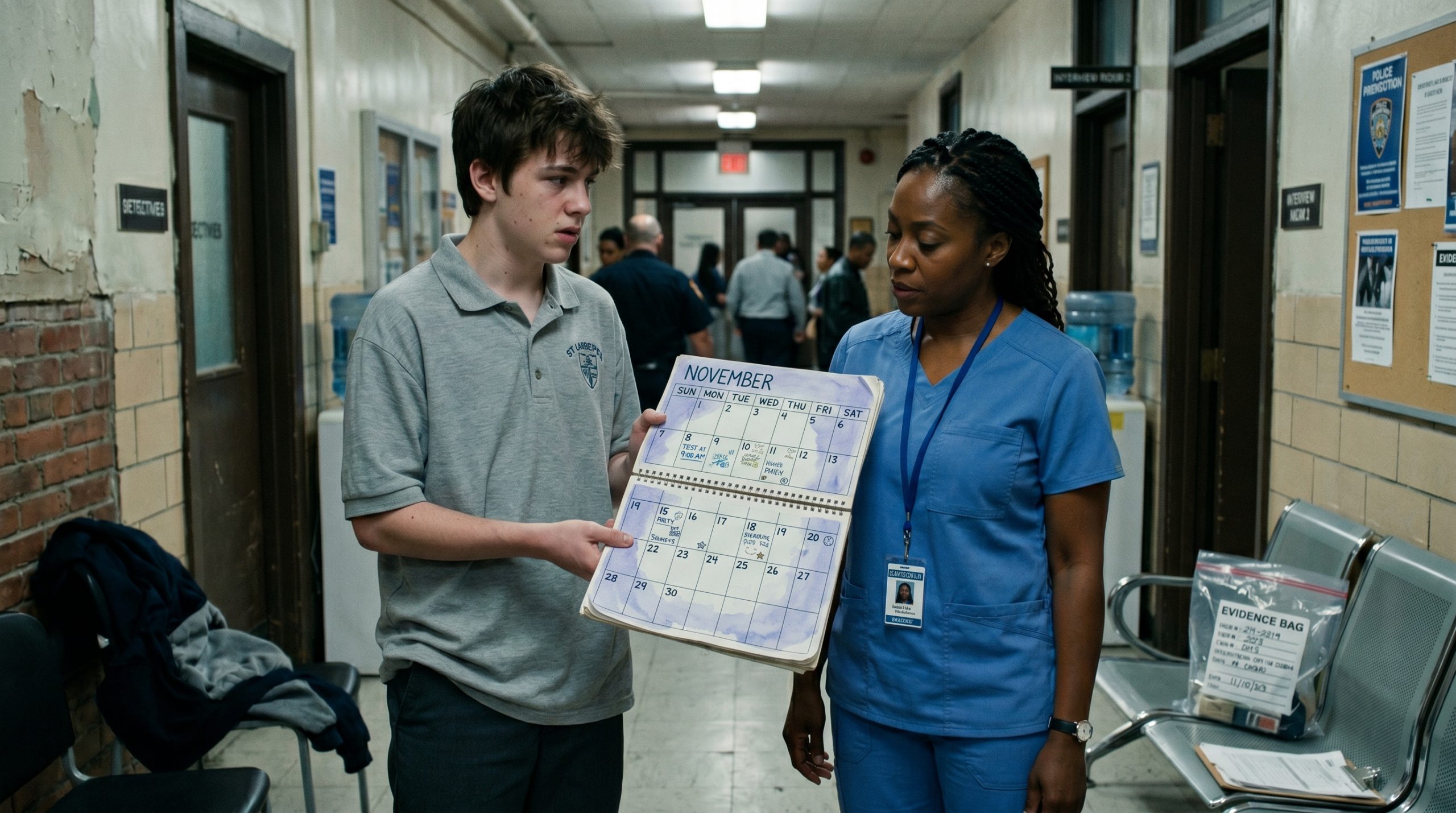
Nathan Hale was sixteen. He had his mother’s jaw and his father’s silence — or at least that was what his aunt always said, and Nathan had no way to verify either half. He wore a grey school shirt that was slightly too large across the shoulders, the cuffs pushed up past his wrists, and he held a cardboard-covered calendar on his knees with both hands, the way a person holds something they are afraid to put down.
He had been sitting on the bench for forty minutes.
The calendar was from six years ago. His mother had bought it from a charity stall at the community hall in October, the year before everything ended. It had watercolour flowers on the cover, which had always embarrassed her slightly, and her handwriting inside was quick and practical — appointments and reminders and the occasional underlined deadline. Nathan had found it in a box at his aunt’s house three months after the conviction. He had not told anyone he had it.
Not because he had been told not to.
Because he had not been asked.
He had been nine years old. Nobody at the trial had asked a nine-year-old anything at all.
The courtroom door opened and a woman in blue scrubs came out — ID badge swinging, shoes that made no sound on the floor. She stopped when she saw Nathan. She had the kind of stillness that nurses develop after years of walking into rooms where something was wrong and being the calmest thing in it. She looked at the boy on the bench, at his hands on the calendar, at the tightness across his shoulders.
She sat down.
Not beside him — one seat away, respectful of the space.
— You look like you’ve been here a while, she said.
Nathan said nothing. Then: — Since nine.
She checked her watch. It was half past eleven.
She did not say anything about that. Instead she looked at the calendar on his knees — at the cardboard cover, at the way his fingers had pressed shallow dents into the edge from holding it so long.
— Do you have someone in there? she asked, tilting her head toward Courtroom Four.
— No, Nathan said. Then, quieter: — Not anymore.
The nurse — her name badge read CLAIRE BARROW, Paediatric, Level 3 — looked at the corridor. The radiator ticked. Somewhere at the far end, a phone rang twice and stopped.
— What’s in the calendar? she asked.
Nathan looked down at it.
Slowly, he opened the cover. He turned to March. He held it out.
Frozen.
Because Claire Barrow looked at the page and froze instantly. Because the name written fourteen times in small, careful ink — the name she was reading beside appointment times in a dead woman’s handwriting — was the name on the witness schedule she had collected from the clerk’s desk that morning when she had come to give her own testimony.
Dr. Gerald Marsh.
She had his schedule in her bag. His name had been at the top.
Fourteen Entries
Claire had been called as a supporting witness — a procedural appearance, her ward supervisor had said, twenty minutes at most. She had come in her scrubs because she had a shift directly after and had not thought it would matter.
She had not expected to sit down on a bench and have a boy hand her a dead woman’s calendar.
She turned the pages carefully. March: Gerald, 10am. Gerald, the fourteenth. Gerald, the twenty-second. April: Gerald again, twice in the same week. She counted without meaning to. She counted because the numbers would not let her stop.
Fourteen times. The same first name. In a calendar that ended abruptly in August, three months before the arrest.
Claire had grown up in a house where her mother kept a calendar on the kitchen wall, and she knew exactly what a calendar entry looked like when it was a friend. You wrote a first name. You wrote a time. Sometimes a location. You did not write a title or a surname because there was no need — you knew who it was.
She also knew what Gerald Marsh had said this morning, in a room thirty feet away, under oath.
I have never had any personal contact with the defendant or her family. Our interaction was entirely professional and limited to my appointment as expert witness.
Claire looked at the page.
She looked at March fourteenth. Gerald, 2pm.
— How long has your mother been in prison? she asked, her voice level.
— Six years, Nathan said. She got twelve.
Claire turned another page.
— Did she have a friend named Gerald?
Nathan looked at her steadily. — She said he was her closest friend. She talked about him all the time. He came to the house. He—
He stopped.
Claire waited.
— He testified that he’d never met us, Nathan said. His voice was very quiet and entirely certain. He said it like it was nothing. And I was nine, so nobody cared what I thought.
Claire closed the calendar gently. She held it for a moment, both hands, the watercolour flowers pressing against her palms. She had been a nurse for eleven years. She had sat beside enough beds to know what it looked like when someone had been carrying something alone for a very long time, and it looked exactly like the boy beside her on the bench.
Her own reason for being in this building surfaced — not the ward supervisor’s procedural attendance, not the twenty minutes. Something older and more specific. Twelve years ago, before nursing, before her own testimony in a different case in a different city, she had watched a verdict land on a woman who had told the truth and not been believed because the man contradicting her had a title and a suit and a calm, unhurried voice. The woman had been her mother. The man had been her mother’s GP.
She had never spoken about it. It had never been relevant.
It was relevant now.
— Nathan, she said. I need you to come with me.
She stood. She held out the calendar. He took it.
— Where are we going? he asked.
— To find a police officer, she said. One who’s actually here.
They walked. The calendar was in Nathan’s hands. Behind them, the door to Courtroom Four opened and a court officer leaned out, scanning the hallway — then looked at Claire, looked at Nathan, looked at the calendar.
She stepped back inside without a word.
Nathan froze. Because someone had seen what they were carrying. And had not stopped them.
What He Said Under Oath
The duty sergeant’s name was Paulson and he had been on a long shift and he looked like it. But he looked at the calendar. He looked at the witness schedule Claire had pulled from her bag, Marsh’s name at the top, and he looked at Nathan — sixteen, grey school shirt, jaw set — and something shifted in his face. He picked up his phone.
Fifteen minutes later, Detective Inspector Yvonne Cross arrived.
Yvonne Cross. Twenty-two years on the force, the last four in serious crime review.
She sat across from Nathan in the duty room with the calendar open on the table between them, and she did not rush. She turned the pages the way evidence is turned — slowly, with clean hands, reading every entry before moving to the next.
When she reached August — the last full month — she stopped.
August eleventh. Gerald, 11am — the word URGENT written beside it in a heavier hand, pressed hard into the page, the pen almost breaking through.
Two days before the arrest.
— Has this calendar ever left your possession? DI Cross asked.
— No, Nathan said.
— Has anyone else handled it?
— My aunt, when she packed the box. She didn’t look at it.
— And your mother never mentioned him by surname in your presence?
Nathan shook his head. — She just called him Gerald. I was little. I thought he was just a friend.
DI Cross looked at the August entry for a long moment.
Then she looked at Nathan.
— Dr. Marsh testified this morning under oath, she said carefully, that he had no personal relationship with your mother. That all contact was professional and initiated after the case was assigned to him.
Nathan said nothing.
— The case was assigned to him, DI Cross continued, in September. After the arrest.
Silence.
Nathan said: — Then what was he doing at our house fourteen times before that?
The room held very still.
It was Claire who broke it — not with words. She set her hand flat on the table. Slowly, deliberately. The way people do when they need something solid. Because what DI Cross had just said had opened something that did not have a clean edge, and the thing underneath it was not the question of whether Gerald Marsh had lied. That question was already answered. The thing underneath was larger: if he had known the family before the arrest, if he had been in the house, if the URGENT notation two days before the arrest meant what the most obvious reading of it meant — then his selection as expert witness had not been random. Someone had selected him. Someone had known.
This was not a single man lying under oath.
This was something with more than one moving part.
The door opened. A court officer — not the one from before — leaned in and said that Marsh’s testimony was finishing. That he was about to be released.
Claire stood.
She sat back down.
She stood again. Picked up her bag. Set it down.
She drafted a message on her phone — to her ward supervisor, two words: running late — and then deleted it. Because running late implied she was coming back soon, and she did not know if that was true.
Then she looked at Nathan.
He was watching her with his mother’s patience. Waiting to see what the adult in the room would decide.
She thought about the ward. She thought about the six children currently on Level 3 who were not her patients but whom she knew by name. She thought about the shift that started in forty minutes.
She said: — We need to be in that hallway before he walks out.
They went.
The calendar was in Nathan’s hands when they reached the corridor.
Marsh came through the courtroom door thirty seconds later, suit jacket buttoned, briefcase at his side — and he stopped when he saw the boy.
His face did not change.
But his hand — his left hand, the one holding the briefcase — went perfectly, absolutely still. The kind of stillness that is not calm. The kind that is control being applied very hard to a body that has already understood what it is looking at.
