


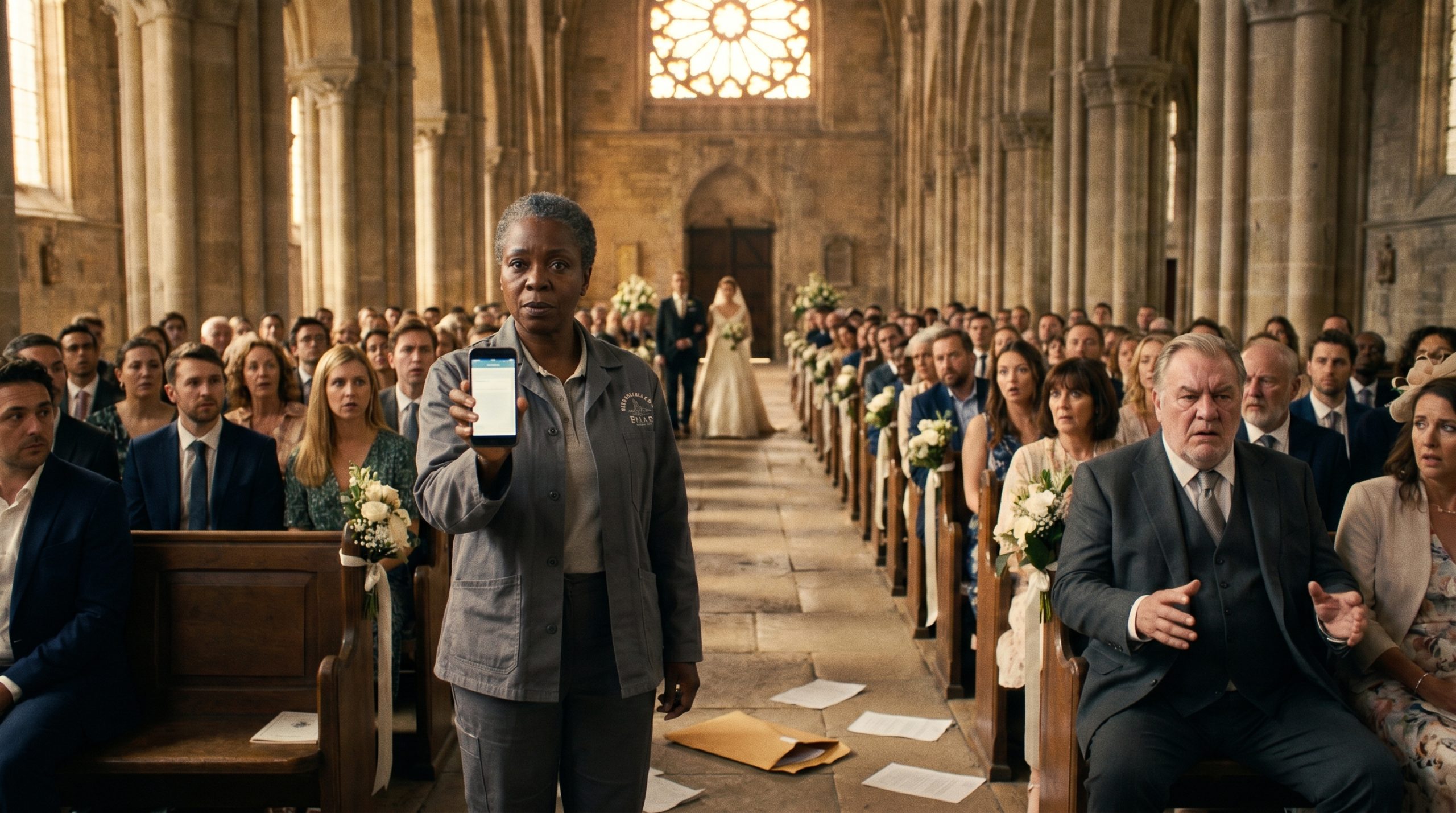
White Flowers
The church was full of white flowers and the kind of happiness that photographs well.
St. Clement’s had been booked for eleven months. The pews were full. Three hundred guests in their best clothes, a string quartet in the gallery, late-afternoon light falling through the rose window in long amber columns. The kind of wedding that gets featured in magazines — the kind where nobody checks the programme too carefully because everything already looks correct.
Grace Hollis stood at the altar in ivory silk, her veil pinned with her grandmother’s pearl brooch, her hands steady around the bouquet. Beside her, Daniel Mercer, thirty-four, junior partner at a Bristol law firm, facing the priest with the composed expression of a man who had rehearsed this. They had met at a charity gala. They had dated for two years. The engagement had been announced in a Sunday supplement.
Nobody in the room was watching the side door.
Elena Marsh had worked at St. Clement’s for nine years. Not as clergy. Not as staff in the traditional sense. She cleaned the building — the nave, the vestry, the small room behind the sacristy where the priest kept his files and the building’s maintenance records and, for the past three months, a locked grey cabinet she had never been asked to touch. She was fifty-one years old, Black, with close-cut grey hair and a way of moving through a space that made her functionally invisible to the people inside it. She had learned this invisibility slowly, over years. She had also learned that invisible people hear everything.
She had not been scheduled to work today.
She came anyway.
She slipped in through the vestry entrance four minutes before the ceremony began, carrying the mop bucket she always carried, wearing the grey uniform with her name embroidered above the left chest pocket: ELENA. The uniform was her permission slip. Nobody questions a uniform. She set the bucket quietly against the wall near the side entrance and stood there, and nobody looked at her, and the ceremony began.
The priest read the opening words. The quartet finished their piece. Daniel Mercer turned to face Grace Hollis with the expression he had prepared.
And Elena looked at the man standing with his hands clasped near the front pew — the one who had arrived with Daniel’s family, the one Daniel had called his father’s oldest friend — and she felt something in her chest go absolutely still.
Because she recognised him.
Not from this church. From a different building entirely, nine years ago, when she had been cleaning a different floor and a different kind of file had been left open on a different desk by a man who believed she wasn’t worth looking up for.
The Cabinet Behind the Sacristy
Her name was not Elena Marsh then.
It had been Elena Hartley — before the divorce, before the move, before she had rebuilt herself in a city that didn’t know her previous shape. She had been a medical records technician at a private clinic outside Bath. She had been good at it. Careful and thorough and quietly professional. She had also, at twenty-seven, given birth to a daughter she was told had not survived.
The doctor who delivered that verdict — calm-voiced, clean-handed, regretful in the precise way that is designed to close a door rather than open a conversation — had a name she had never forgotten.
Dr. Phillip Hewett.
The man standing near the front pew of St. Clement’s Church had aged. He had more grey in his hair and a heavier jaw and he wore the kind of suit that said he had done well in the years since. But his hands were still the same. She had always remembered his hands.
Elena had not come today because she had proof. She had come because three months ago, while cleaning the priest’s office, she had noticed a name on a file left open on the desk. Not the priest’s file. A file that had been brought in from outside and left there carelessly, the way powerful people leave things carelessly in rooms they consider beneath them.
The name on the file was Hollis, Grace A.
And below it, in a different typeface, almost as a footnote: Birth registration amendment — authorising physician: P.R. Hewett, 1994.
Elena had read it once. Stood very still. Turned and pushed her mop bucket out of the room and did not go back to finish the floor that day.
She had not told anyone. She had not had proof of what it meant. She had only had a date, a name, and the specific weight of a coincidence too particular to be accidental.
The file had been collected the following week. Elena had not been able to copy it. But she had the date memorised, and the authorising physician’s name, and she had spent the next three months looking at Grace Hollis through the quiet windows of Sunday ceremonies, watching a young woman plan a life built on a foundation she could not see.
The grey cabinet behind the sacristy had been locked for the entirety of those three months.
Last Tuesday, it was not.
She had found it during the morning clean. The lock had been left disengaged — a small mechanical failure, a turned key not fully extracted. She had stood in the doorway for forty seconds looking at it. Then she had opened it.
Inside: administrative files, maintenance logs, one brown envelope at the back with a handwritten label.
The label read: FOR THE RECORD — HOLLIS FAMILY.
She had not opened it. She had taken a photograph of the label with her phone and left everything exactly as she found it. Then she had walked back through the nave, past the pews they were decorating for today’s ceremony, and gone home and sat in her car in her own parking space for twenty-two minutes with the engine off.
Because the envelope was still there. And the wedding was Saturday.
And Dr. Phillip Hewett was on the guest list.
The Worst Kind of Silence
She almost didn’t go.
Saturday morning, Elena sat at her kitchen table with the photograph of the cabinet label on her phone and her keys in her hand. She had drafted a message to Father Connelly twice — both versions said something different but both versions said the same thing underneath: I might be wrong. I might be remembering wrong. Maybe that date means something else.
She deleted both messages. Set her keys on the table. Picked them up again.
The thing she kept coming back to was not the file. It was the way Phillip Hewett had spoken to her, twenty-four years ago, when she had asked to see her daughter. Not angry. Not unkind. Careful and precise in the way of a man managing a situation he had already decided the outcome of.
“There’s nothing to see,” he had said. “She didn’t make it. I’m sorry.”
Six words. The door was closed before she finished the sentence she had started in response.
She had spent three years after that trying to find a record. The clinic had closed within eighteen months of the birth. The files were listed as transferred to a regional archive that, when contacted, had no knowledge of any such transfer. The doctor’s registration had lapsed and been renewed under a different practice twice in the intervening years — hard to trace unless you were looking carefully and had the patience of someone who had been looking carefully for two decades.
Elena put her keys in her pocket. Put her uniform on. And drove to the church.
The ceremony had already begun when she came through the vestry entrance.
She did not go to the cabinet. She already knew what she needed. She had the photograph on her phone, the date memorised, and twenty-four years of understanding exactly what Phillip Hewett’s handwriting looked like on a medical authorisation form — because she had typed beside it for two years before the clinic closed.
She stood by the side wall, invisible in the way she had learned, and waited.
The priest reached the central vows. Daniel turned to Grace. Grace turned to Daniel.
— “Do you take this woman—”
And Phillip Hewett, standing in the third pew with his hands clasped, glanced across the room with the easy survey of a man cataloguing what he owned.
His gaze crossed the side wall. Moved past the mop bucket. Moved past the grey uniform.
Stopped.
Elena watched him recognise her.
Not with surprise. With the particular alertness of a man who has spent thirty years ensuring certain things stay closed — and has just seen one of them open.
