


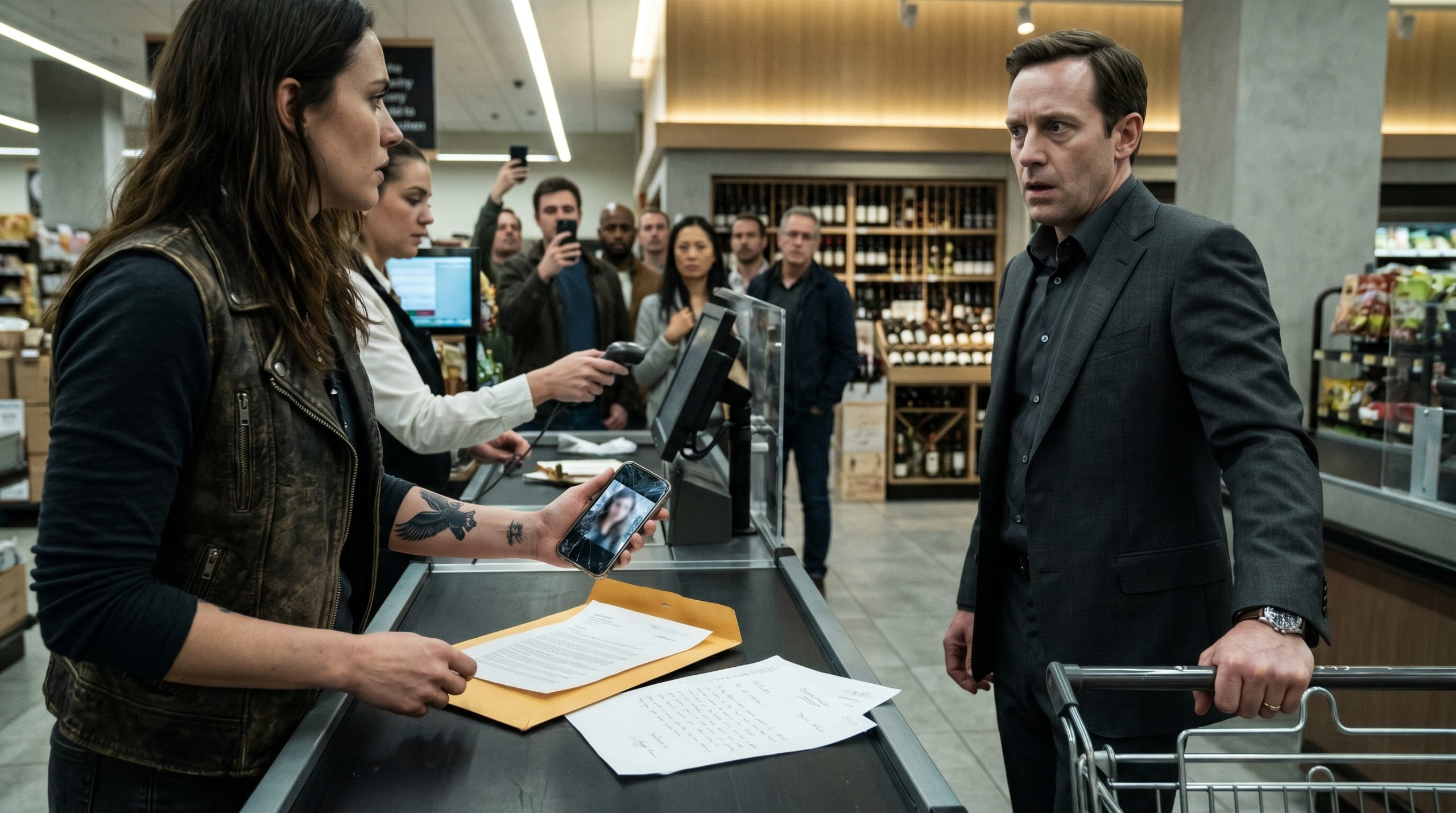
What the Recording Proved
She sent the file from the store car park, sitting in the front seat with the engine off and the doors locked and the afternoon light going grey and flat through the windscreen.
She sent it to four places. The first was the regional board’s compliance escalation line, which she had been told was monitored and had spent fourteen months doubting. The second was the legal team at the child protection charity whose number she had saved in September, after the hallway, after the transcription, after the seventeenth time she’d read it and felt the cold recognition. The third was a journalist whose work she had followed for three years and whose direct contact she had obtained in the entirely unofficial way that people obtain direct contacts when official routes feel like walls built by the same hands.
The fourth was the case file itself. She re-attached the audio to the original referral and re-submitted it through the formal portal, flagged as urgent, with a cover note that was four sentences long and named Marsh by name and his instruction by its exact words.
She sat in the car for another twenty minutes after that. She was not certain what she was waiting for. Perhaps for the weight of fourteen months to shift. It didn’t shift immediately — it redistributed, became something different, less like carrying and more like having set something heavy on a table and stepped back from it.
Her phone screen lit up. A case number she recognised. The Brixton placement.
Marsh had signed the file closure three weeks after his call. The sign-off bore the standard review language. But the date on the associated welfare visit — the one that should have been conducted before closure — was blank. Not missing. Not misfiled. Blank. Someone had left the field empty and signed above it anyway.
She photographed it. She added it to the packet she had already sent.
The case was reopened at 9:15 the following morning. By 11:40, a welfare visit had been initiated. By 2:00 PM, the boy was with a registered emergency carer whose file Elena had reviewed herself, twelve months earlier, and marked as suitable.
Marsh was placed on administrative leave pending formal investigation by 4:30 PM on the same day. She received the notification as she was walking back to her car from the board offices, where she had spent the morning giving a recorded account. The notification was two sentences. She read it standing on the pavement, and she stood there for a while after, in the specific kind of stillness that is not shock and is not relief but sits somewhere between them: the stillness of a person who did a thing and lived.
The Verdict, and What It Left Open
The formal hearing was six weeks later.
It was held in a grey-carpeted conference room on the third floor of a civic building in the city centre, with tall windows that let in too much light and chairs that were slightly too low for the tables they surrounded. Elena arrived twenty minutes early. She wore the same leather vest over a dark shirt, the same boots, the same cracked phone in her vest pocket — not as a statement, she told herself, just because it was her phone and she hadn’t replaced it yet and she wasn’t going to pretend the last six weeks had been about acquiring a new one.
Marsh arrived with a solicitor. He did not look at her when he entered. He arranged himself in his chair with the same deliberate care she had watched him give the burgundy in the queue — the posture of a man performing composure in a room where performance would not hold.
The hearing took four hours.
The audio recording was entered into the record in the first thirty minutes. It was played in full, which meant that everyone in that grey-carpeted room sat in silence and listened to Marsh’s voice instruct a colleague to close a file on a seven-year-old without conducting the required welfare visit, because the timing was inconvenient for a panel review. The solicitor raised three procedural objections. All three were noted and overruled.
The blank date field on the welfare visit sign-off was entered into the record in hour two.
By hour three, the second voice on the recording had been identified. It belonged to a compliance officer who had, it emerged, raised the same concern through internal channels twice in the eighteen months prior to Elena’s referral — and been told, both times, that the matter was under review. That officer had left the board eight months ago. She was contacted and agreed to provide a supplementary statement.
Elena did not speak until she was asked to. When she was asked, she was direct and specific and took up exactly the amount of time the account required, no more.
The panel chair — a White woman in her late fifties, dark blazer, reading glasses on a chain — looked at her over those glasses near the end of Elena’s statement and said, in a tone that was neither warm nor cold but simply precise: — “You filed the internal flag fourteen months ago.”
Elena said: “Yes.”
The chair said: “And it wasn’t acted on.”
Elena said: “No.”
The chair wrote something down. She wrote for longer than the exchange seemed to warrant. She did not explain what she was writing.
The outcome was delivered in writing the following Thursday. Daniel Marsh was formally dismissed. The closure of the Brixton placement file was ruled procedurally invalid. A systemic review of all case files he had overseen in the preceding three years was ordered, with a specific mandate to identify any other instances of welfare visit fields left blank at sign-off.
The boy — whose name Elena had never written in any file, only ever referenced by case number, because the names were the part she could not carry and still function — was placed permanently with the emergency carer by the end of that same week. She received a brief notification from the placement team. Two sentences. She read it at her desk and then got up and made coffee and stood at the office window with it for a long time.
She kept the phone. The crack didn’t spread. The recording stayed on it, filed alongside seventeen other things she had noted and saved over the years in cases that had opened and closed and left their residue.
She never told the panel chair that she had been in that checkout queue by accident. It didn’t seem relevant. What was relevant was what had been on the phone when she got there.
The second voice on the recording — the compliance officer who had raised the concern and been silenced and left — sent Elena a message three weeks after the outcome was delivered. It was two lines. The first said: I filed the same flag in year one. The second said: I didn’t think anyone was going to do anything about it.
Elena read it twice. She typed a response, deleted it, typed another version, deleted that too. In the end she sent three words back.
Someone did now.
