


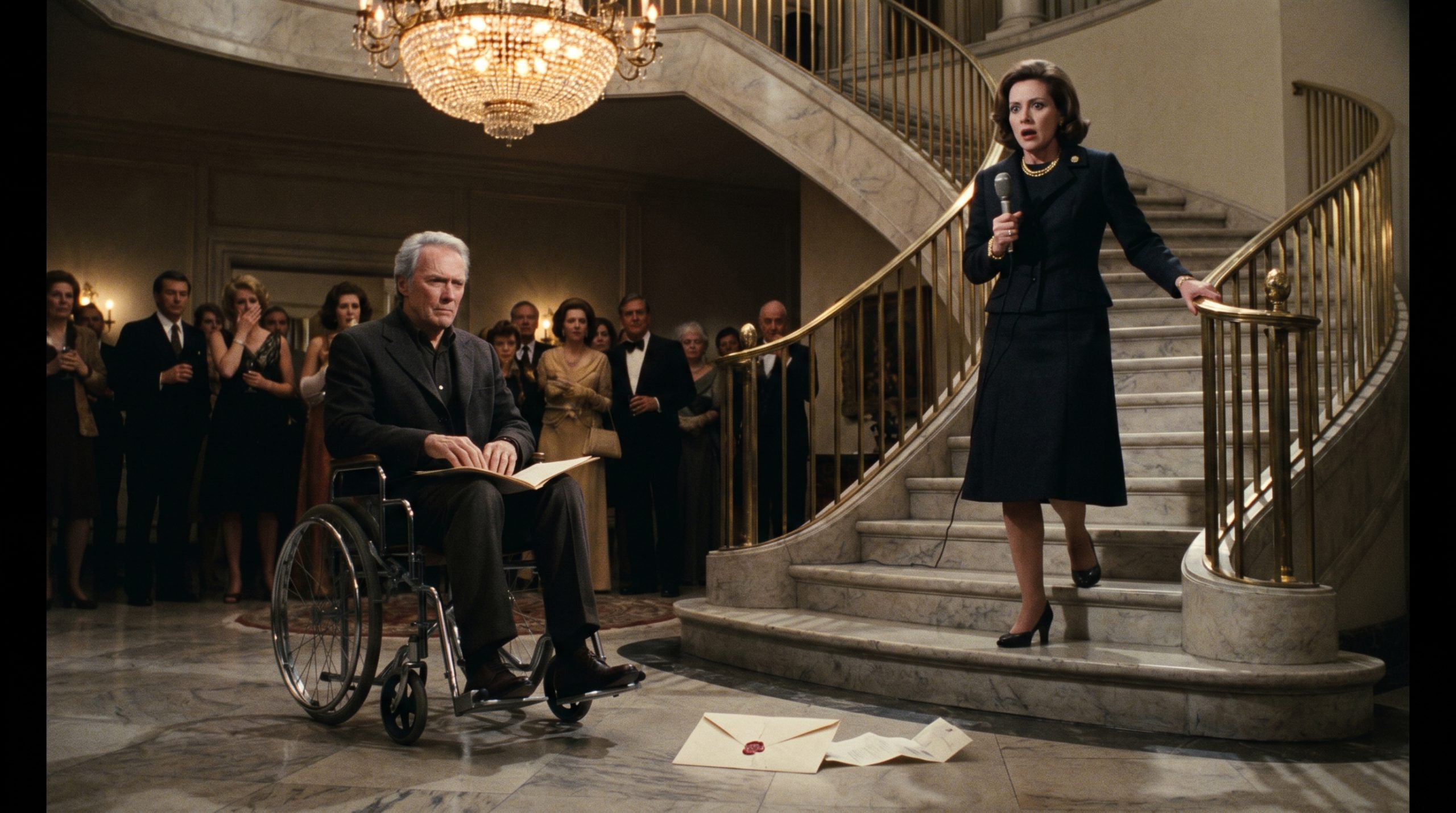
What Margaret Left in the Room
He didn’t open the envelope at the back of the room. He wheeled forward.
The crowd parted again — the same parting as before, but different now, because the room had heard what Claire said and the room was embarrassed and embarrassment makes people step aside faster than courtesy does.
He stopped at the foot of the staircase. He could not go up. He had never been able to go up, at any gala, and the architect who had restored this house had not considered him when they designed the ground-floor access.
Claire looked down at him from the landing. The microphone was still in her hand.
“Thomas.” Same voice. Same precision. “We can find somewhere private to—”
“My wife wrote this.” He held up the envelope. “Before she died. She asked me to open it here.”
“That’s a private matter—”
“She addressed it to the foundation. It’s dated fourteen months before the restructure you just announced.” He looked at her steadily. “Would you like to tell them what’s in it, or shall I?”
Claire’s hand tightened on the microphone. One small movement. Involuntary. Her eyes moved to the envelope — not to his face, to the envelope — and she answered too quickly: “Whatever Margaret wrote, it won’t change the legal status of—”
She stopped. Because she had already said too much. Because the speed of her answer had told the room she knew what was in it.
He broke the wax seal. He had not used his right hand that way in three years — the grip strength came back in the third month of physio and he had refused to show it to anyone until now. The seal cracked cleanly. The document unfolded in his lap.
He read the first line aloud. Margaret’s voice, as he remembered it: direct and without theatre.
— “I, Margaret Elaine Aldren, being of sound mind, state that the Voss Residential Model was developed solely by Thomas Aldren and myself between March and August of the year prior to my diagnosis. No other party contributed to its design. This document, countersigned by my solicitor and by a witness whose name is recorded separately, constitutes my formal statement of authorship and patron intent. The foundation exists because of Thomas. It must continue to exist because of Thomas. Anyone who removes him removes its reason for being.”
The room.
Held its breath.
Grace Hollis made a sound that was not quite a word.
Claire Voss had not moved. Her face was the face of someone who had prepared for every version of this moment except the version where the document actually existed.
Because nobody outside the family knew. Nobody.
The solicitor Margaret had used — the Edinburgh firm, separate from the estate — had kept a duplicate. The duplicate had been filed with the charitable commission eighteen months ago, before the restructure, before Claire had begun the governance review. Before any of it.
Thomas set the document on his knee. He looked up at the landing.
“She wrote it down,” he said.
⚡ CLOSE-UP — the document in his lap, Margaret’s signature at the bottom, the wax-sealed secondary page still folded beneath it. One name visible on the secondary page’s header: a firm he did not recognise.
The clock above the staircase struck the quarter-hour.
He had not finished reading.
The Second Signature
The charitable commission’s representative arrived at nine o’clock.
She had been called — Thomas learned later — by Grace Hollis, who had recognised the document the moment he held it up. Grace sat on three charitable trust boards. She had seen commission-filed statements before. She had stepped away from the room at the exact moment Claire began her speech about governance, and she had made two phone calls, and she had come back and put her hand on Thomas’s wrist, and she had been the only person in that room who hadn’t looked away.
The commission’s representative — a woman named Victoria Marsh — stood in the foyer with a leather briefcase and the particular stillness of someone who did not need the room to like her. She asked Claire Voss to remain on the premises. She asked, politely, for the governance restructure paperwork.
Claire provided it. Her face had not changed, but her hands had. They moved too carefully now, too deliberately — the performance of steadiness, which is different from steadiness, and Victoria Marsh watched them the way she was trained to watch hands in rooms like this.
The restructure, it emerged, had been filed through a secondary charitable vehicle — a dormant trust, incorporated eight years ago, in the name of a firm that did not share any of its directors publicly. Thomas had never heard of it. He had never been consulted. The foundation’s legal reincorporation had been executed without the patron agreement that Margaret’s original filing required.
The original filing, countersigned by the Edinburgh solicitor, was the document in Thomas’s lap.
By ten o’clock, the governance restructure had been suspended pending full review. By ten-thirty, Claire Voss had been escorted to a private room with Victoria Marsh and two commission officers. The gala guests drifted to the drawing room or into the gravel drive, speaking quietly.
Grace sat beside Thomas at the foot of the staircase.
“She planned this for you,” Grace said. “Margaret. She knew.”
“She always knew,” he said. “She just waited until she was certain I’d stay in the room long enough to use it.”
He looked at the secondary page of the document — the one still folded, the one with the unfamiliar firm’s name at the header. He had not read it aloud. He had not needed to. The commission had taken photographs of every page.
But the firm’s name sat in him like a stone, because it was not Claire’s name and it was not Margaret’s and it was not any name he had encountered in four years of building this foundation. Someone else had helped Claire structure the vehicle. Someone who knew charitable law well enough to make the restructure look legitimate for eighteen months.
The commission would find them. That was not his work. His work had been to stay in the room.
Margaret’s portrait was back on the wall when he turned to look. Grace had retrieved it from whatever back corridor it had been moved to, and hung it herself, slightly crooked, while the commission was still taking its notes. She had not mentioned doing it.
Thomas looked at the photograph — Margaret at the garden table, laughing, the summer before the diagnosis — and he thought: she would have found this very funny. She would have said he had waited too long and he would have said he was building the case and she would have said the same thing she always said, which was that he never did anything without a reason and she had loved that about him and also found it profoundly exhausting.
He hadn’t told her he’d recognised the case number on the commission’s internal correspondence. He had written the original patron-protection complaint himself, four years ago, under a different procedure, and it had been quietly archived. The same number. The same reference code. Re-opened.
Somehow, before he had known to re-open it.
He looked at the secondary page one more time.
He didn’t stay for the applause.
