

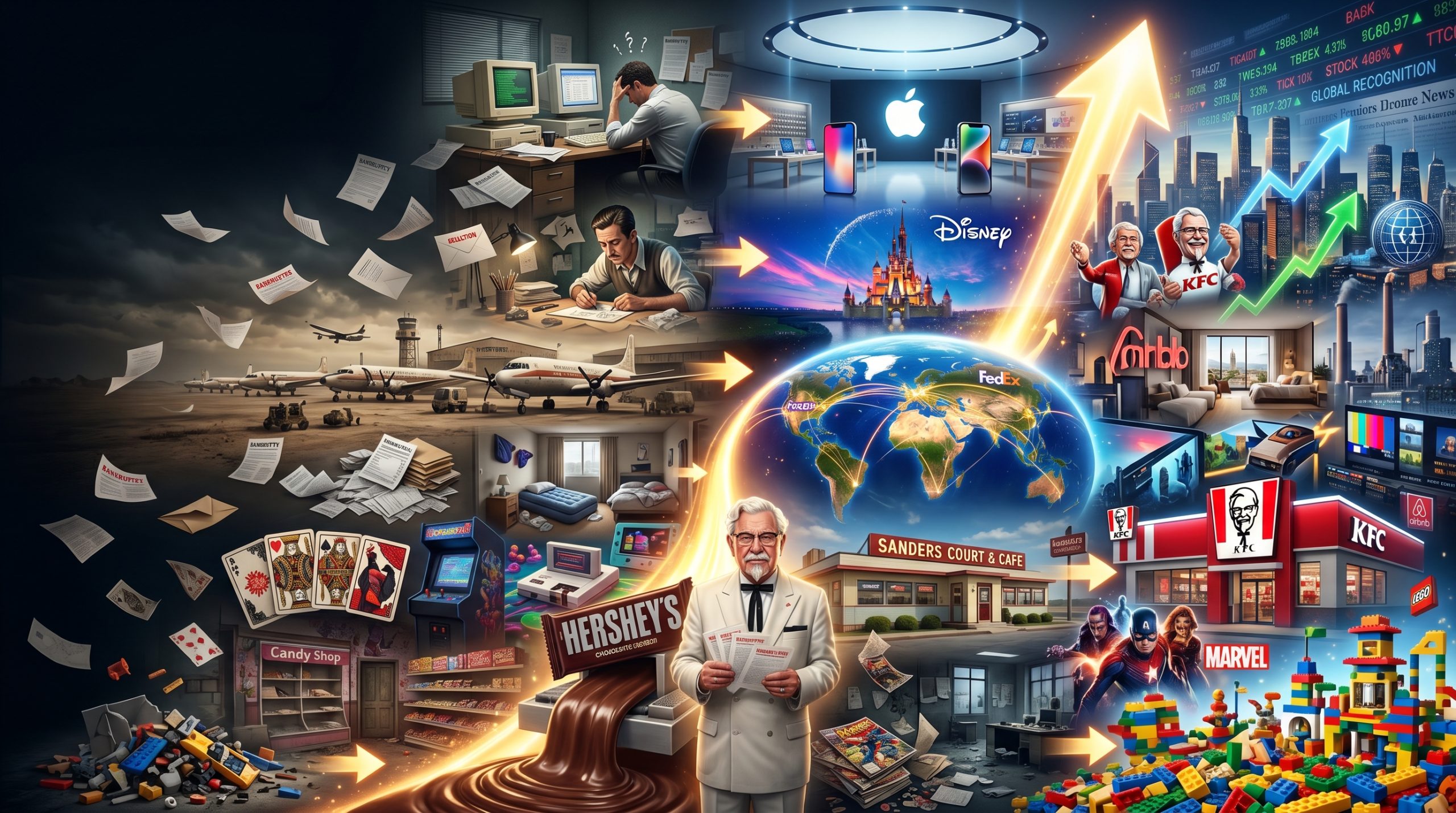
Have you ever looked at a mega-successful brand—like Apple dominating tech or Disney enchanting the world—and thought, “They must have nailed it from day one”? Spoiler: Nope. Most iconic companies we know today kicked off with epic flops, near-bankruptcies, brutal rejections, or outright disasters. The difference? They didn’t quit. They pivoted, learned, innovated, and turned those “complete failures” into legendary comebacks.
In this deep dive, we’ll unpack nine famous brands that started as total wrecks but rose to dominate their industries. These stories are packed with lessons on resilience, timing, and smart risks—perfect if you’re building something yourself or just love a good underdog tale. Let’s jump in and see how failure wasn’t the end; it was the launchpad.
1. Apple: From Near Bankruptcy to the World’s Most Valuable Company
Back in the mid-1990s, Apple was circling the drain. After Steve Jobs got ousted in 1985, the company churned out flop after flop—clunky computers, poor sales, and a market share shrinking fast. By 1997, Apple was bleeding cash so badly that experts predicted doom. They had just weeks of runway left.
Then came the miracle turnaround. Microsoft (yes, their rival) invested $150 million to keep Apple alive—partly to avoid antitrust heat. Jobs returned, slashed products to a few winners, and unleashed the colorful iMac in 1998. That kicked off the revolution: iPod (2001), iPhone (2007), iPad (2010). Today, Apple’s market cap tops trillions, proving one thing—sometimes a brutal low is the reset you need.
Key Lesson: Focus ruthlessly. Jobs cut 70% of products to save the company. If you’re struggling, ask: What’s truly essential?
2. Disney: Bankruptcy, Rejections, and the Birth of Magic
Walt Disney’s first studio, Laugh-O-Gram, tanked in 1923 after bad deals and poor management—straight into bankruptcy. Walt moved to Hollywood, but even Mickey Mouse’s debut faced hurdles. Distributors ripped him off, and early cartoons bombed.
The big pivot? Creating full-length animated features. Snow White and the Seven Dwarfs (1937) was mocked as “Disney’s Folly”—cost a fortune and risked everything. It became a smash hit, funding Disneyland and the empire we know. From theme parks to Marvel and Star Wars acquisitions, Disney’s now a $200+ billion juggernaut.
Fun Fact: Walt faced over 300 rejections for Mickey before landing a deal. Persistence pays.
3. FedEx: A Gambling Founder and a Last-Ditch Poker Win
Fred Smith founded Federal Express in 1971 with a Yale paper idea for overnight delivery. Early days? Disaster. Fuel costs skyrocketed during the 1973 oil crisis, losing $1 million monthly. By 1975, the company was broke.
Legend has it Smith flew to Vegas with the last $5,000, won $27,000 at blackjack, and used it for fuel to keep planes flying. That bought time. By focusing on logistics efficiency, FedEx turned profitable and revolutionized shipping. Now a global giant valued in the hundreds of billions.
Lesson: Sometimes bold risks (even literal gambling) keep the dream alive when logic says quit.
4. Airbnb: 7 Brutal Investor Rejections Before Billions
In 2008, Brian Chesky and Joe Gebbia couldn’t pay rent, so they rented air mattresses during a conference—AirBed & Breakfast was born. Investors? They got rejected seven times straight. One email famously called it “crazy” and worthless.
The founders sold cereal boxes themed “Obama O’s” and “Cap’n McCain’s” during the election to fund operations. That hustle kept them going until Y Combinator invested. The 2008 financial crisis ironically helped—people needed extra cash from renting rooms. Airbnb exploded, hitting unicorn status and going public in 2020.
Takeaway: Rejection hurts, but each “no” refines your pitch. Chesky later said those rejections taught him to listen harder.
5. Nintendo: From Card Games to Gaming Dominance After Near Collapse
Founded in 1889 making playing cards, Nintendo tried everything—taxis, hotels, toys—most flopped. In the 1980s, their arcade games did okay, but the Famicom (NES in the West) launched with bugs and recalls. The U.S. video game crash of 1983 left the market dead; Nintendo barely survived.
The comeback? The NES in 1985, bundled with Super Mario Bros., strict quality control, and licensing hits like Zelda. Then Game Boy, Wii, Switch. From near bankruptcy in the ’80s to billions today, Nintendo shows reinvention works.
Pro Tip: Don’t fear pivots—Nintendo ditched failing ventures for what clicked.
6. Milton Hershey: Multiple Bankruptcies Before Chocolate Empire
Milton Hershey failed twice at candy businesses in the 1870s–1880s—one in Philadelphia, another in New York—both bankrupt. He learned caramel-making in Denver, returned east, and finally nailed it with Lancaster Caramel Company.
Selling that, he bet everything on chocolate in 1900. Hershey’s milk chocolate bar became iconic, building Hershey, Pennsylvania, as a model town. The brand’s now synonymous with sweets worldwide.
Inspiration: Third time’s the charm. Each failure taught recipes and resilience.
7. KFC: Colonel Sanders’ 1,009 Rejections at Age 65
Harland Sanders ran restaurants but lost his big one during the Great Depression. At 65, with just a Social Security check, he hit the road selling his fried chicken recipe. He got rejected 1,009 times before a restaurant said yes.
Franchising exploded. By his death in 1980, thousands of KFCs existed. Yum! Brands now owns it—billions in revenue.
Motivational Note: Age is no barrier. Sanders started his empire in “retirement.”
8. Marvel: Bankruptcy to Blockbuster Universe
In the 1990s, comic sales crashed; Marvel filed for bankruptcy in 1996, drowning in debt from overexpansion. Toy and licensing deals tanked.
The pivot? Selling film rights to Spider-Man, X-Men, etc., in the late ’90s. Iron Man (2008) launched the MCU—now the highest-grossing franchise ever. Disney bought Marvel for $4 billion in 2009.
Lesson: Assets (IP) can save you. License wisely.
9. LEGO: Near Bankruptcy to Toy Empire Revival
In the early 2000s, LEGO overdiversified—theme parks, video games, clothes—losing $174 million in 2003–2004, nearly bankrupt.
The fix? Refocus on core bricks, license Star Wars/Harry Potter, target adults with sets, and The LEGO Movie (2014) boosted everything. Now the world’s most profitable toy company.
Final Insight: Strip back to what made you great.
These nine brands prove failure isn’t fatal—it’s fuel. From rejections and bankruptcies to desperate gambles, their stories show grit, adaptation, and timing win out. Next time you’re facing a setback, remember: The biggest successes often start as the biggest messes.
What’s your favorite comeback story? Or have you bounced back from a failure yourself? Drop it in the comments—I’d love to hear!
