


Bridge Block
—confused.
She looked at the envelope on the conveyor belt between them. It was cream-coloured, thick, sealed with a small gold sticker that had no logo on it. He hadn’t said what it was. He had simply set it down, nodded once, and walked toward the exit before she could form a single word.
The checkout line behind her had gone very still.
She picked it up with two fingers. It was heavier than it looked. Her name was on the front — not her surname, just her first name, Margaret, written in careful block letters with a fountain pen. She had never been written to in fountain pen before.
She looked up. The automatic doors were already closing behind him.
The woman behind the register two lanes over was watching her. A teenage boy with a basket of energy drinks was watching her. Even the security guard near the entrance had turned around.
Margaret stood at her checkout with the envelope in both hands and understood, for the first time in three years, that someone had been paying attention.
The Queue
The grocery store checkout was the one place in the city where everyone was equal for exactly as long as it took to scan the total.
After that, they were not equal at all.
Margaret Holt had worked register six at Fenwick’s on Caldwell Street in Cincinnati for eleven years. She knew which customers counted their change before they reached the belt, which ones let their children throw items onto the conveyor without looking up, which ones spent the whole transaction staring at their phones. She knew who apologised for the size of their shop and who did not. She had learned to read the whole transaction — not just the items, but the person — in the time it took to find a loyalty card.
She was not a person who looked for moments. She was a person who showed up, scanned the items, bagged them correctly, and went home. That was enough. It had been enough for eleven years.
The Tuesday morning that changed everything was not especially busy. Rain on the windows. The store still smelled of the bread delivery from six-thirty, warm and yeasty, slightly sweet. Margaret had her till balanced, her bags staged, her coffee wedged in its usual spot behind the receipt roll.
The elderly man came through just after nine.
He was moving slowly — not struggling, deliberate. White male, thin through the shoulders, a grey cardigan buttoned to the collar despite the mild morning. His basket held seven items. She scanned them without speaking because she understood that some customers preferred quiet. Tinned soup. A small brown loaf. Two tins of sardines. A packet of porridge oats. A single banana. One pint of milk.
When the total appeared — £8.40 — he reached into the front pocket of his cardigan and produced a small leather coin purse. He opened it. He counted once. He counted again.
His face did not change. But his hands went still.
Margaret had seen this moment more times than she could count. She had seen it in people who were embarrassed and people who were frightened and people who had simply made a mistake with their budget. She had also seen it in people for whom this was not a mistake at all — for whom this was the week’s mathematics, come up short.
She recognised this man’s particular stillness. It was the stillness of someone who had hoped the numbers might be different, and they were not.
She had stood at a checkout very much like this one, eleven years ago, six months after her husband left. Her daughter had been four. The total had been twelve pounds and she had had nine.
She pressed four keys in sequence. Discount applied. Staff discretionary.
— “Four-forty,” she said. “There’s a reduction on the bread today.”
There was no reduction on the bread. There had never been a reduction on the bread on a Tuesday.
The old man looked up at her. His eyes were pale grey and very clear.
“I see,” he said.
He paid four pounds and forty pence. He picked up his bag. He thanked her once, very quietly, and walked toward the exit.
Margaret was already scanning the next customer’s items before he reached the door.
The Corner Table
She had not noticed the man in the corner.
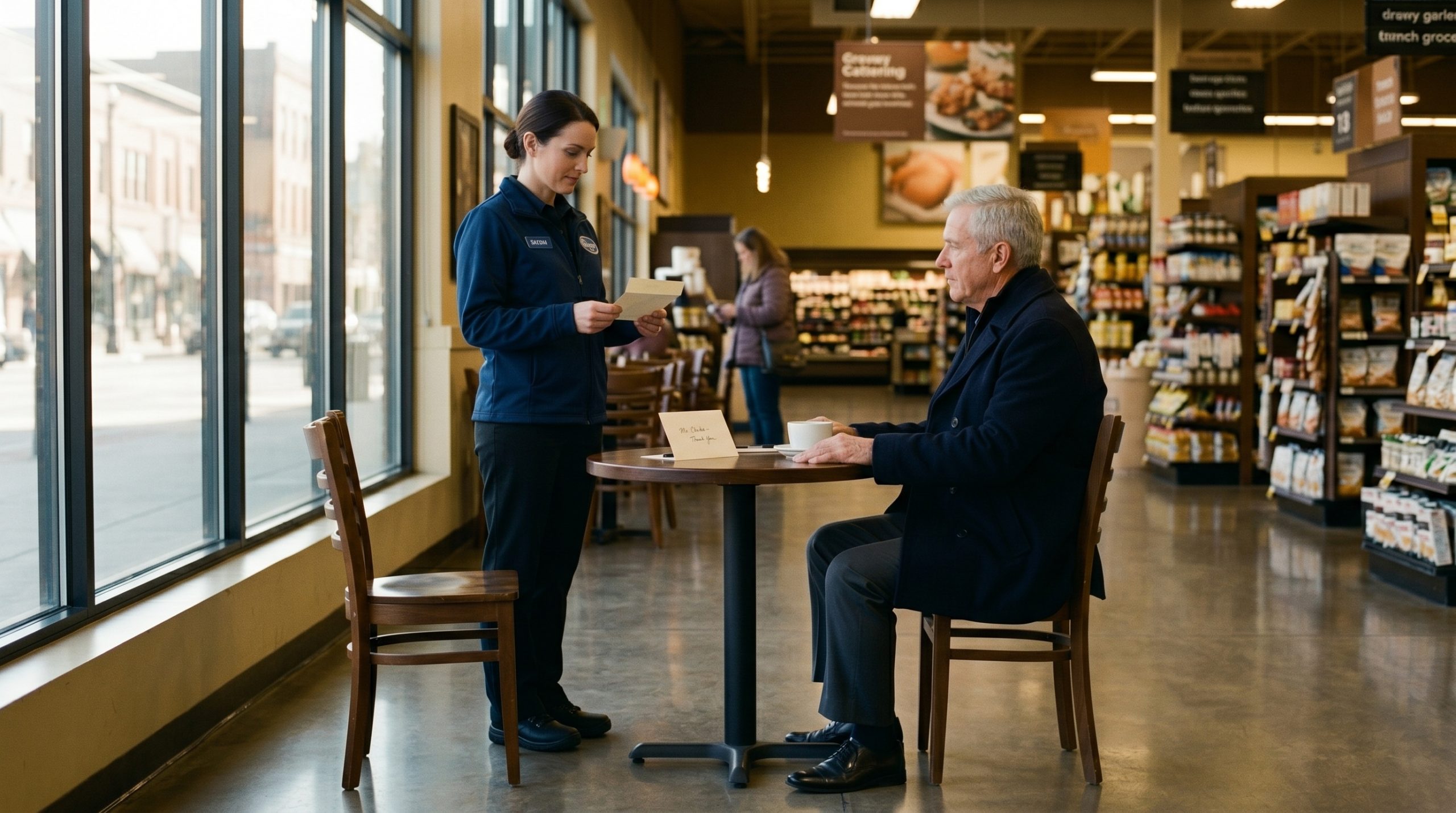
This was partly because her register faced the belts, not the seating area by the café counter. And partly because the man in the corner had, it would later seem, arranged himself to not be noticed. A small round table. A cup of coffee — untouched, she realised, when she thought about it afterward. A newspaper open in front of him, never turned.
He was large in a quiet way — not the kind of large that announced itself. White male, sixties, a dark wool coat worn with the ease of something that had been expensive long enough to stop being new. Silver hair, close-cropped. He sat with both hands flat on the table on either side of the newspaper.
He had been there when Margaret’s shift started at seven.
She found this out later, from the café assistant — a young woman named Priya who said she’d offered him a refill twice and he’d declined both times without looking up from the newspaper. The newspaper that he never turned.
Margaret did not know any of this on Tuesday morning. On Tuesday morning she only knew the bread, and the coin purse, and the four keys she had pressed, and the fact that she had taken £3.60 from her own shift float and replaced it at the end of her break from her wallet so the till would balance.
She did this without deciding to do it. It was simply the next thing.
The envelope appeared on her belt at five past eleven.
She had been on her feet for four hours. Her back ached at the usual place. She was thinking about whether she had enough mince in the freezer for her daughter’s tea when she looked down and saw it.
⚡ CLOSE-UP — a cream envelope, thick stock, sealed with a gold sticker. Her name on the front. Margaret. Block letters. Fountain pen.
She looked up.
The belt was empty in both directions. No customer at her register. No one waiting.
She stepped from behind the till and looked down the main aisle. Then toward the café.
The corner table was empty. The coffee cup was still there, full, cold.
The chair had been pushed in, perfectly straight.
Margaret stood in the middle of aisle four holding the envelope and felt something she could not immediately name — not fear, not excitement, something older and quieter than both.
The envelope was sealed. She did not open it.
Not yet.
She carried it to the break room, locked it in her locker, and went back to register six.
She told herself she would open it at the end of her shift. She told herself this six more times before her shift ended.
The Break Room
She did not open it at the end of her shift.
She drove home with it on the passenger seat. She made her daughter’s tea — mince, there had been mince — and ate standing at the counter while her daughter described a disagreement about seating arrangements at school with the forensic seriousness of a seven-year-old who had been wronged. Margaret listened. She washed up. She put her daughter to bed.
Then she sat at the kitchen table with the envelope in front of her and did nothing.
She was frightened. She understood that clearly. She was frightened not because the envelope seemed threatening — it did not — but because nothing good had arrived in her life through an envelope in a very long time. The last one had been solicitor’s correspondence. The one before that, a final demand. She had learned, slowly and expensively, that things sealed in envelopes were rarely gifts.
She picked it up. She set it down. She went to the kitchen, filled a glass of water she did not drink, came back.
She sat for nine minutes with her keys in her hand. She had them out because she had briefly, clearly, considered driving back to the store, placing the envelope on the manager’s desk, and saying she had found it on the floor. Making it not her problem. She was quite good at making things not her problem — she had learned this the same way she had learned everything else.
She set the keys down.
She thought of the old man’s hands going still over the coin purse. She thought of her daughter at four years old, and a checkout very much like hers, and the woman on the register that day who had not looked up.
She opened the envelope.
Inside: a handwritten letter, two pages, and a smaller sealed envelope within. The letter began:
*You helped a man this morning who did not ask to be helped and would not have told anyone. I have been watching this store for six weeks. In six weeks, I have seen many transactions. I have seen one act of genuine decency.*
She read the letter twice.
⚡ Then she opened the smaller envelope.
Her hands were not quite steady.
Outrage. Not the angry kind — the wrong kind. The kind that comes when you understand that you have been good, in private, in small ways, for a very long time, and the world has been watching in a way you did not expect and cannot quite absorb.
The letter ended with a name and a figure. The figure had six digits.
Margaret sat very still at her kitchen table for a long time.
Because she recognised the name on the letter. The name of the company. The name that appeared on the side of the building four streets from the store — the development company that had been buying parcels of the neighbourhood for three years, the one that had made her landlord an offer on her building two months ago.
The name that had the power to change everything, or to take everything, depending entirely on whose side it was on.
She did not know yet which this was.
