


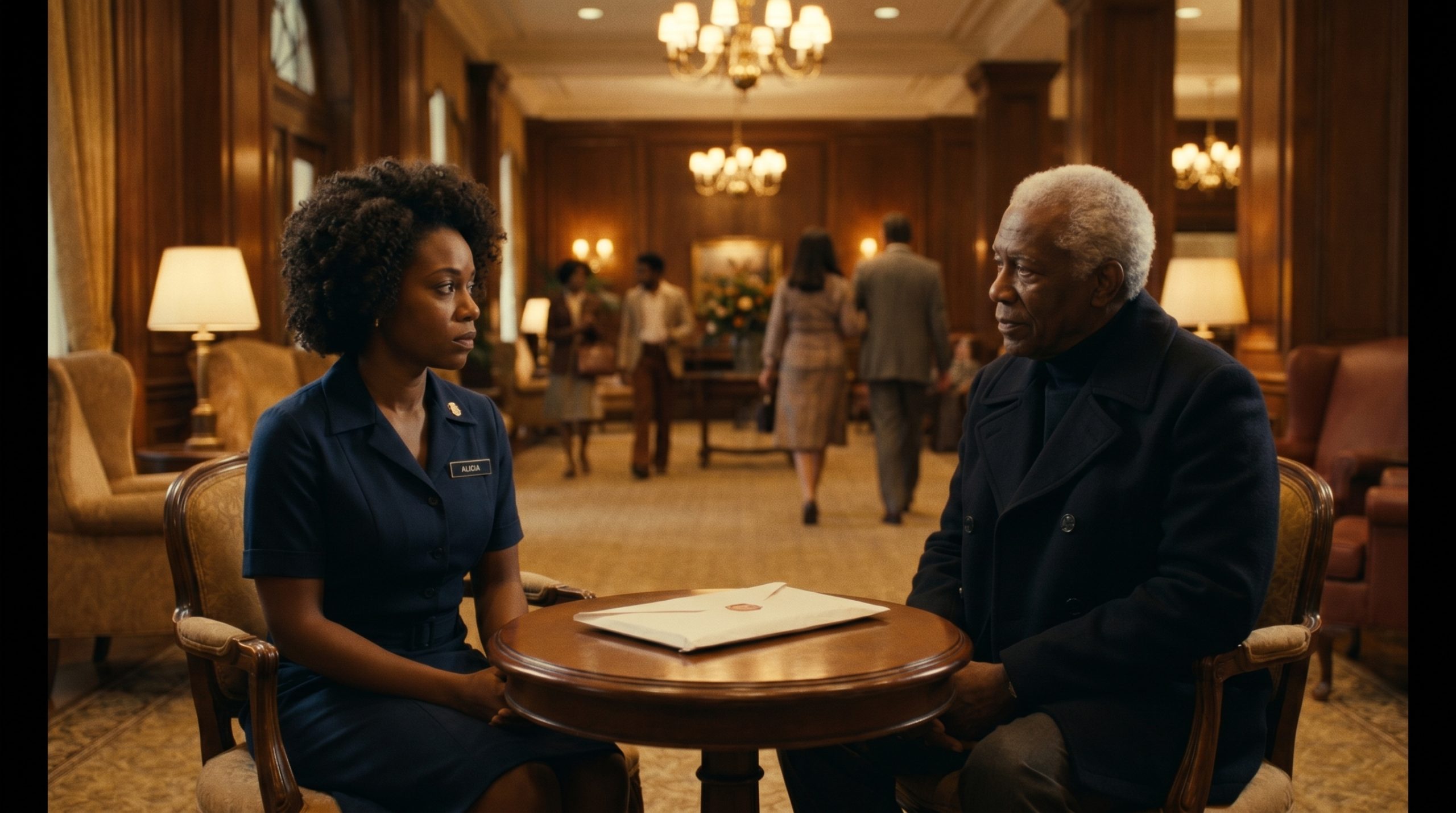
The Meeting
The hotel lobby was warm and unhurried. Thomas Adeyemi was already seated when she arrived — same dark coat, same stillness. A second cup of tea on the table, still steaming. He had ordered it for her before she walked in.
Thomas Adeyemi. Chairman of the Adeyemi Foundation. Fourteen hospitals funded across three continents. She had not known this the day before and she absorbed it now without letting her face change, because changing her face felt like the wrong thing to do.
He did not perform the explanation. He gave it simply, the way he had given the card — directly, without ornament.
His wife had died seven months ago. He had come back to this city because she had grown up here. He had been visiting her grave in the cemetery at dusk for weeks, and on one particular Tuesday afternoon he had stopped at the store on his way back because he needed something for the evening and he had miscalculated what remained in the account he used for ordinary things.
He had watched what Grace did. He had watched the queue not notice. He had watched her move directly to the next customer.
He told her he had spent forty years funding institutions. He said: *I have rarely seen someone act from pure reflex of goodness. Without calculation. Without an audience.*
Grace looked at her tea.
— I didn’t do anything, she said. It was nine pounds.
— Yes, he said. That was the point.
He placed a second envelope on the table. Smaller. Thicker. He did not explain it. He said she should open it when she was ready, not now.
She looked at the envelope. Then at him.
— Why? she asked.
He smiled, for the first time. — Because my wife would have done the same thing you did. And nobody noticed her either, for a long time.
Grace picked up the envelope. She did not open it. She put it in her coat pocket, same as the first one.
The Envelope
She opened it at the kitchen table at 11pm.
Inside was a letter of appointment. A role — clinical liaison for the Foundation’s community health programme in the city. Full salary. A start date three weeks away.
She kept the letter flat on the table and looked at it for a long time.
She had not told him she had been a nurse. She had not told him about the restructuring letter, or the fourteen months, or the night her mother had died in a corridor while Grace was fifty metres away and didn’t know.
She called her sister for the first time in four months. She did not explain the whole thing. She said: *Something happened today that I need to tell you about.*
The letter was real. She confirmed it the next morning.
She was ready to call Thomas Adeyemi’s office to accept when she noticed something she had not seen the night before. At the bottom of the appointment letter, below the Foundation’s official seal, was a second signature — a co-signatory from a partner organisation.
The name of the organisation was not one she recognised.
But the signatory’s name was.
It was the same name that appeared on her mother’s 2019 hospital file. The consultant who had signed off that the corridor bed was non-urgent.
Grace set the letter down.
She did not know yet whether that meant something. She did not know whether Thomas Adeyemi knew. She did not know whether the kindness and the name on the bottom of the page were connected, or whether the world was simply smaller and more tangled than it appeared from a checkout lane.
She left the letter on the table.
She would call in the morning.
Maybe.
