


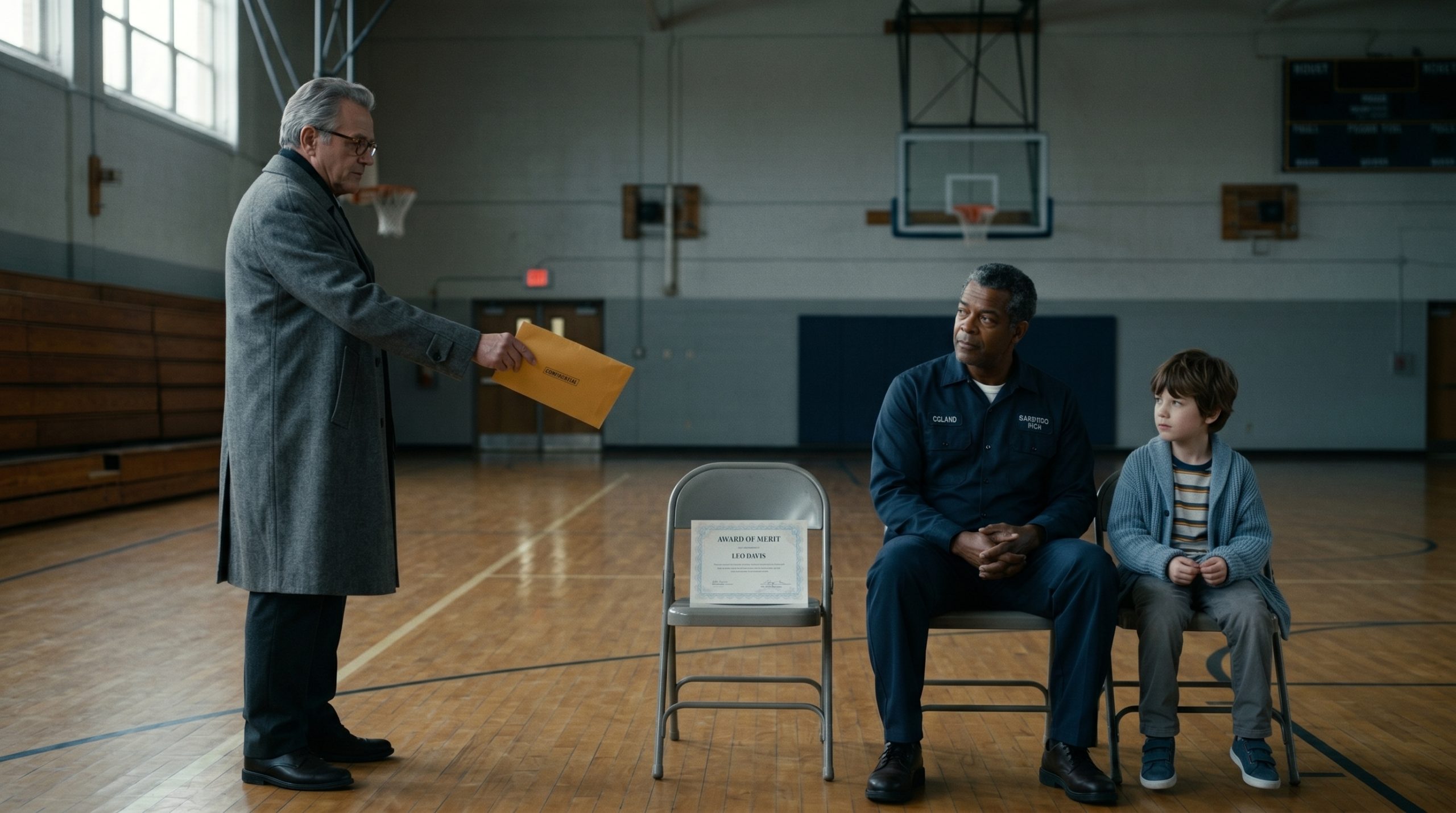
The Mop and the Medal
The school’s head receptionist, a brisk woman named Sandra whose lanyard read STAFF in block capitals, appeared in the gymnasium doorway at six forty-three.
She had been informed by a passing teacher that a child was still uncollected. She had her clipboard. She had the look of someone who managed situations like this with efficient compassion — the kind that is genuine but has also been systematised for speed.
“Oliver Crane?” she said.
“Yes,” Oliver said.
“We’ve reached your mum. She’s on her way — about twenty minutes.” Sandra looked at Martin with a professional nod that meant: you can leave now, we have it from here. Then she looked at Mrs. Harlow, whose presence required a different kind of accounting. “Mrs. Harlow — I didn’t realise you were still—”
“I’m fine here,” Mrs. Harlow said. Simply. Without elaboration.
Sandra processed this, nodded again, and withdrew. She left the door open, which was protocol for uncollected children — so the child was never alone with one adult in a closed room. Martin noted this and approved of it. Rules existed because history had demonstrated their necessity.
The three of them settled back into the particular quiet of people who have stopped needing to explain themselves to each other.
Oliver looked at Martin. “Do you like your job?” he asked.
This was the kind of question that a seven-year-old asks without any awareness that it has a difficult answer. Martin considered it as seriously as it deserved.
“I like this building,” he said. “I’ve known it a long time.”
“I like it too,” Oliver said. “Except the lunch hall smells.”
“That’s the drain under the serving counter,” Martin said. “I’ve reported it four times.”
“Does anyone fix it?”
“Not yet,” Martin said. “But I keep reporting it.”
Oliver considered this. “That’s good,” he said. “That you keep trying.”
Martin was quiet.
He had not thought about it in those terms before. He had thought about it in terms of the report forms, the maintenance queue, the particular institutional indifference that treated his observations as suggestions rather than facts. He had not thought about it as trying. He thought about it that way now.
Mrs. Harlow was watching them both with the expression of someone witnessing something they had not expected to need to witness.
“I want to do something,” she said. Abruptly. Not impulsively — it had the weight of a decision made, not an impulse spoken.
Martin looked at her.
“For Oliver,” she said. “Not — I don’t mean charity.” She stopped. Started again. “My husband runs the Harlow Foundation. We have a mathematics scholarship. For secondary school. It’s early — Oliver is years away from secondary — but there’s an associated primary programme. Tutoring. Academic support.”
She looked at Oliver. “It’s not a rescue,” she said, with a precision that suggested she understood the difference and wanted him to understand it too. “It’s a head start. Because you earned one.”
Oliver looked at his certificate. Then at Martin.
Martin gave him the small nod that means: it’s your call, I’m not going anywhere.
“Would my mum have to say yes?” Oliver asked.
“Yes,” Mrs. Harlow said. “It’s entirely up to her.”
“She’ll say yes,” Oliver said, with the quiet certainty of a child who knows his mother’s values even when her schedule makes them difficult to demonstrate. “She cares a lot about maths. She says it’s what everything—”
“Is made of,” Martin and Mrs. Harlow said, at the same time.
Oliver looked between them.
“Dad said it a lot,” he said.
Neither of them spoke. The flickering light at the far end of the gymnasium had stopped flickering. It held, steady and full, for the first time all evening. Martin noticed it. He did not mention it. Some things you let be what they are.
Still Waiting
Oliver’s mother arrived at seven o’clock exactly.
Her name was Clare Crane. She was a Black woman in her mid-thirties — still in her work uniform, a dark blue care assistant’s tunic with the name of the residential home embroidered on the chest pocket. She had run from the bus stop. Martin could tell by the slight breathlessness she was managing down as she came through the gymnasium door, and by the way she scanned the room with the specific terror of a parent who has made their child wait.
She saw Oliver and stopped.
He was still sitting in his chair. He was holding his certificate. He had, at some point in the last twenty minutes, allowed Martin to take the chair directly beside him rather than leaving the gap of one between them. He was telling Martin about a calculation he had done at lunch — how many tiles were in the gymnasium ceiling — and whether his estimate of four hundred and twelve was right or whether he needed to recount from the third row.
Clare Crane crossed the gymnasium floor in ten steps.
“I’m so sorry,” she said. “The shift ran — the bus—” She stopped. She looked at Martin. She looked at Mrs. Harlow. She looked at the fact of two adults sitting with her son as if time were not a concern.
“He wasn’t alone,” Martin said.
The words were simple. They were also the only thing she needed to hear. He watched them land.
“Thank you,” she said. Not the reflexive thank-you of someone moving through a moment. The full kind — the kind that means: you gave me something I cannot give back, and I know it.
She held Oliver for a moment. He let her, with the slightly performative patience of a seven-year-old who has decided he is too old for this but understands the circumstances require it.
“Mum,” he said, when she released him. “I won Outstanding Achievement in Mathematics.”
“I know, love. I know you did.”
“And Mrs. Harlow knows about a programme. For maths. She said you have to say yes.”
Clare looked at Mrs. Harlow.
Mrs. Harlow stood. She extended her hand. “Catherine Harlow. My husband chairs the Harlow Foundation. I’d like to speak to you about Oliver, if you have a few minutes.”
Clare Crane looked at her son. Oliver nodded, with the gravity of a child who has already conducted the due diligence and found it satisfactory.
“Yes,” Clare said. “I have a few minutes.”
Martin gathered his cart.
He had a drain report to file — the fourth one, technically the fifth if you counted the informal verbal mention he had made to the facilities coordinator in October, which nobody had written down and which therefore did not exist in any official sense. He would write it down tonight. He would keep reporting it until it was fixed, because that was what you did with things that needed fixing: you noted them, you documented them, you did not stop.
He was at the gymnasium door when Oliver called after him.
“Mr. Martin.”
He turned.
Oliver held up the certificate. “Four hundred and twelve,” he said. “Do you think I’m right?”
Martin looked up at the ceiling. He made a show of counting from the first row, moving his lips slightly. He looked back at Oliver.
“Four hundred and eleven,” he said. “There’s a replaced tile above the east wall. Different size. Throws the count.”
Oliver stared at him. “You actually know?”
“I know this building,” Martin said.
He left them there — Clare Crane and Mrs. Harlow exchanging numbers near the trophy table, Oliver tilting his head back to recount from the first row, certificate still held flat in both hands.
The corridor was quiet. The flickering light above the east panel had held steady all evening. Martin made a note to check the fitting in the morning — sometimes things settled on their own; sometimes they needed one last small adjustment to hold.
He had never told his son about the eleven minutes. His son was thirty-one now, an engineer in Edinburgh, and they spoke every other Sunday. Martin had not mentioned it because it did not seem like a story that needed telling. It seemed like a debt that could only be paid forward, not back.
He pushed his cart toward the service exit.
He would file the drain report when he got home. He would keep filing it until someone fixed it. That was what you did with things that mattered: you showed up, you stayed, you kept the record — not because anyone was watching, but because the work was real whether or not anyone saw it.
The gymnasium door swung shut behind him.
Oliver’s voice carried faintly through it, still counting tiles, starting again from row one.
