


The Store That Noticed Who Didn’t Belong
The store was the kind of place that played soft music and charged for the quiet, and the staff had been trained to notice who didn’t belong.
The floors were the pale grey of expensive intentions. The lighting was warm and indirect. The checkout lanes were wide enough for the kind of prams that cost more than a month’s rent, and the organic section near the entrance smelled faintly of crushed basil and justification. It was a Tuesday afternoon. The queue at Lane Four stretched back past the wine display — seven people, all in coats that cost something, all quietly performing the patience of people accustomed to getting what they wanted eventually.
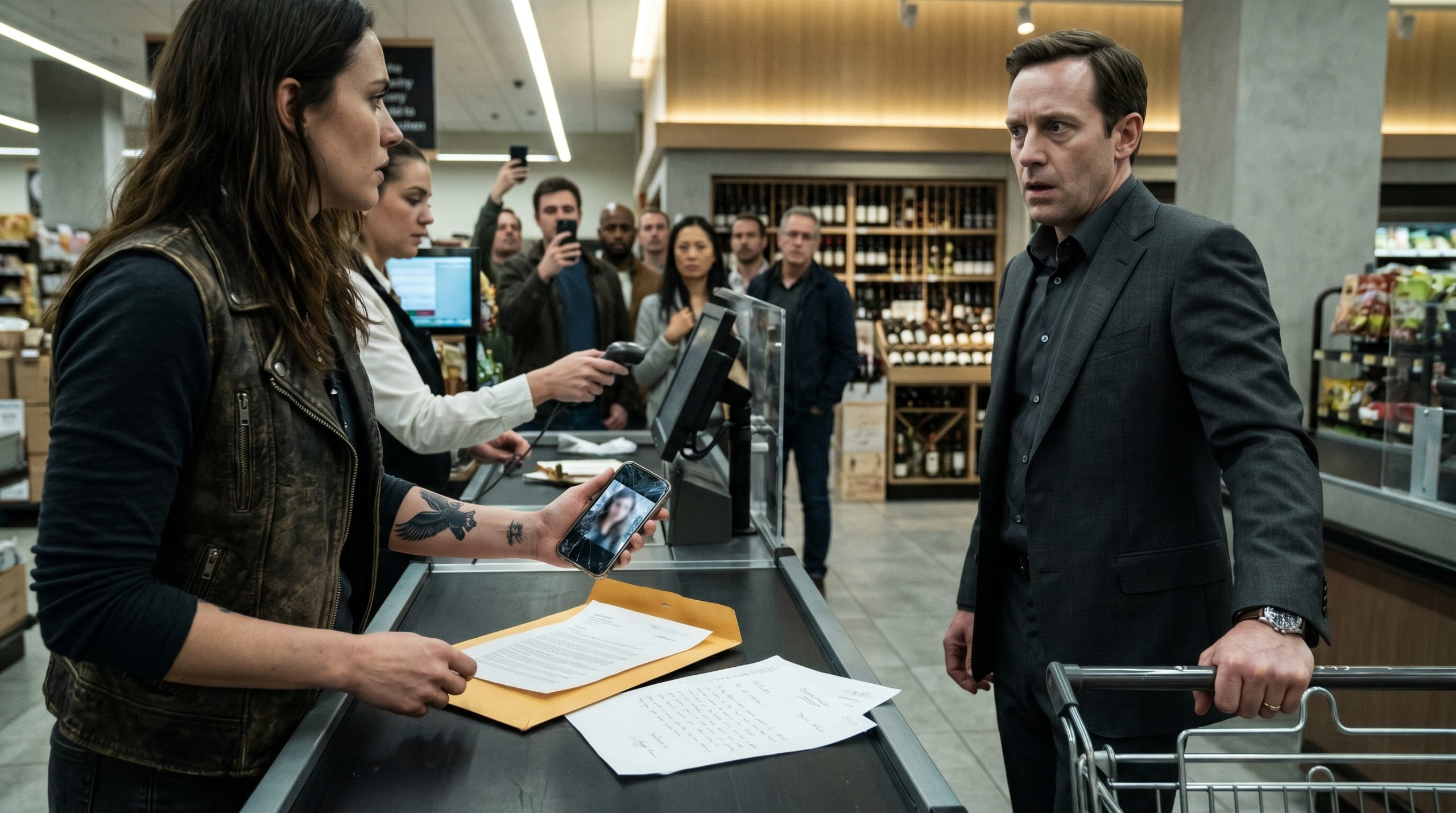
Elena Voss walked in at 2:47 PM.
She wore a leather vest over a dark fitted shirt, black jeans, and boots with enough heel wear to suggest she’d been walking for years and intended to keep going. The tattoo on her left forearm — a name in script, Thomas, her brother’s name — caught the overhead light as she set her basket on the belt. She worked childcare investigations for a regional oversight board. She had been working this particular case for fourteen months.
She was here to buy milk.
That was all. She had filed the final report two days ago. The case was closed — transferred to a senior compliance officer named Daniel Marsh, whose job it was to review her findings and either escalate or discharge. She had done her part. She had documented everything. She had followed every protocol.
Then—
The man two places ahead of her in the queue turned slightly, and Elena recognised the profile. Fitted charcoal coat. Greying temples. The specific posture of a man who had never once stood in a checkout line and felt uncertain about whether he belonged there.
Daniel Marsh. Buying wine.
She didn’t move. She didn’t look away. She watched him place a bottle of burgundy on the belt with the careful handling of a man who measured his own worth in what he selected and how he held it.
Her basket sat on the belt between them. The milk was at the bottom. Her hand had gone still without her telling it to.
What She’d Carried Since the Transfer
Elena had not planned to speak to him.
That was the honest version of what happened next, and she held onto it later when the rest of it became complicated. She had not come here looking for him. She had not driven to this specific store, which she knew he frequented because she had run his background check the same week he was assigned her case file, the same week she noticed that his address and the address on her most sensitive referral sat within six streets of each other. She had noted it. She had flagged it internally. She had been told that proximity was not conflict of interest.
She had filed that note in the same drawer where she kept everything she wasn’t supposed to know.
The phone in her vest pocket had been cracked since October. She had not replaced it because the crack ran across the bottom left corner of the screen and did not touch the recording function, and the recording function was the only thing on the device she used regularly enough to warrant spending money on a new one.
She had made a recording in September. She had made it because she had walked into a hallway during a joint review — a scheduled review, logged, attended by four people including herself — and she had heard Marsh on a call behind a closed door that she should not have been able to hear through but could, because the building’s internal walls were the original 1960s partition board and sound moved through them like water through gauze.
The call had lasted four minutes and eleven seconds.
She had recorded three minutes and forty-two seconds of it before the phone battery dropped to two percent and she’d had to stop.
She had transcribed it the same evening. She had read the transcription seventeen times in the weeks that followed, and each time she read it she felt the same thing she’d felt the first time: not surprise. Recognition. The particular cold clarity of having suspected something terrible and been proven right in the worst possible way.
The file had stayed in her drawer. She had told herself she was waiting for the right moment. She had told herself she needed more.
The truth — the version she admitted to herself in the car park of that store while Marsh stood two places ahead of her in the queue — was simpler and harder than that. She had been afraid. Not of him, specifically. Of the machine that kept him in place. The network of reviewed decisions and signed approvals and escalated non-escalations that meant one woman with a cracked phone and a three-minute recording could spend a year building a case and still end up standing in a checkout queue watching the man who had buried it select a decent burgundy.
She reached into her vest pocket.
The screen lit up. The crack caught the light. The waveform was still there, exactly where she had left it.
The Worst Act, Spoken in His Own Voice
She pressed play at 2:51 PM, in a checkout queue in a grocery store that charged for the quiet.
The volume was at maximum. She had not turned it down. She told herself later that this was because she had forgotten, and that was partly true, and partly not true at all.
Marsh’s voice filled the lane.
Not her voice describing what he’d said. Not a summary. His voice — the measured, carefully modulated tone of a man who had been speaking in rooms where his words had consequences for so long that the cruelty in them had become completely invisible to him — speaking the exact words he had spoken in that hallway in September.
— “Don’t escalate the Brixton placement. Leave it with current carers. I need the file closed before the panel review.”
A pause. The other voice — not recorded clearly, just audible enough to be identifiable as a response.
— “The boy is seven. If the caseworker’s concerns are accurate—”
— “The caseworker’s concerns are noted. They are not accurate. Close the file.”
Another pause. Longer.
— “If something happens—”
— “Nothing is going to happen. And if it does, we manage it then. Close the file.”
The waveform ran for another forty seconds. Ambient sound. A door. Footsteps.
Elena did not move. She held the phone at her side, screen facing outward, and she watched Daniel Marsh’s back in the queue ahead of her. She watched the moment the first syllable of his own voice reached him — the slight shift in posture, barely perceptible, the kind of adjustment a man makes when something enters a room that he wasn’t expecting.
He turned.
She had expected him to say something cutting. Something composed. Something designed to remind her of the precise hierarchy of the institution that kept him standing in expensive grocery stores on Tuesday afternoons.
What he said was: — “You have no idea what you’re doing.”
[LOUD — confident, dismissive]
And then, when she didn’t respond, when she simply held the phone and let the waveform keep running: — “You’re a junior investigator. This isn’t your case anymore.”
She almost left. That was the honest part — the part she told no one except herself, at 3 AM a week later when the formal hearing had been announced and her sleep was unreliable and the night had the particular texture of decisions that cannot be unmade. She had stood in that queue with the phone in her hand and she had thought, with complete clarity: you can still put this away. You can still walk out. You can still be the person who flagged it internally, who noted the proximity, who followed the protocol and trusted the process.
Thomas’s name on her forearm. Script letters she’d had done the year he aged out of care and had nowhere to go.
She raised the phone.
— “He’s still in that house.”
[QUIET — steady, certain]
The queue went still. Not the quiet of polite discomfort — the absolute, held stillness of people who have just understood that something is happening in front of them that they will not be able to explain away.
Marsh’s glass slipped. He caught it — but barely, and a beat too late, and everyone in that queue saw him catch it.
