


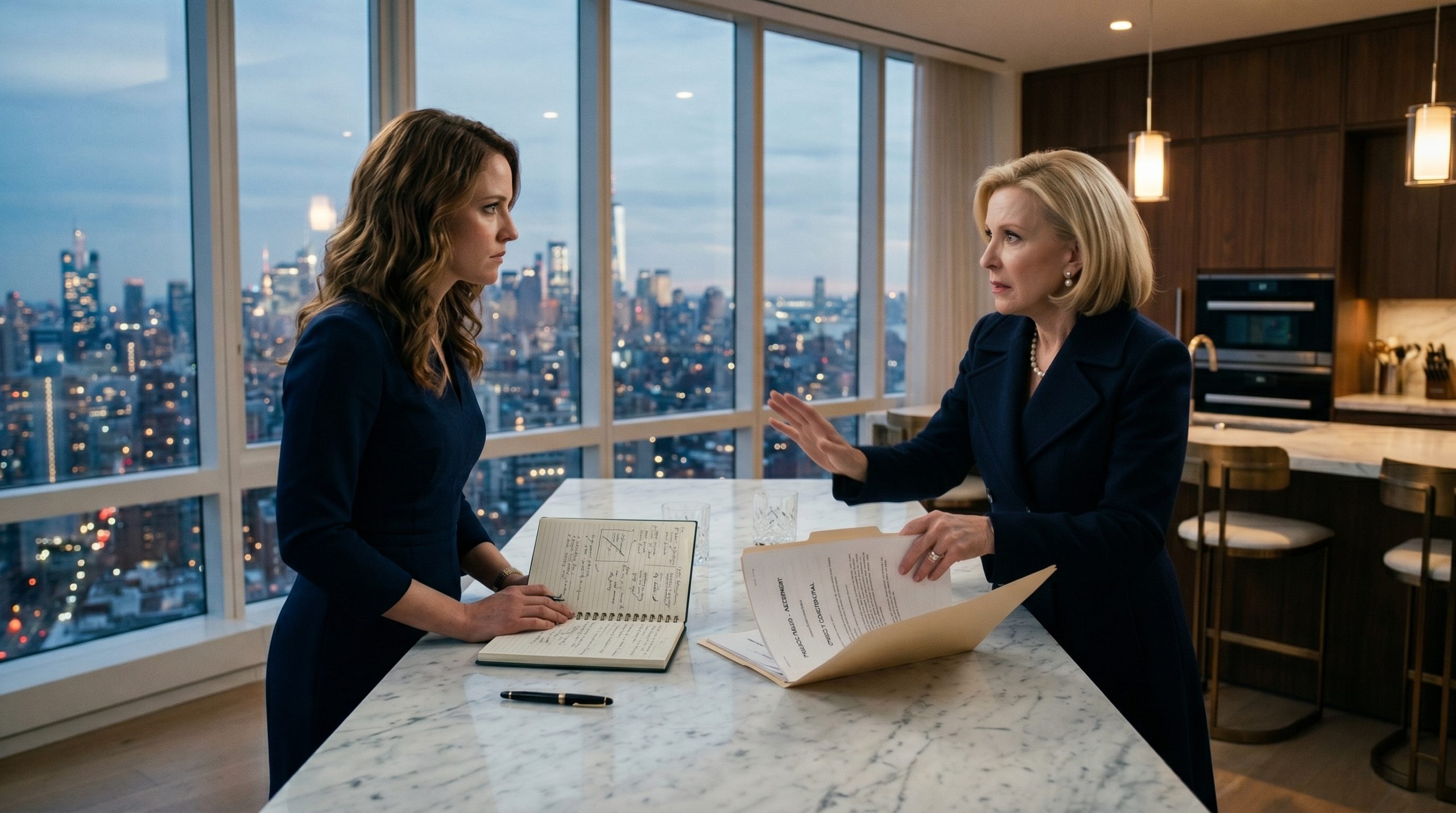
The Second Signature
He was mid-conversation with a woman in a red dress when Claire arrived at his side. She waited — not deferentially, not impatiently, just present — until the woman’s eyes moved to Claire and then back to him in a small social question.
“Forgive the interruption,” Claire said to the woman first. Then she turned to Ellison. “Sir Richard. I believe you know Voss and Partners.”
He looked at her with the precise expression of a man who had navigated unexpected conversations for forty years. Alert. Pleasant. Nothing showing. “I know a great many firms.”
“You know this one specifically.” She opened the folio. Not the document — not yet. She had one other thing to show him first. A printed email thread, its origin line clearly showing an Ellison Advisory address. The date. The subject line: *Re: Hargrove — confirm sign-off.*
He looked at it for three seconds longer than a man with nothing to hide would have.
That was his body. That was the tell.
She had learned to wait for it. Her own solicitor had told her, eight months ago, that circumstantial connections were not enough — that she needed to put the documents in front of the right face and watch. “The face will tell you before the courts do,” he’d said. She had thought it was an odd thing for a solicitor to say. She had understood it now.
“I’d like to speak with your legal representative,” Ellison said. His voice was steady. Professional. But his right hand had moved to the lapel of his jacket — the same small self-soothing gesture she had watched Victoria perform with her champagne glass twenty minutes ago.
“You’re welcome to.” Claire removed the second document from behind the email thread. The welfare concern. His signature on the consultant sign-off line, dated six days before submission. “But I wanted you to see this first. In person. So there was no question about whether I had the document or whether I had read it correctly.”
The woman in the red dress had not moved away.
Two other people nearby had gone quiet.
Claire was aware of this. She had not planned the public aspect — she had intended a private conversation, the same conversation she had attempted with Victoria. But Victoria had made the room the location, and the room had witnesses, and there was nothing she could do about that now except be precise and be calm and let the documents say what they said.
“These are confidential legal documents,” Ellison said.
“They were,” Claire agreed. “My solicitor obtained them through disclosure last month. They’re part of the case file now. They’ve been filed with the family court.” She paused. “I imagine your legal team knows that already. I imagine that’s why there’s been no challenge to the disclosure.”
He had no answer for that.
Victoria had arrived at the edge of the group that had formed — four people now, then five, the social gravity of a conversation that had stopped being ordinary pulling others in without their quite realising it.
Claire did not look at her.
She was looking at Ellison. At the careful stillness of a man deciding whether the story he was about to tell would hold. She had seen that calculation before. In the courtroom, on Victoria’s face, in the moment before the judge read the welfare assessment into the record.
She had been on the wrong side of it then.
“My daughter’s name is Lily,” Claire said. She had not planned to say this. It came from somewhere below the document and the email thread and the fourteen months of careful, furious work. “She is seven years old. She has been living with my ex-sister-in-law for fourteen months because a welfare concern was submitted — by your firm, in coordination with hers — that I have never been able to adequately challenge. Until now.”
Ellison’s jaw was set. His eyes were moving — to Victoria, back to Claire, to the people around them.
“I don’t want to be here,” Claire said. “I want to be home with my daughter. You have the choice to make that easier or harder. But either way — the documents exist. They have been filed. And the hearing is in three weeks.”
She closed the folio for the last time.
She put it under her arm.
And she waited.
The Verdict
The family court hearing took place on a Tuesday morning in November, in a room with bad fluorescent lighting and chairs that had been replaced sometime in the previous decade and not since.
Claire wore the navy dress again.
Her solicitor — a compact, efficient man named Daniel Park who had taken the case on a reduced-fee basis after reading the disclosure documents — sat beside her with his papers in two neat stacks. He had told her the night before not to expect a fast ruling. That judges preferred measured language and time. That the best outcome was a strong indication from the bench with a formal order to follow.
What they got was faster than that.
Victoria’s legal team had filed a response to the conflict-of-interest disclosure forty-eight hours before the hearing. The response acknowledged the relationship between Voss & Partners and Ellison Advisory Group but characterised it as routine professional consultation — arms-length, undisclosed only due to oversight, nothing that had materially influenced the welfare assessment’s content or conclusions.
The judge read this characterisation into the record. Then she read the email thread — the one with the subject line *Re: Hargrove — confirm sign-off* — into the record alongside it.
The room was quiet enough to hear the clerk’s pen.
The judge looked at Victoria’s lead solicitor over the top of her reading glasses. She did not ask a question. She simply looked. The solicitor began a sentence and stopped.
“The original welfare concern filed in this matter,” the judge said, “was submitted in coordination with an advisory firm that had a financial relationship with the applicant’s legal representatives. That relationship was not disclosed to this court, to the respondent’s legal team, or to the family liaison officer at the time of filing. The sign-off document was dated six days prior to submission.” She set the pages down. “The welfare concern is struck from the record.”
Claire did not cry. She had been afraid she would — had been afraid that when the moment came, something in her would break and the breaking would feel like losing, even in the middle of winning. But what she felt instead was something quieter. The specific sensation of a door opening that had been locked for over a year.
She heard Daniel exhale beside her. Very quietly. The professional equivalent of relief.
Victoria sat three metres away. She did not look at Claire. Her solicitor was writing something. Her hands were folded in her lap with the precision of a woman maintaining composure through force of will alone.
The judge continued. The emergency custody variation was suspended pending a full welfare review by an independent officer — one with no connection to either party’s legal teams. Lily would be returned to Claire’s care within five days, subject to a standard welfare check. A formal review hearing was set for sixty days out.
“She kept every letter.”
That was what the family liaison officer told Claire afterward, in the corridor outside the courtroom. Lily had kept every letter Claire had sent her — fourteen months of weekly letters that Victoria had presumably allowed because stopping them would have looked like suppression. They were in a shoebox under Lily’s bed. She had put them there herself. She had told the liaison officer she was keeping them safe.
The child was watching.
Claire sat in the corridor on a wooden bench for a long time after everyone else had left. Daniel had gone to file the order. The building emptied around her. A cleaner moved past with a cart, wheels squeaking on the linoleum, and glanced at her without slowing.
Five days.
She thought about the shoebox. About Lily arranging letters in a box and pushing it under her bed. About a seven-year-old deciding that something was worth keeping safe without being told to.
She had not told Lily to keep them.
Lily had decided that herself.
Claire sat with that for a while — the specific weight of being known by a child who had not stopped knowing you, even across fourteen months of distance and locked doors and a welfare concern that had been designed to make her seem like someone not worth knowing.
She stood up.
The corridor was empty. The fluorescent lights buzzed. Outside, through the tall window at the end of the hall, the city was going about its morning — ordinary and indifferent and entirely unaware that anything had just changed.
She walked toward it anyway.
The document was still in the folio under her arm. The hearing was over. The order was filed. She didn’t need it anymore.
She held onto it all the same.
