

Bridge Block
The word died in his throat.
Not because he chose silence. Because the photograph in her hand had already said everything his mouth was trying to deny.
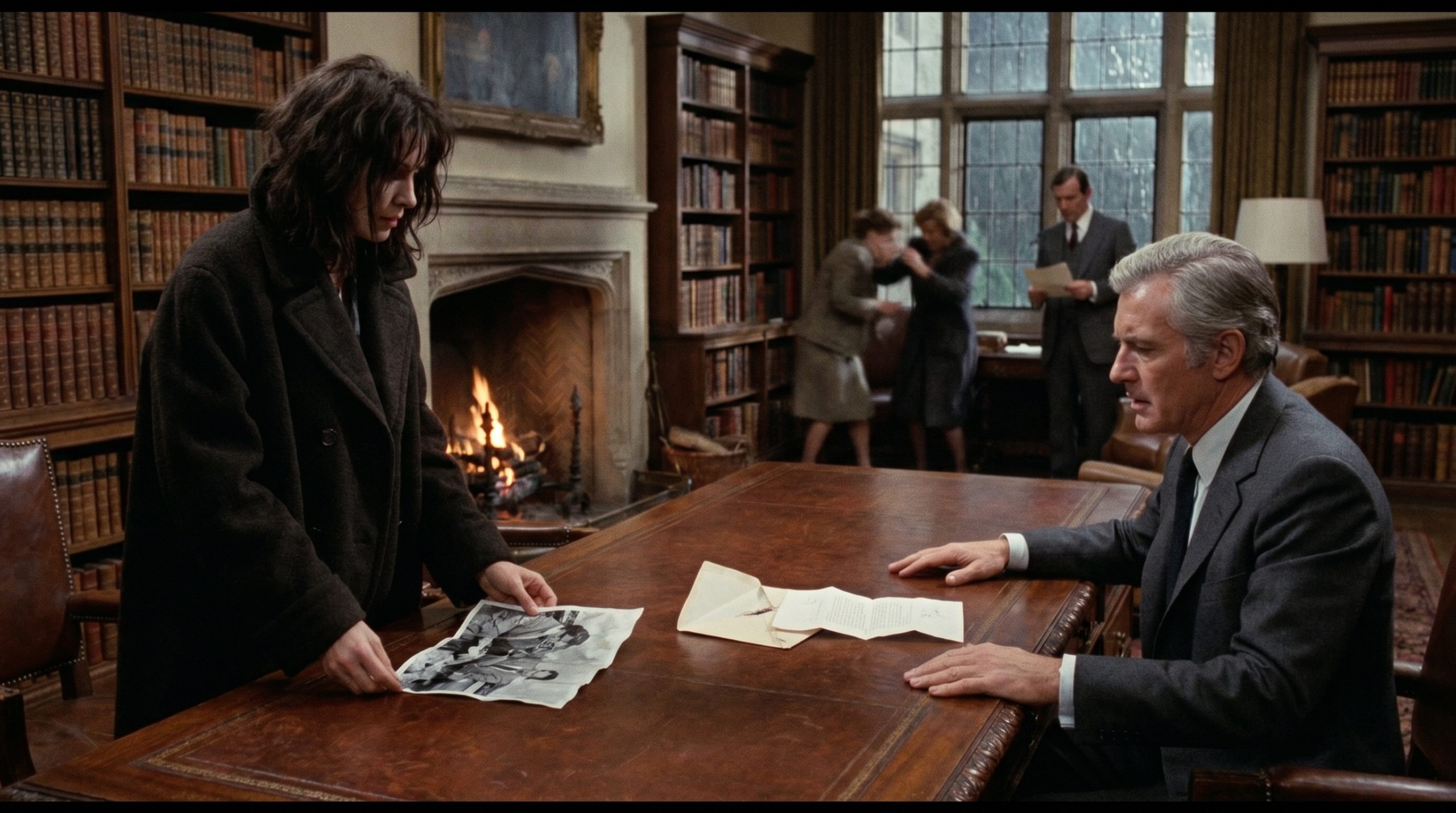
The room — all leather and firelight and a century of inherited certainty — held its breath. The solicitor’s pen stopped moving. The two cousins by the window looked at each other and then looked away, which was its own kind of answer.
Natalie Voss set the photograph face-up on the mahogany table. She did not look at the man across from it. She looked at the photograph. The way you look at something you have been keeping alive for ten years just to reach this exact room.
Harrison Croft’s hand was on the arm of his chair. The knuckles had gone white before his face caught up.
That was the first betrayal. The hand.
The face came second.
The Estate
The library at Croft Hall smelled like woodsmoke and old money — the particular combination of oak panelling, leather spines, and a fire that had been burning in that grate every winter for eighty years. Rain pressed against the tall windows. Portraits of men who had never doubted themselves watched from the walls.
Then—
The solicitor, a careful White man named Gerald Fenn, cleared his throat and said that before the reading of the will could proceed, there was a matter regarding the estate’s secondary beneficiary that required resolution.
Natalie Voss heard her name and did not move.
She was thirty-one. She had been thirty-one for three weeks. She was wearing the only good coat she owned, dark wool, slightly too large at the shoulder — a detail that, in this room, among these people, registered as loudly as a wrong note in a quiet church. She was White, dark-haired, slim — and she had been in eleven foster homes before the age of sixteen, which meant she had learned to read rooms faster than most people learned to read books.
This room said: you are not supposed to be here.
She already knew that. She had known it since the letter arrived six weeks ago informing her that Edward Croft — a man she had met exactly once, when she was seven years old — had named her in his will.
Harrison Croft sat across the table. Sixty-four. White. Silver-haired. The kind of man whose suits fit like architecture. He had the easy stillness of someone accustomed to patience — the patience of a man who had always known how things would end.
He looked at Natalie the way you look at something that has arrived in the wrong room.
She had seen that look in eleven different kitchens. It never meant anything good.
But she had also, in her coat’s inner pocket, a photograph that she had been carrying for ten years. Creased along the fold. Slightly water-damaged at one corner. Still perfectly legible.
She did not reach for it yet.
Fenn opened the document folder. The fire shifted. Rain ticked against the glass.
Harrison said, quietly and with complete authority: “Before Gerald reads anything, I think we should discuss whether Miss Voss has any legitimate claim to be in this room at all.”
The two cousins by the window said nothing. The solicitor’s pen stopped.
Natalie looked at the fire.
She had been waiting for this moment since she was twenty-one, when she first understood what the photograph meant. She had not told a single person. Not because she was afraid — but because she had learned, in eleven different houses, that you do not show your hand until the room has no exits.
Fenn reached for a second document. His expression changed.
Natalie’s hand went still in her pocket.
What She Carried
The photograph had been in her possession for ten years, but it was older than that.
It had been tucked inside a cardboard envelope — the kind used by school photographers — at the bottom of a clear plastic bag labeled PERSONAL EFFECTS: VOSS, N. The bag had followed her from placement to placement, the way certain objects follow children who have no fixed address. A drawing. A small blue shoe. The envelope.
She had opened it at twenty-one, alone in a bedsit in Bristol, because she had finally stopped moving long enough to look at what she owned.
The photograph was of two people standing on the steps of a building she did not recognise. A woman — young, dark-haired, her arm around a child too small to see clearly — and a man. The man was perhaps forty. Silver beginning at the temples. A suit that fit like architecture.
On the back, in a handwriting she did not know: *E + N. June. She knows about Harrison.*
Natalie had frozen. Not slowly — instantly. Because the child in the photograph was wearing a blue shoe she recognised. The match to the one in her plastic bag.
The woman in the photograph was her mother. And the man beside her was Edward Croft.
She had known about Harrison Croft for nine years before she walked into this room. She had known that Edward’s brother had been present at the meeting where her mother was discredited. Had signed a document that removed her mother’s name from a custody case that Natalie had never been told existed. Had ensured that a seven-year-old girl entered the foster system instead of the care of a family that had already agreed to take her.
She had not gone to a solicitor. Not to a journalist. Not to the police.
Because at twenty-one, she had nothing but a photograph and a handwritten line on the back. And she had spent enough years in rooms where powerful people said *prove it* to understand what proof actually required.
So she had waited.
Fenn was reading now. The words *secondary beneficiary* and *equal share* fell into the library like stones into still water.
Harrison Croft’s jaw tightened once. That was all. Then the stillness returned.
But Natalie had seen the jaw.
Fenn reached the clause about the secondary estate documents — a separate sealed envelope that Edward had lodged with the firm eighteen months before his death, to be opened only in the presence of all named beneficiaries.
Harrison reached for his water glass. And stopped.
Because the envelope Fenn produced from his folder was not sealed. The flap had been carefully opened. Then resealed. Then opened again. The paper had given up on the third attempt.
Fenn looked at it. Then at Harrison.
Harrison said nothing. But his hand, still extended toward the water glass, did not complete the movement.
The Worst Act
What Harrison did next was the thing Natalie had always believed he would do.
He smiled.
Not at her — at the room. At Fenn, at the cousins, at the general principle of the situation. The smile of a man who has managed difficult things before and found the management straightforward.
“This is a fabrication,” he said. The word *fabrication* landed precisely, like a man who had chosen it in advance. “My brother was not well in his final years. Anyone who knew him understood that. Gerald, I think you’ll find the codicil was added under — how shall I put this — compromised circumstances.”
Fenn said, carefully, that the codicil had been witnessed and dated.
“By whom?” Harrison asked.
Fenn named the witnesses.
Harrison moved on without hesitation — which was the tell. A man genuinely uncertain pauses. A man who has already investigated does not. “She has no documented connection to this family. Whatever Edward believed he remembered, whatever this young woman told him—”
“I didn’t tell him anything,” Natalie said. Her voice was level. “He found me.”
“People in grief find all kinds of things comforting.” Harrison looked at her now — directly, unhurriedly, the way you look at something you have already decided about. “You were in the system for nine years. That’s documented. Edward was sentimental about people the system had failed. That’s also documented. None of that creates a legal claim.”
This was the moment.
Natalie looked at the window. The rain had thickened.
She thought, with complete clarity, about the drive here. About the point on the motorway, forty minutes out, where she had pulled into a layby and sat with the engine running for eleven minutes. The photograph on the passenger seat. Her hand on the gear shift. The absolute practical possibility of turning around, selling the photograph to a journalist, and never entering a room like this one again.
She had turned the engine off.
“Miss Voss,” Harrison said, and the patience in his voice had the particular texture of a man performing it. “You were in my brother’s care — briefly, symbolically. He felt responsible for you. He had those feelings about a number of people. I’m sure that was meaningful. But you were never family. You were never close to family. And I think on some level—”
He let the pause land.
“—you know that.”
The cousins said nothing. Fenn looked at his hands.
Natalie reached into her coat.
Fenn’s expression changed before she produced anything. He had seen something — on the table, half-visible beneath the open envelope — that she had not yet touched.
A second document. Folded into thirds. Edward’s handwriting on the outside, in ink that had bled slightly at the edges: *For Gerald. To be read aloud. She will be there.*
Harrison saw Fenn’s face change. Then he saw what Fenn was looking at.
For the first time since Natalie had entered the room, Harrison Croft moved without deciding to.
