


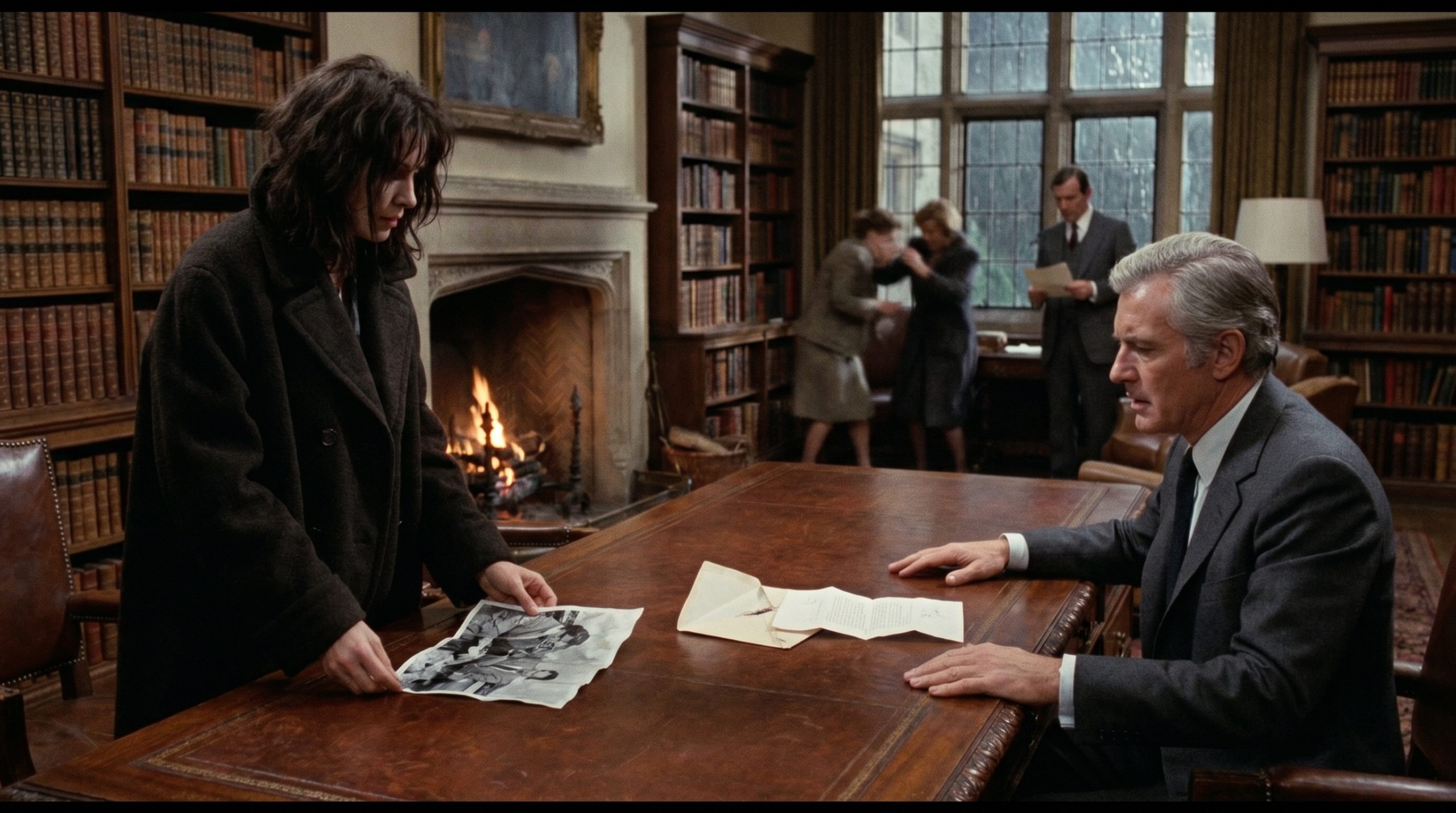
The Weapon
He reached for it.
Arm extending across the mahogany. Too fast. The water glass caught his elbow and rocked — did not fall, but rocked — and the sound of it, the small shocked ring of glass on wood, was the loudest thing in the room.
Fenn picked up the document before Harrison’s hand arrived.
Two fingers. Carefully.
Harrison sat back. His face had not broken — not quite. But the jaw was doing something it hadn’t done at the beginning of the meeting. The absolute stillness had developed a cost. You could see the cost now, in the set of the jaw, in the way his eyes had stopped moving with the easy survey of a man who owns the outcome.
Fenn unfolded the document and read.
Edward Croft, in a letter dated fourteen months before his death, addressed to his solicitor and to any beneficiary present, stated three things.
First: that he had been present in June, twenty-two years ago, when Natalie’s mother — Elena Voss — had been removed from a custody hearing on the grounds of documented instability, grounds that had been provided to the court by a source Edward had, at the time, not questioned. He had questioned it afterward. He had been questioning it for twenty years.
Second: that the source of the documentation had been his brother.
Third: that eighteen months ago, while clearing the family solicitor’s storage, Edward had found the original file. With Harrison’s signature on the supplementary statement. And the date of that signature — three days before the hearing — made clear that the *instability documentation* had not been gathered. It had been written.
Fenn’s voice remained even throughout.
Natalie produced her photograph and placed it face-up on the table. It made no sound. She did not look at Harrison.
“The woman in that photograph,” she said quietly, “is my mother. That is your brother beside her. On the back it says she knew about you. She knew what you had done to the land trust — the one your father left jointly. Edward knew too, by then. That’s why she had to go.”
Harrison said: “That photograph proves nothing.”
His voice was still steady. But his hand — the one that had reached for the document — was resting now on the table’s edge, and the fingertips were pressing into the wood. Not gripping. Pressing. The way a hand presses when the rest of the body is trying not to react.
Natalie looked at it.
“I know,” she said. “That’s why I waited for the file.”
Fenn looked up from the letter. “There is a final paragraph,” he said carefully.
The cousins had moved away from the window.
The Thread
The final paragraph named a law firm.
Not Fenn’s. A different firm — one based in Edinburgh, whose name Natalie did not recognise. Edward’s letter stated that a duplicate of the original file, including the signed supplementary statement, had been lodged with this firm under a separate instruction: to be released to a named journalist at a named publication if no contact was received from Edward Croft by a date that had passed fourteen months ago.
The room processed this in silence.
Fenn set the letter down.
Harrison Croft looked at the fireplace. The fire had settled into itself — deep orange, unhurried, indifferent to the room.
Natalie had expected to feel something larger at this point. She had been carrying the photograph for ten years, the knowledge for nine, the waiting for all of it. She had expected relief, or anger completing itself, or the particular satisfaction of a door finally opening.
What she felt instead was tired. And then, a few seconds later, something cleaner.
Fenn asked Harrison if he wished to respond to the contents of the letter.
Harrison said nothing.
That was its own kind of answer.
The quotable verdict line, when it came, was not dramatic. Fenn said it almost as a procedural note, looking at the document: “The estate proceeds as written. All named parties have standing.”
She kept every letter.
That was what Edward had written, in the margin of the final page, beside Elena Voss’s name. Not to anyone. To himself, perhaps. Or to Natalie, across twenty years. *She kept every letter.*
The cousins left first. Then Fenn, briefly, to make a telephone call he did not explain.
Harrison remained in his chair by the fire.
Natalie picked up the photograph. She looked at it once — her mother’s face, young, her arm around a child too small to see — and put it back in her pocket.
She was almost at the door when Harrison spoke.
“The Edinburgh firm,” he said. His voice was controlled and almost steady. “You knew about it before today.”
Natalie stopped. Did not turn.
“No,” she said. “I didn’t.”
She opened the door. Cold air from the corridor.
“But,” she said, and paused with her hand on the frame, “someone did. Before Edward lodged the file. Someone knew he was going to. And that person isn’t in this room.”
She left him with the fire.
The document had two signatures on the supplementary statement. Fenn had read only one name aloud. Natalie had seen the second in the margin — briefly, before Fenn turned the page — and she had not recognised it.
She would need to. The name had not been in this family. Not in this house.
Not anywhere she had looked for twenty-two years.
